7th Grade (3-3): Lost to Brunswick, 44-20. Plays home to Austintown Fitch on Wednesday, October 2, at 6:00 pm.
8th Grade (5-1): Defeated Memorial (South Euclid/Lyndhurst), 16-14. Plays home to Austintown Fitch on Wednesday, October 2, at 7:30.
Freshmen (3-3): Defeated Gilmour Academy JV, 14-7. Plays home to Cleveland Glenville (JV?) on Thursday, October 3, at 6:30 pm.
Junior Varsity (3-1-1): The Uniontown Lake was canceled. Plays home to Cleveland Glenville on Saturday, October 5, at 10:00 am.
Review of the DeMatha game
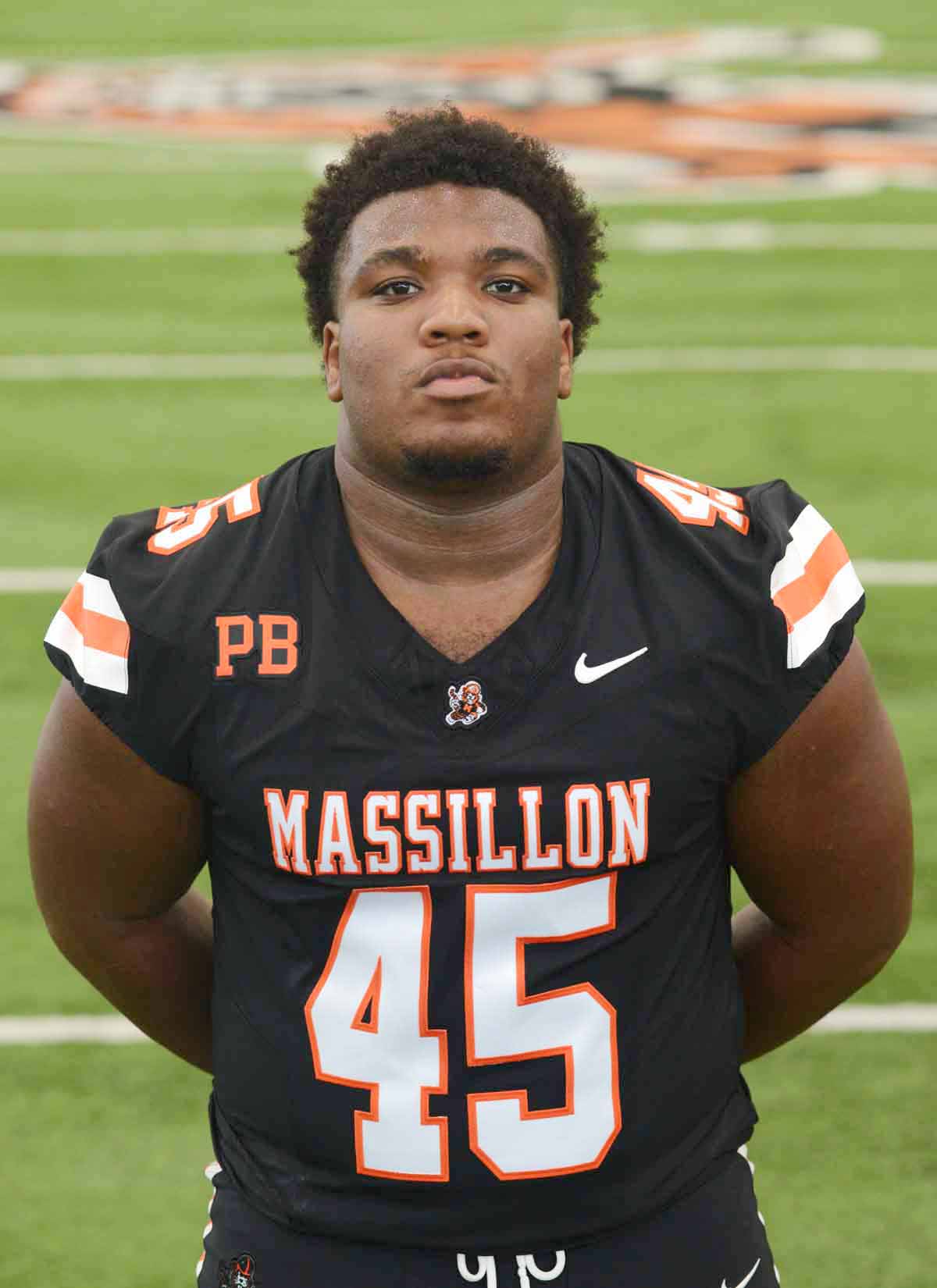
Michael Wright Jr
In a matchup of two nationally ranked high school football teams, parochial school power DeMatha Catholic (3-1) came out on top of Massillon (4-2) 20-14 at Paul Brown Tiger Stadium. Simply put, although the Tigers played to their capabilities, the Stag were bigger, stronger and faster, and they used those assets to control the game from start to finish. The Stag also took advantage of a short field on three of their four scores. But the Tiger defense never quit and kept the game score under control.
“Obviously, we didn’t like taking the loss,” said Massillon head coach Nate Moore. “Our defense played incredibly. They stood tall. Mike Wright had a great game. We were right there with a chance to win at the end.”
The guest players were defensive back Tyler Hackenbracht and defensive lineman Michael Wright Jr. “They had a lot of really good skill players,” said Hackenbracht. “But we kept going. We kept coming back. That shows our improvement.” Wright added that the defense “really showed up.” He said that the defense could have given up. But they didn’t.
Football North Scouting Report
Football North, which is affiliated with Clarkson Secondary School, is located in Mississauga, Ontario, just west of Toronto. Their goal is to educate students while also focusing on American-style football in order to create academic/athletic opportunities at American universities. As such, they play exclusively American competition. They are also a member of the East Coast Power Prep League, along with Life Christian Academy (VA), Mt. Zion Prep (MD), St. Francis Regional (MD) and Virginia Academy (VA). They currently have a 4-1 record, as shown below:
Impotep Charter, PA – Lost 38-20
Life Christian Academy – Won 36-6
Virginia Academy – Won 41-13
Mt. Zion Prep – Won 50-0
Ironton – Won 28-27
Last year the Chargers finished with a record of 3-3, with a 35-15 loss to Lakewood St. Edward and a 24-21 loss to Cleveland St. Ignatius. In 2022 they defeated Mentor, while losing to Akron Hoban, St. Edward and St. Ignatius. They also have a 5-year record of 9-21. Massillon has never played Football North.
This is not your typical Canadian team, one that would lose 50-0. Think of them as Ontario’s all-star team and they are good enough to defeat most American football teams. They play fast and physical and correct mistakes from the previous weeks. “They’re big. Maybe, the biggest line we’ve seen all year. They have good skill with speed. A good quarterback. He does a nice job of running the offense.”
The offense aligns in 10 and 11 personnel (one or two wide receivers). They run plays similar to the Tigers, although there is an element of rawness to the unit. Nevertheless, they are all good players, both on the line and in the skill positions.
It starts with the offensive line, which appears to be the strength on that side of the ball. Behind that beef, North tries to establish the run first. Afterwords, they aim to get the ball to their receivers in space, using primarily tag screens and corner routes. But they are also not shy about chucking it deep. Below is a breakdown of the offensive line:
Senior left tackle Dejan Guzina (6′-7″, 354); 2-star recruit; University of Maine offer; massive and mean.
Senior left guard Tamarley Smith (6′-5″, 295); 3-star recruit; Eastern Michigan commit; huge body.
Senior center Owen Taylor (6′-4″, 290); Mercyhurst offer.
Sophomore right guard Matteo Capilongo (6′-2″, 285); 2-star recruit.
Junior right tackle Owen Richardson (6′-6″, 280); University of Maine offer.
The quarterback is senior Winston Chapman (5′-10″, 195). He can pass and run equally well, often in set pieces. Consider him a run threat. But he can also throw into tight windows. So it will imperative to get pressure on him. Behind the QB is senior running back Lucas Shannon (5′-11″, 210). Moore calls him a “bruiser.” He has good vision and will get vertical. All of the receivers have good size and speed.
The defense aligns mostly in an even front, with 4-2 and 4-3 looks. The secondary utilized a lot of cover-4, with some cover-2 and man-to-man mixed in. Often, they will walk down a linebacker and present a 5-1 look. The line has good size, averaging 6′-2″, 240 lbs. The best player in this group is sophomore Graham Harburn-Welburn (6′-2″, 240). He is quick off the ball and gets off blocks. He also has a big motor. Senior inside linebacker Brock Schaubel (6′-1″, 205) is also very good. He can shed blocks and make plays. Senior strong safety Kash Grewal (6′-1″, 185) is perhaps, according to Moore, the most athletic player in the secondary. He has great speed and drives on the ball. He also holds an offer from Maine.
The game does not count in the Harbin System. As such, the Tigers will receive an average of the total season points earned.
2024 Booster Club Report – Week 5 – Post-St. Edward; Preview of the DeMatha Catholic Game
Massillon (4-1) defeated Lakewood St. Edward (3-2), 31-21. Massillon now leads the series 6-4. It was also historical win No. 952. This week Massillon hosts DeMatha Catholic (2-1).
7th Grade (2-2): Awaiting the score from the Madison game. Plays at Brunswick on Wednesday, September 25, at 6:00 pm.
8th Grade (4-1): Lost to Warren, 36-14. Plays home to Memorial (Euclid) Wednesday, September 25, at 6:00 pm.
Freshmen (2-3): Lost to St. Edward, 28-6. Plays at Gilmour Academy on Saturday, September 28, at 6:00 pm.
Junior Varsity (3-1-1): Lost to Lakewood St. Edward, 21-10. Plays home vs. Uniontown Lake on Saturday, September 28, at 9:00 am.
Review of the St. Edward game
In one of best matchups of the season, the top two teams in the state of Ohio (per national rating service Calpreps.com) battled it out for 48 minutes at Lakewood’s First Federal Stadium, with Massillon coming out on top, 31-21. It was the third straight victory by the Tigers over the Eagles, with the wins coming in consecutive years. The Massillon offensive and defensive lines held the advantage throughout, rushing for 236 yards against 51 yards for St. St. Edward. Running back Ja’Meir Gamble had his best outing of the season, carrying the ball 22 times for 144 yards and scoring two touchdowns. On defense, Ja’Dyn Williams recorded 16 tackles.
“We’re happy for the victory,” said Massillon head coach Nate Moore. “The Tigers played well. In places were were undersized.” Moore was also appreciative of the support the several thousand Tiger followers brought to the event. “Our fans were amazing,” he said. “At the critical moments you guys showed up. It was a huge side of the victory. You guys are the 12th man!”
The guest players were running back Ja’Meir Gamble, linebacker Ja’Dyn Williams and safety Tyler Hackenbracht. Collectively, they felt that the Tigers dominated in all three phases of the game: offense, defense and special teams. On offense, Massillon finally got the running game going, rolling up 236 yards on the ground at 6.6 yards per tote. On defense, they held the Eagles to little yardage on the ground, including three stops on fourth down. And on special teams, they blocked a punt, negated a field goal attempt and kicked a crucial field goal. But this week, against DeMatha, the players said that they are facing some big lines and a good quarterback. But nothing they haven’t seen before.
DeMatha Catholic Scouting Report
DeMatha is the No. 3 team in Maryland per Calpreps.com, behind Archbishop Spalding (28-14 win over Hoban) and St. Francis Academy. They hold wins over Zion Prep, MD (0-3), 48-0, and Roman Catholic, PA (4-1), 49-12, with a loss to Spalding (5-0), 26-10. The “Stag” plays in the Washington Catholic Athletic Conference along with 2023 Massillon opponent St. John’s College, DC. Last year DeMatha finished 9-2, with victories over Ohio Division I runner-up Springfield, OH, 35-7, and St. John’s, 21-14 in the regular season and 21-3 in the playoffs. The Stag has a 5-year record of 35-13, along with two league playoff runners-up.
“Out of the frying pan and into the fire,” remarked Moore. ” DeMatha is one of the best teams in the country. Their offensive line is really big. The running back is going to Maryland. It’s the best quarterback we’ve seen. He can throw and run. And they have a wide receiver going to Penn State. Great players everywhere.”
According to the scouting report DeMatha is a team with a great collection of talent. What the coaches need to see is if that great talent can play as a team to the level needed to win against good competition.
The offense operates out of the spread. This is the the fastest and most athletic offense to have faced the Tigers this year, particularly at quarterback and running back. Their offensive line is massive, averaging 6′-3″, 295 lbs., about the size of line on last year’s Lakewood St. Edward’s team. Their top personnel are as follows:
Senior quarterback Denzel Gardner (6′-0″, 185), 3-star, Marshall commit; best offensive player; designed runs; good arm
Junior wide receiver Lavar Keys (5′-11″, 170), 3-star, Penn State commit; favorite target; good route runner
Senior running back Bud Coombs (5′-10″, 195), 4-star, Maryland commit; downhill runner with good speed; can get to the outside
Senior fullback Michael Boxley (6′-0″, 220); solid; finishes blocks; physical
Junior tackle Zion Smith (6′-5″, 300), 2-star, Syracuse offer
Senior tackle Anthony Chuman (6′-1, 300), Syracuse offer
The defense is a 4-front with three linebackers, but plays like a 4-2-5, with one linebacker having defensive back skills. The line on this side of the ball also has good size, averaging 6′-3″, 266 lbs. The strength of the group is the linebacker corps. Their top personnel are as follows:
Senior nose tackle Anthony Chuman (6′-1″, 310), 2-star, Syracuse offer; strong and holds ground well
Sophomore end James Pace (6′-4″, 225), 4-star, Florida offer
Senior middle linebacker Jermaine Minnis (6′-1″, 215), 3-star, Ohio U commit; very athletic and moves well
Senior outside linebacker Noah Chambers (6′-2″, 210), 4-star, Virginia Tech commit; very good tackler; makes a lot of plays
Senior outside linebacker Terry Dorsey (6′-1″, 195), 2-star, Akron offer
Senior cornerback Jacob Wallace (6′-2″, 175), 2-star, Marshall offer; explosive out of his breaks
Junior safety Darrell Carey (6′-2″, 175), 2-star, West Virginia offer; fast and physical; covers a lot of ground
“In games like this, the best TEAM is going to win,” said Moore. “We have plenty of good players, too!” In other words, DeMatha has some great personnel based on the number of college offers. But how well they play as a team will determine the outcome the game.
In one of best matchups of the season, the top two teams in the state of Ohio (per national rating service Calpreps.com) battled it out for 48 minutes at Lakewood’s First Federal Stadium, with Massillon coming out on top, 31-21. It was the third straight victory by the Tigers over the Eagles, with the wins coming in consecutive years.
The intensity in the game displayed by both players and fans rivaled that of a good Massillon-McKinley game, given its playoff atmosphere and overflow crowd. The Tigers displayed a crushing defensive front-7 that brought the Eagle run offense to its knees, forcing them to go to the air, especially after they had lost the lead at the end of the first half. By the time the game ended Massillon had held its St. Edward and their huge offensive line to a mere 51 yards on the ground, against 251 yards through the air. But it is a rare day when the Tigers lose a game to a one-dimensional passing team.
Ja’Meir Gamble
The Tigers had struggled to run the ball consistently in their previous four games. So, the key for this one was to establish the run and mix in the pass to consistently move the sticks. Although they did sputter at times with both, there was enough of each to get the job done. Ja’Meir Gamble had his best outing of the year, rushing 22 times for 144 yards (6.6 ave.) and two touchdowns, including a burst up the middle for a 47-yard jaunt to the end zone. Late in the game, part-time running back Mylen Lenix added a 39-yard touchdown run that sealed the victory. Quarterback Jalen Slaughter added just enough, completing 14 of 22 passes for 106 yards and a score, that one going to Braylyn Toles. Five passes were caught by Deonte Malone.
Defensively, junior linebacker Ja’Dyn Williams had a marvelous day, recording 19 tackles, 1.5 sacks and 3 tackles for loss. On one play he literally in one motion knocked the blocking running back to the ground and then proceeded to sack the QB seven yards past the attempted block. Cornerback Daylan Pringle added another nine tackles. Michael Wright Jr. was a beast on the field disrupting the Eagle runs up the middle and three times he was in the backfield helping to stop the runner for a loss. Kicker Mateo Herrera converted a 26-yard field.
For St. Edward, quarterback Thomas Csanyi, who was also the starter in last year’s game, had perhaps his best outing of the season. He completed 19 of 30 passes for 251 yards and three touchdowns. Twice he hit deep, with a touchdown throw of 69 yards and another of 39 yards that advanced his team to the red zone. Running back Tyrese Buchanan, who played in place of the injured Elijah Kimble, carried the ball 20 times for 49 yards (2.5 ave.).
Both teams were quickly stopped on their initial possessions. The Eagles, on their second try, used seven plays to advance the ball from their own 30 to the Tiger 10, aided by Csanyi’s 39-yard bomb to Zach Hackleman. But, after being stopped on downs, they attempted a 42-yard field goal, only to have it blocked by Malone.
Massillon then went on an 11-play 59-yard drive that was halted at the St. Ed 9 yard line. But it wasn’t for naught, as Herrera gave his team a 3-0 advantage with a 26-yard field goal. Late in the drive, sophomore Savior Owens plowed 11 yards up the middle from the wildcat position, reminiscent of his older brother’ Da’One’s modus operandi during last year’s state championship run.
Following a punt by the Eagles, the Tigers came right back and this time scored a touchdown on a 15-yard run by Gamble. It took 8 plays to methodically advance the ball 43 yards to paydirt.
Then it was the Eagles’s turn. First was an 8-play, 50-yard drive, with a 14-yard pass to Bradley Eaton. Then it was a 69-yard pass to Hackleman for a second score, that one coming on the first play of the series, to put St. Edward up 14-10 with 2:58 left in the half.
But Massillon wasn’t yet done. A 15-yard run by Gamble, a 12-yard carry by Slaughter and an 18-yard 3rd down pass to Deontay Malone set up a final 7-yard pass to Toles for a score, as the Tigers regained the lead at 17-14.
Michael Wright Jr
Massillon received the second half kickoff and made the most of it, driving 80 yards in just four plays. After Slaughter connected with Malone on a 25 yard pass, Gamble on the next play broke through the line and outraced the secondary to the end zone for a 47-yard touchdown. It put the Tigers up 24-14 and suddenly the Eagles had their backs against the wall. So, for the rest of the game, they focused on the pass.
Two series later St. Edward’s Csanyi completed a 4-yarder to Joe Saffold to close the margin to 24-21 and that’s as close as they got for the rest of the game, as Massillon then focused on defense. On St. Ed’s next drive they were stopped on downs at the Massillon 35. They next punted from the Tiger 41. On the third try they were stopped on downs at the Massillon 40.
But Massillon had the ball at the Eagle 39 and a minute and a half remaining. And the Eagles were out of timeouts. So, it might have been time to take a knee. But Lenix found a gap on the right side of the line and quickly burst through it. After that, it was clear sailing to the end zone. But on the downside, it gave St. Eds time to potentially score and then attempt an onside kick. But as it turned out, with Massillon now aligned in a prevent defense, they managed to move the ball just to the Tiger 31, where they were stopped on downs.
This game has turned into quite a rivalry and looks to continue into the future. It has certainly proved competitive from year-to-year. Massillon now owns a 6-4 lead in the series.
Next week the Tigers (4-1) return home to face another outstanding opponent in DeMatha from Maryland. The Eagles (3-2) also have another tall task as they host Cleveland Glenville.
Go Tigers!
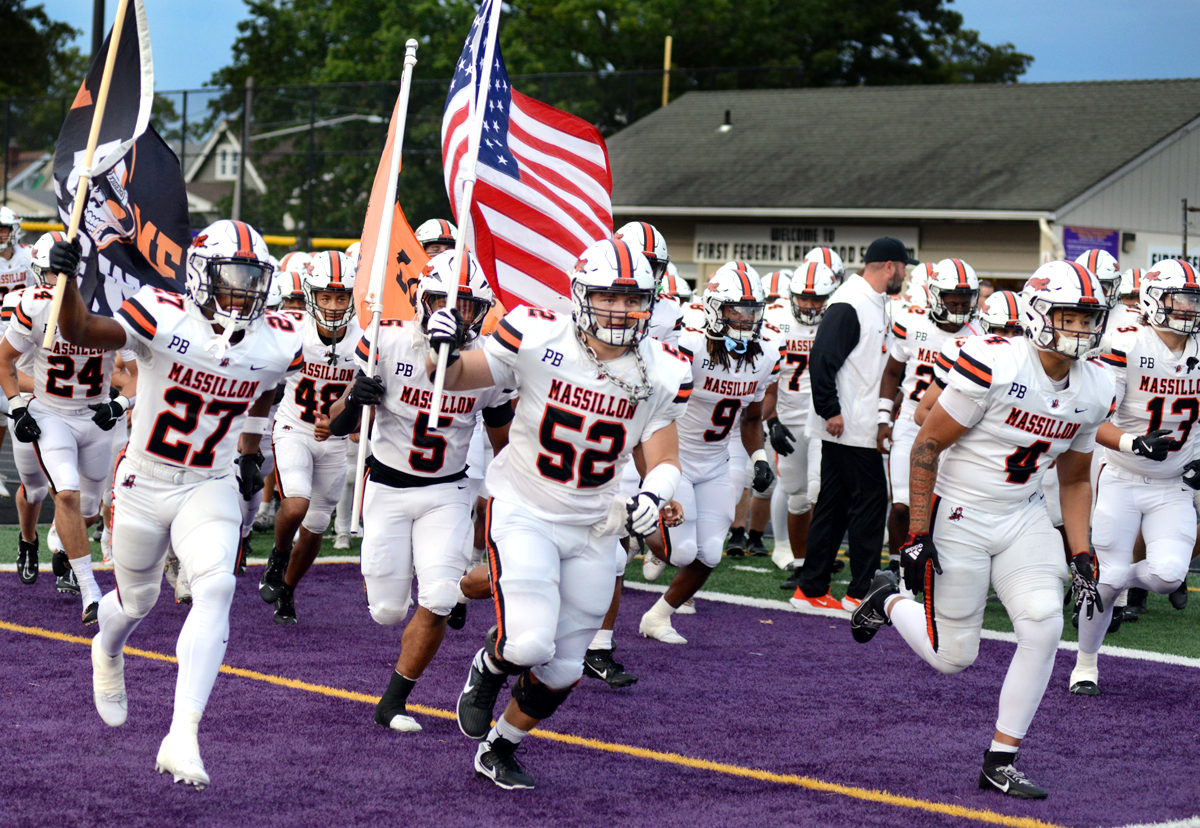
The Tigers enter the field at Lakewood First Federal Stadium
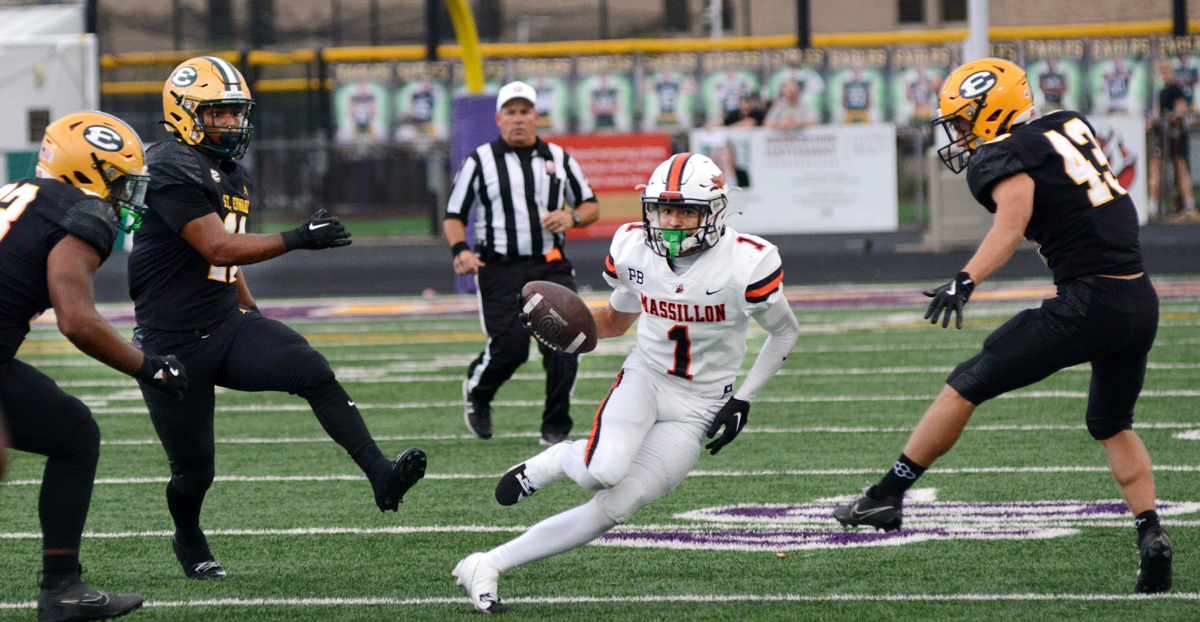
Braylyn Toles (1) looks for running room after the catch.
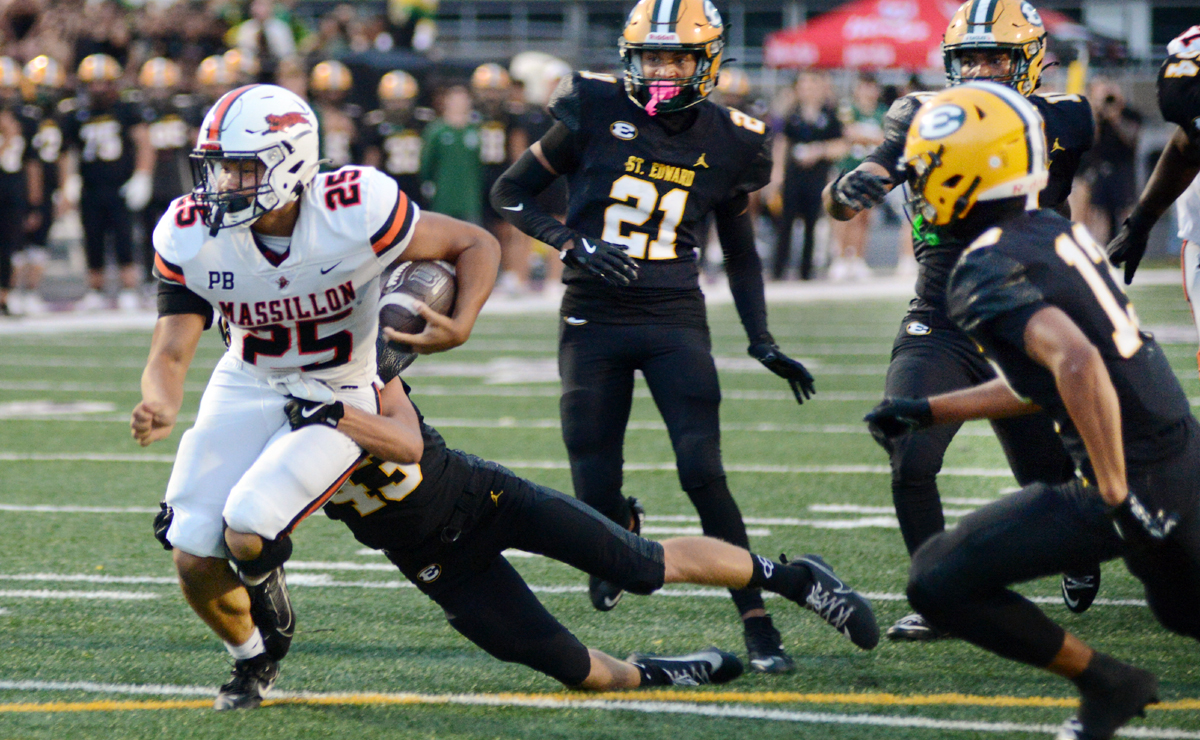
Savior Owens (25) on the wildcat
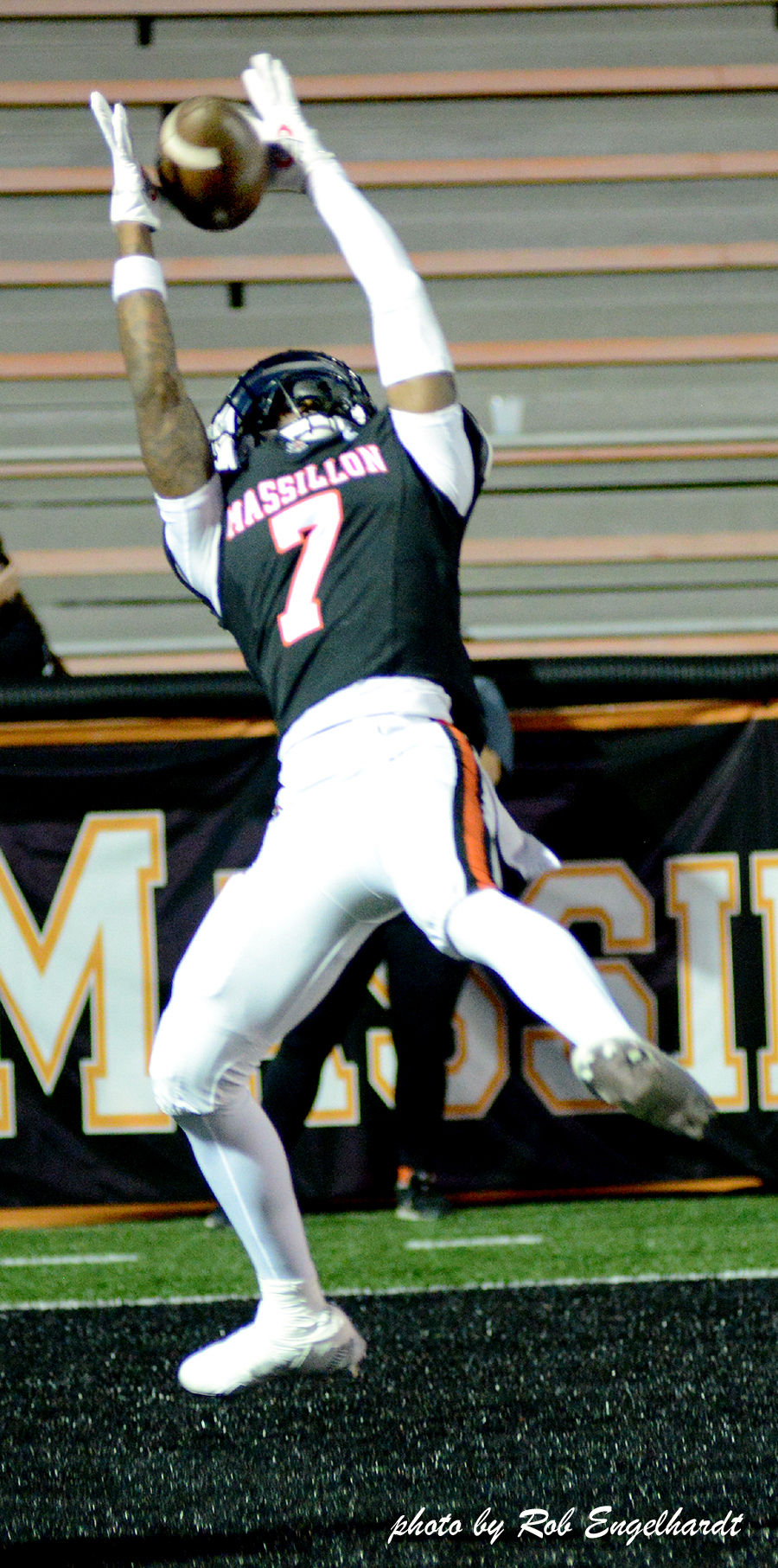
Jacques Carter (7) after the catch; Deonte Malone (80)
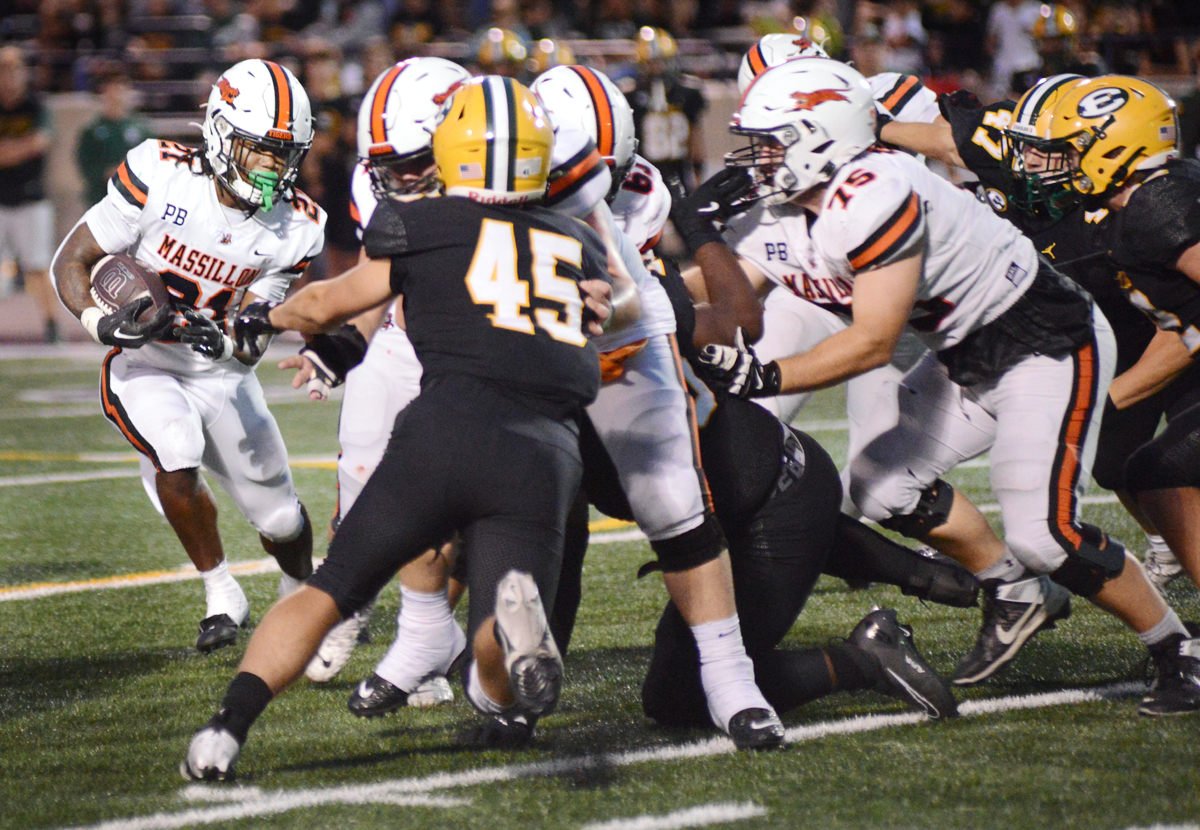
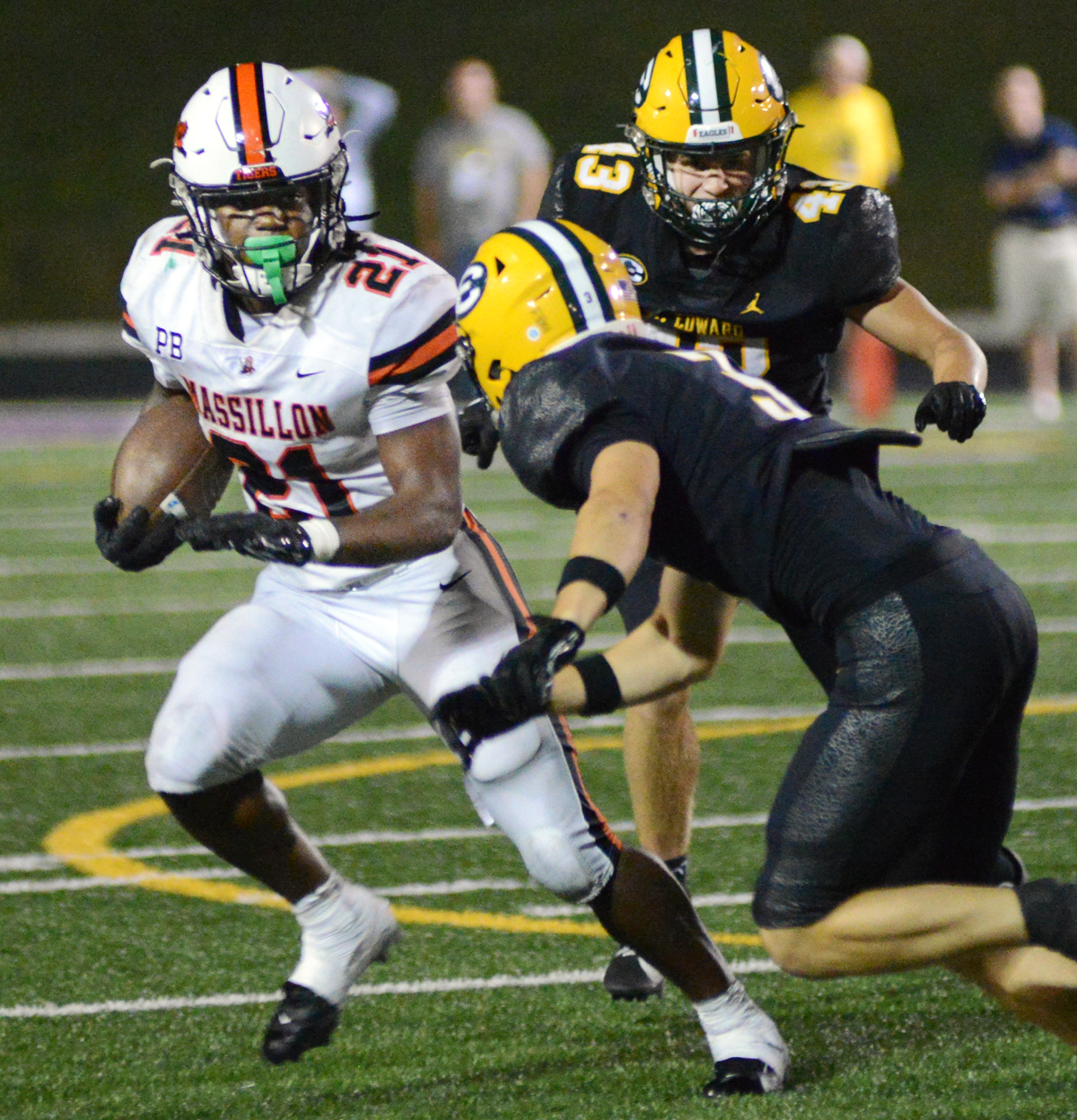
Ja’Meir Gamble (21) cuts to the outside; Michael Looney (75)
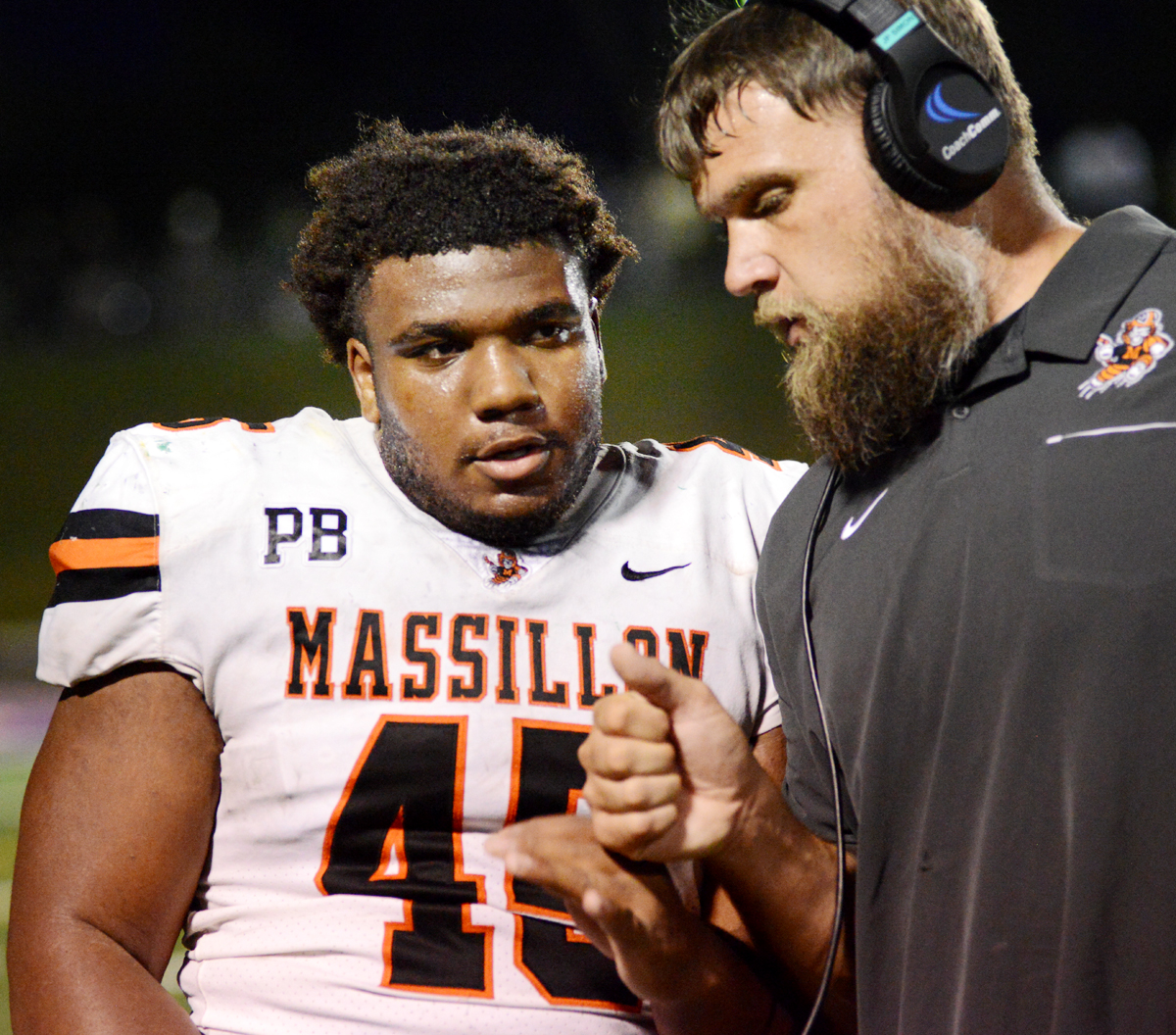
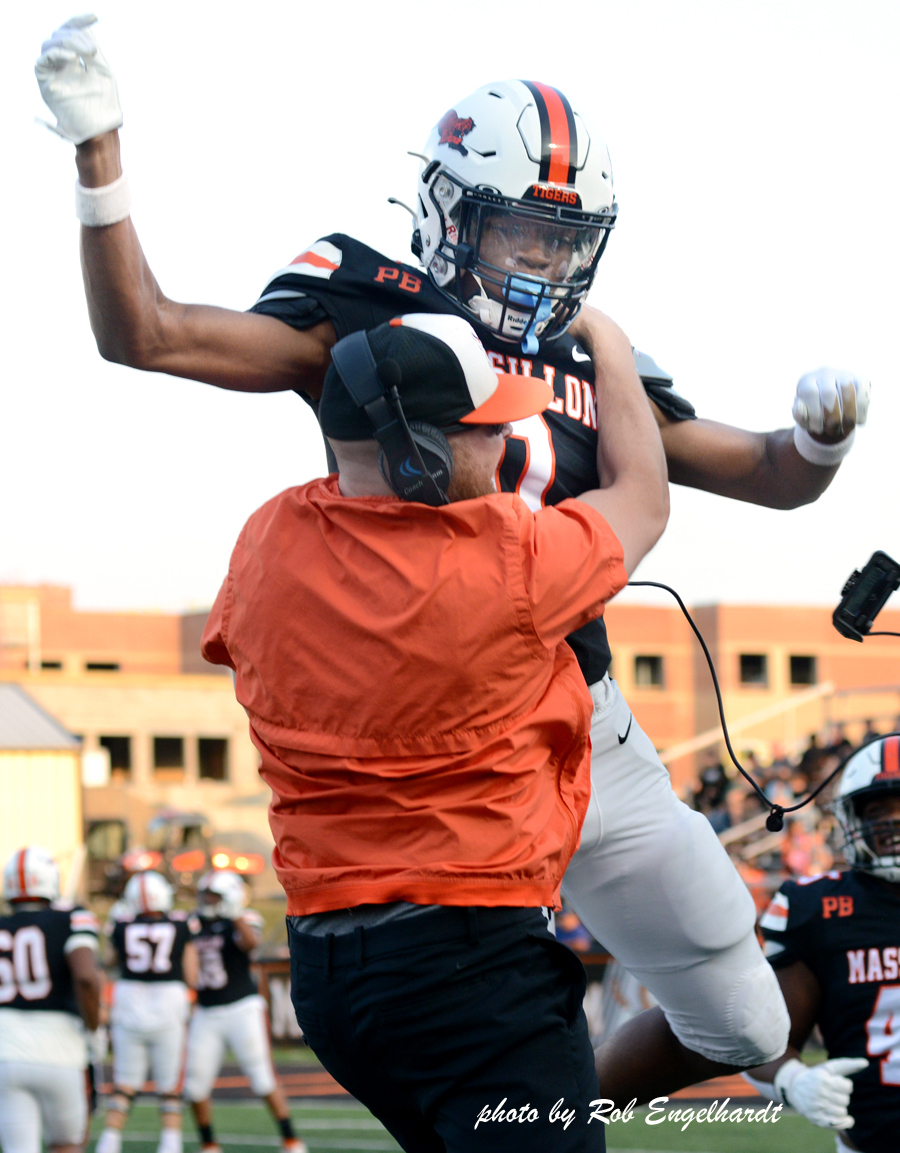
Michael Wright Jr. (45) with assistant coach J.P. Simon
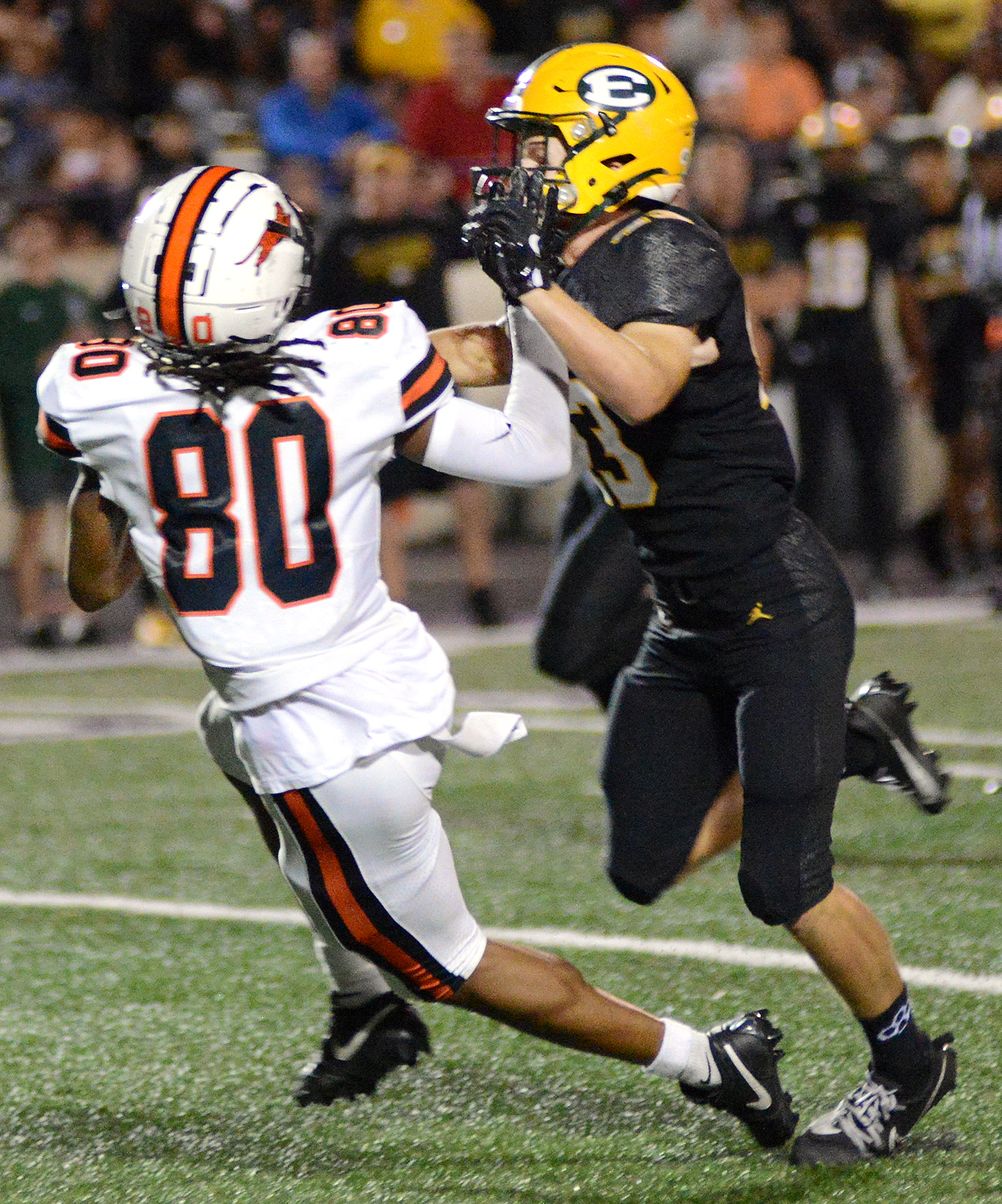
Deonte Malone (80); can anyone say “pass interference?”
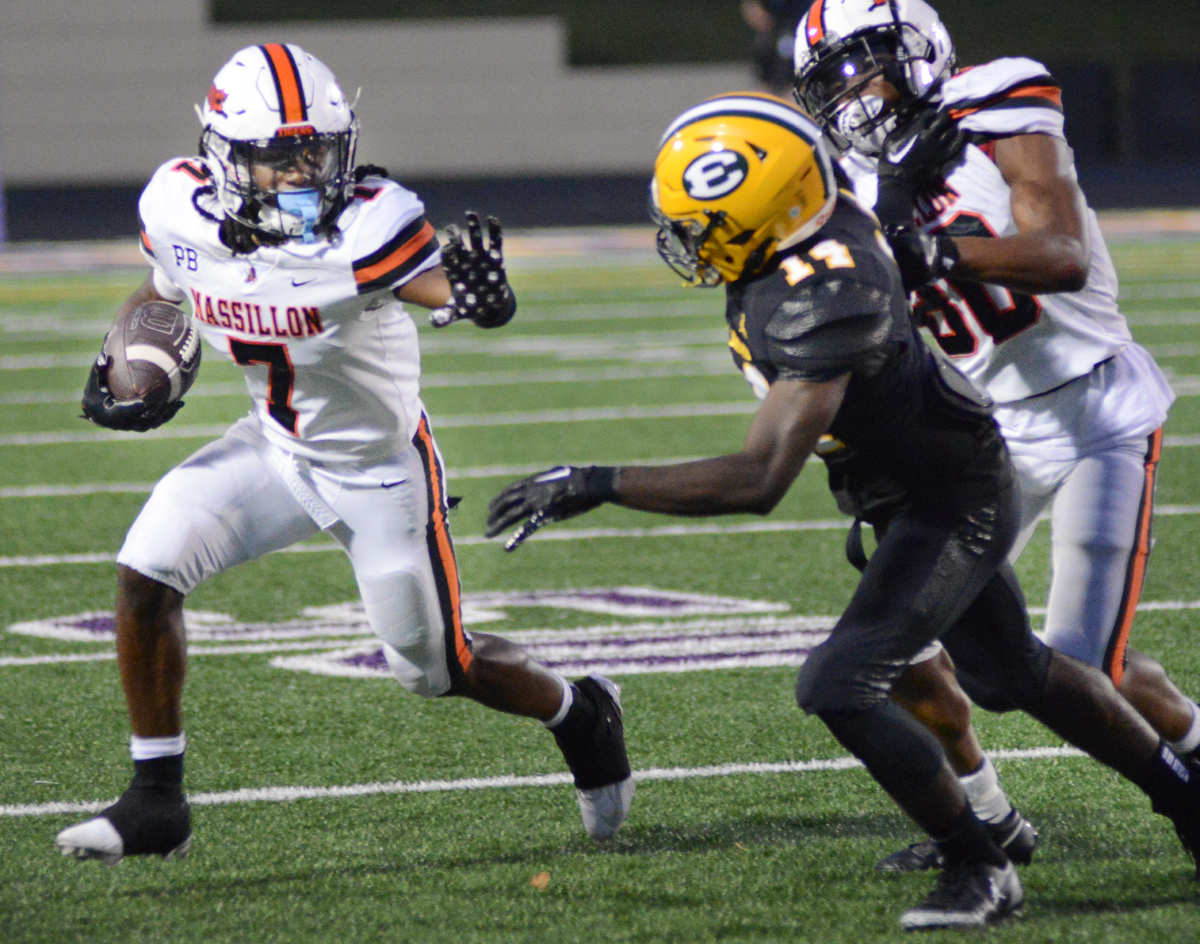
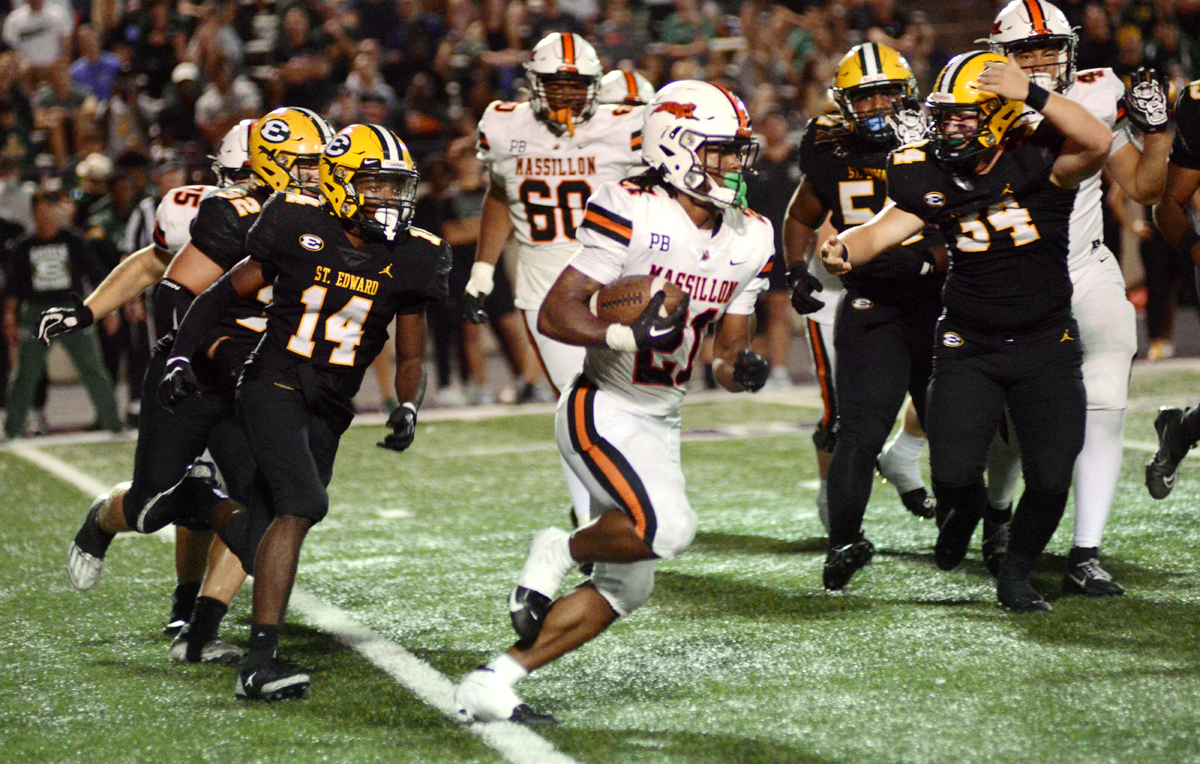
Ja’Meir Gamble (21) heads around end; Marcus Garner (60)
It’s no secret that Massillon’s 2024 football schedule is loaded with quality competition and appears better than most previous schedules. Three major opponents dot the slate, including three teams that are rated in the Top 100 nationally by Calpreps.com, including Bergen Catholic, the defending New Jersey state champion, Lakewood St. Edward, the 3-time defending Division I Ohio state champion, and DeMatha, last season’s No. 2 team in Maryland. But how does this year’s schedule stack up numerically against previous Tiger teams?
Rating the Schedule
In order to rate a schedule one must first have a method of rating each individual opponent. In that regard, a 3-point system has been selected, as follows:
3 points for a large parochial school.
2 points for a mid-sized parochial school or a public school that finishes in the Top 8 of their respective region in the Harbin computer rankings.
1 point for a public school that finishes below No. 8 or does not qualify for the playoffs.
0 points for a team that struggles to play football.
The overall schedule rating is then calculated by summing the individual ratings for all ten opponents.
For the 2024 Massillon schedule, points have been awarded as follows:
NFL Academy – 2 points
Canton GlenOak – 1 point
Bergen Catholic – 3 points
Canisius – 2 points
Lakewood St. Edward – 3 points
DeMatha – 3 points
Football North – 1 point
Warren Harding – 2 points
Canton McKinley – 2 points
The sum of these ratings is 20. Since the Tigers play only nine games, it is pro-rated to 22.2 as the final rating.
Comparing Seasons
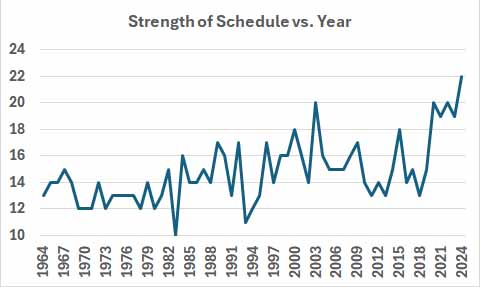
The same rating process described above was applied to all of the Massillon teams back to 1964, which encompasses a span of 61 games. Unfortunately, there was not enough opponent data available prior to this date. The chart below shows the results of that effort. Indeed, this year’s strength of schedule, with a rating of 22, surpasses that of all previous years.
Just behind are three teams that reached a schedule rating of 20, including 2003, 2020 and 2022.
The 2003 schedule included both Cleveland St. Ignatius and Lakewood St. Edward. As did the 2020 Covid year schedule. In 2022 Massillon faced Cincinnati Moeller and St. Edward.
Interestingly, the average schedule rating over the 61-year period is just 14.8, well below recent standards. But, as the chart shows, the strength of schedule rating has been steadily increasing (except during the 2000s), from around 13 in the 1960s to around 20 today.
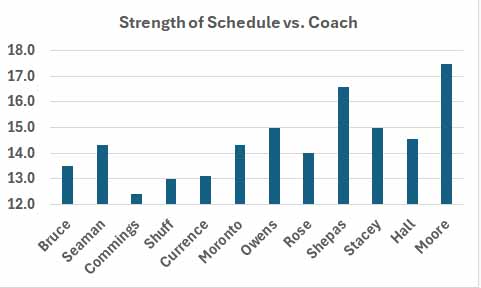
Strength of Schedule by Coach
The chart below shows a lot of variation among coaches in their schedule makeups. Several factors have influenced this and the data shows much variation from coach to coach, a few of which are shown below:
Large parochialschools – The first large parochial school wasn’t scheduled until Mike Currence put Cincinnati Moeller on the slate in 1981. Then, starting with Lee Owens, several of these schools started to appear. But they disappeared under Jason Hall, who felt that the Massillon program was ill equipped due to declining enrollment to compete in these games. They returned under Nate Moore, as the program rebounded and actually elevated itself to the level of the schools.
All-American Conference – Prior to the introduction of the state playoffs, a team needed to produce an undefeated season to win a state championship. Given the strengths of teams across the conference, coaches opted to schedule weaker opponents in between conference games. The AAC dissolved after the 1979 season.
Playoff system – In the early days of the playoffs, very few teams qualified. It was therefore imperative to win a lot of games in order to qualify and scheduling a strong opponent or two could jeopardize that goal. Now, with 16 teams qualifying, the risk has been reduced considerably.
Independent school – Massillon is an independent school. As such, it has been extremely difficult to schedule games beyond Week 3 when most teams are in league play. Several coaches have opted to fill out the schedule with inner-city teams, which are almost always available. However, Coach Moore is not interested in that, but has found that the schools mostly available later in the season are in fact the large parochial schools. Fortunately, his program is now equipped to handle that level of competition.
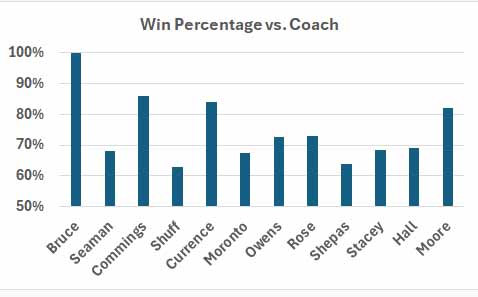
Success vs. Schedule
Do weaker schedules result in more wins? Sometimes, yes; sometimes, no. Mostly, there is more influence on a team’s success from the coaching end than from the schedule end.
Interestingly, Bob Commings had the weakest schedule and second best winning percentage, while his successor, Chuck Shuff, had the second weakest schedule, but the worst winning percentage. Mike Currence won a lot of games with a weak schedule. Nate Moore has won a lot of games with the strongest schedule. So, as one Massillon assistant coach put it recently, “you win when you have the Jimmies and Joes.” And right now Massillon has an abundance of those.
Coaches will tell you that there are three phases to the game of football: offense, defense and special teams. And the performance of each is measured following the game. If one looked at just the scoring statistics, all three measured up quite well for the Tigers, as they cruised to their third win in four starts, defeating Canisius, 41-7.
Massillon scored in nearly any way they could in the game of football. There were two rushing touchdowns. There was a passing touchdown. There was a pick-6 interception return. A punt was returned for a score. And even a fumble was returned to the house. All of that negated a fine defensive performance by the Crusaders.
Lennox Lemon
On Canisius’ first possession they ran the ball twice to set up a 3rd and 5 from their own 40. The situation against the stingy Tiger defense called for a pass. Only, quarterback Matteo Brusco threw the ball right into the hands of Massillon’s Lennox Lemon, who promptly returned it 44 yards to pay dirt. Mateo Herrera’’s kick gave the locals a 7-0 early advantage.
Following a punt by the Crusaders, the Tigers went on a 9-play, 83-yard drive for their second score. The key play was a 43-yard pass from quarterback Jalen Slaughter to Jacques Carter. Carter was covered by a glove as he headed down the middle of field and both players had a hand on the ball. But after it received several more touches Carter managed to secure it at the six yard line. Then, after losing five yards on the next play, Mylen Lenix took a handoff from the jumbo set, the first time it had been used this year, and sped around the right side for the score.
In the second quarter, Canisius punted from their own ten and the ball bounced past return player Tyler Hackenbracht. It looked as if he was going to just let it go, but the ball had a lot of momentum. So, in order to protect field position, he caught it on the bounce while running toward his own end zone and pulled an Austin Brawley by reversing field. Following some fine blocking down the left sideline, he raced for a 52-yard touchdown return. That made the score 21-0.
Nolen Hendricks placed the ensuing kickoff on the three yard line and the return player was content to let it bound into the end zone. Only, Hendricks used a 9 iron on this one and the ball checked up. By the time the returner realized this he quickly retrieved the ball, but was promptly tackled at his own three yard line. An encroachment penalty advanced it to the eight. But three plays later the handoff was fumbled and picked up by Lenix, who had friendly company as he strolled into the end zone. The game was essentially over at that point.
The final score of the half came on a 24-yard bomb to the corner of the end zone from Slaughter to Carter. So, the two teams headed into the locker room with the score sitting at 35-0 and second half to be played under a running-clock situation.
On the Tigers’ first possession after the break they advanced the ball to their own 38 and punted. Only, the ball was fumbled by the Crusaders and recovered by Lo’Quan Young at the 24. Two plays later Ja’Meir Gamble showed his speed in racing around the left side, while eluding two would-be tacklers, for a 9-yard score.
Mateo Herrera
At that point the first team was done for the night, with 1:41 left in the third quarter. The unit had put up six touchdowns: three by the offense, two by the defense and one by special teams. Meanwhile, d Canisius was held under 40 yards of total offense. For the night, Massillon led in first downs 10-8 and total yards 209-131. Gamble rushed 10 times for 63 yards and a touchdown and Slaughter completed 10 of 12 passes for 150 yards and a touchdown. Carter caught 4 passes for 91 yards and two scores. On defense, Lenix and Logan Allman collected five tackles each. Herrera has now converted 41 straight varsity extra points through last season.
It should be noted that the Crusaders were operating just a bit shorthanded in two different ways. The first was that their best player, 3-star recruit running back/receiver/cornerback Elijah Kimble, who holds offers from Michigan and Oregon, had suffered a broken hand earlier in the week when he fell off a bicycle and had the injured limb in a wrap. In a conversation with Canisius Coach Kraig Kurzanski prior to the game, the coach said that running was doubtful and receiving was out of the question, but he would play some defense. In the end Kimble gutted it out and did what he could, rushing 10 times for 15 yards and playing some on defense. He also caught a kickoff one-handed.
The second issue was their small roster size, around 35 players. Coach Kurzanski explained that, unlike the large parochial powers in Ohio that gather good players from the public schools and pay little or no tuition, Canisius experiences the complete opposite situation in that each player is responsible for paying some amount of tuition. Also, in the city of Buffalo, public students can attend any school they desire. As a result, some schools are loading up with talented football players, similar to Cleveland Glenville, and in fact are raiding Canisius, given that no tuition would be required in a public school. Hence, the small roster. Nevertheless, the players the Crusaders do have certainly play good football and they play hard to the end.
For Massillon, the Tigers had difficulty running the ball against a stout Canisius from-7 and gained just 59 yards in 19 carries. In addition, Slaughter was under pressure most times when he dropped back to pass. Sure, the Crusaders had some big defensive linemen. But this is an area that needs to be shored up. The return of the injured senior Gavin Kappes may help and he did perform well when he subbed in. But he was slated in this game mostly for defense, which has its own problems as Coach Nate Moore appears to be still searching for the right players to start, with the goal of keeping All-Ohio Mike Wright in the middle, where he is most effective. Nevertheless, the defense overall did put in a fine performance, particularly against the rush, giving up just 84 yards, mostLY coming against the backups.
Next week Massillon (3-1) travels to Lakewood to face St. Edward. Canisius (1-1) is also on the road, at Erie Cathedral Prep.
Go Tigers!
Robert Blakely (59)
Lennox Lemon (0) following the interception return.
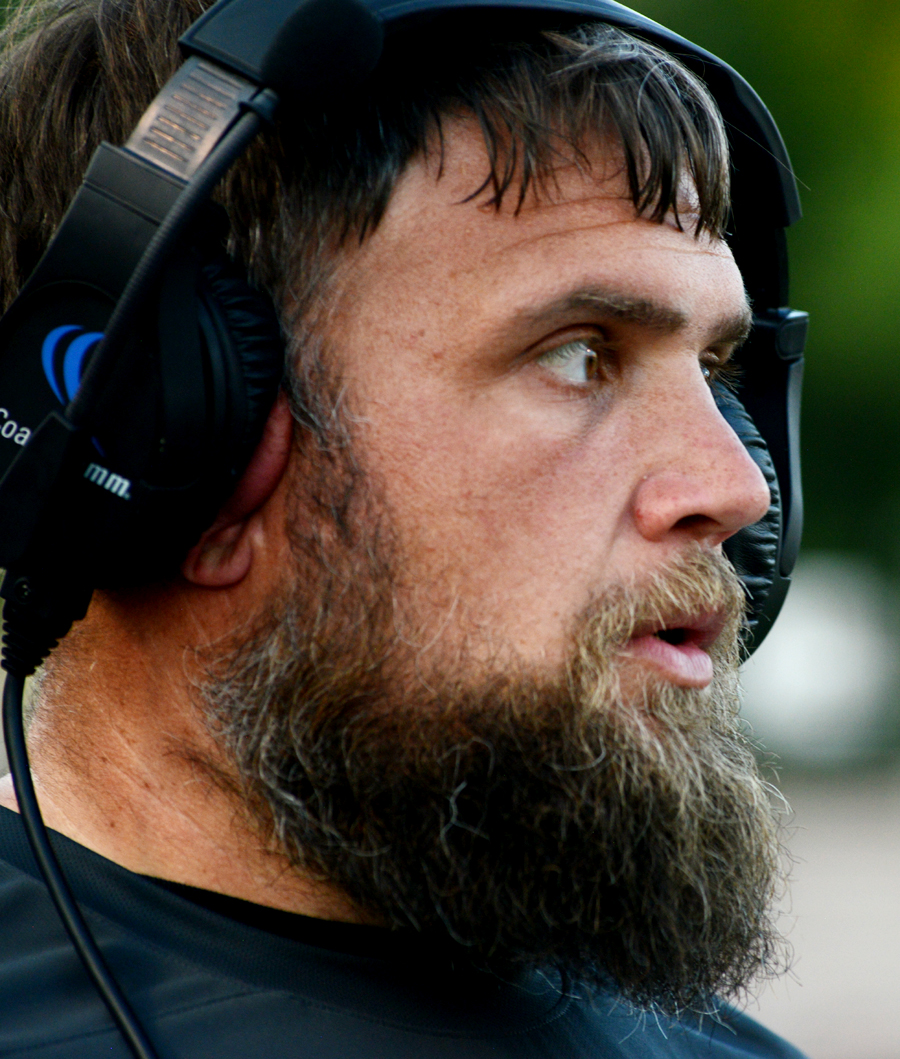
Assistant coach J.P. Simon
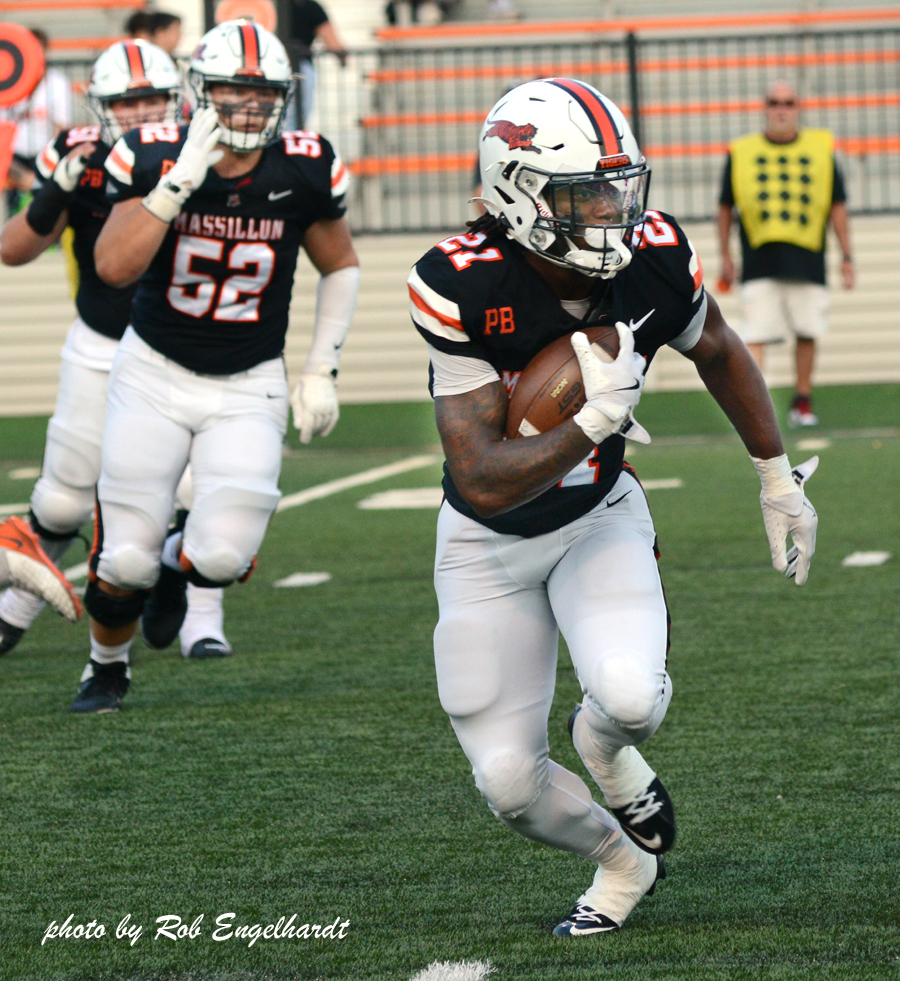
Ja’Meir Gamble runs for yardage; Chris Fair (52)
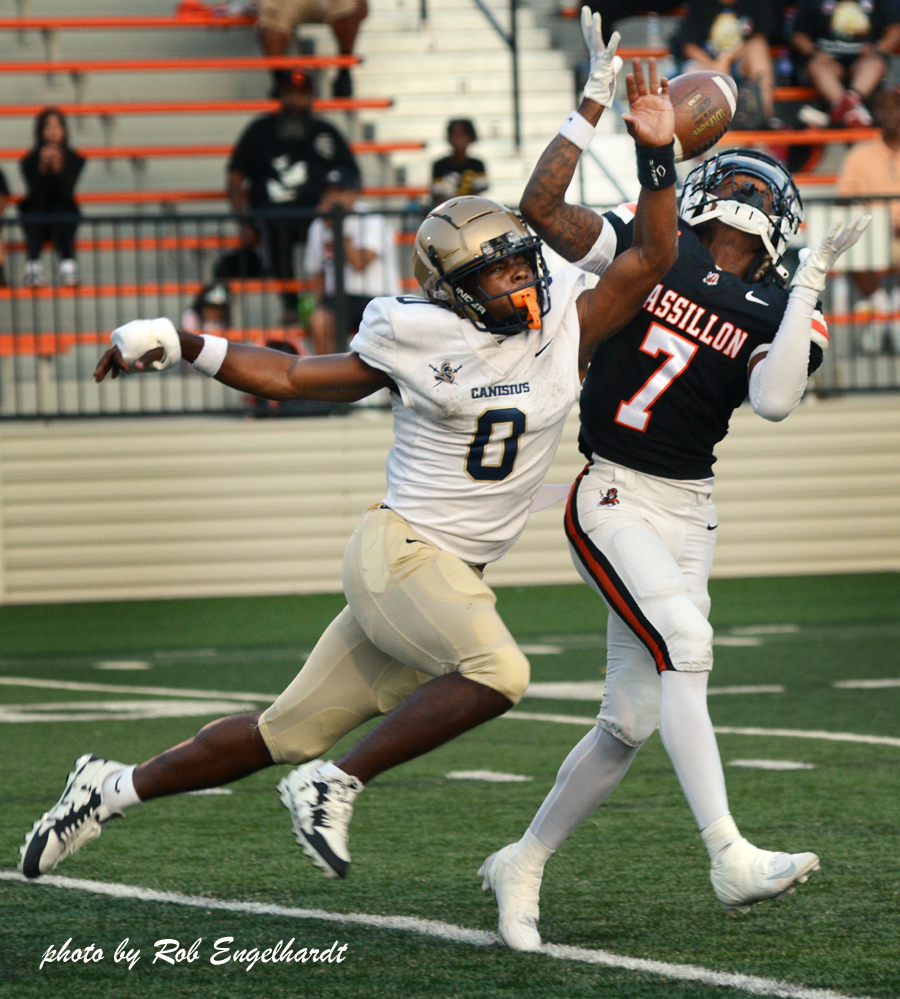
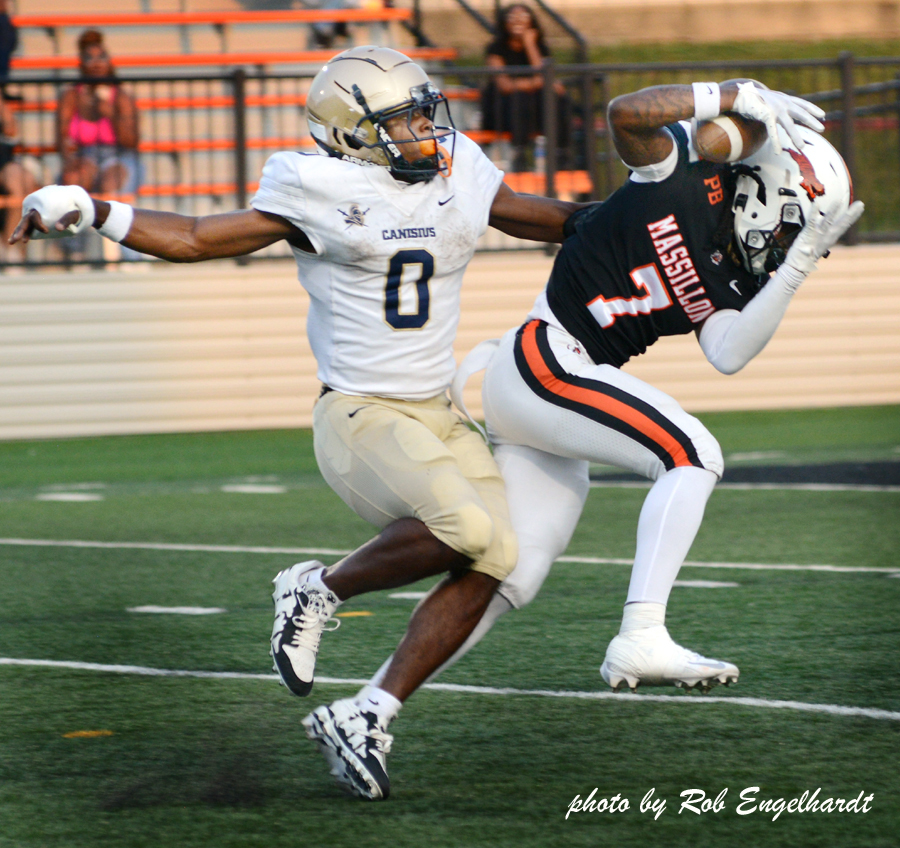
Jacques Carter (7) battles for the ball on the long bomb; Elijah Kimble (0)
Jacques Carter (7) secures the the ball on the long bomb; Elijah Kimble (0)
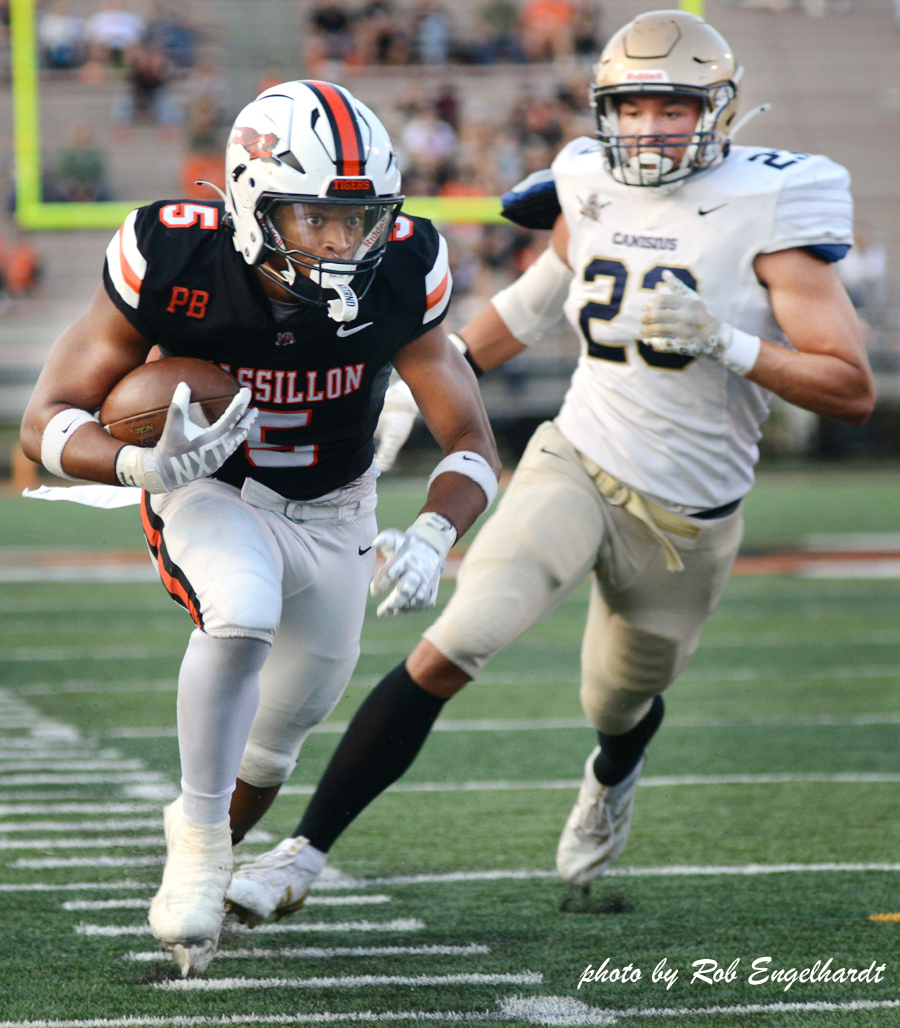
Mylen Lenix (5); Amare Wallace (23)
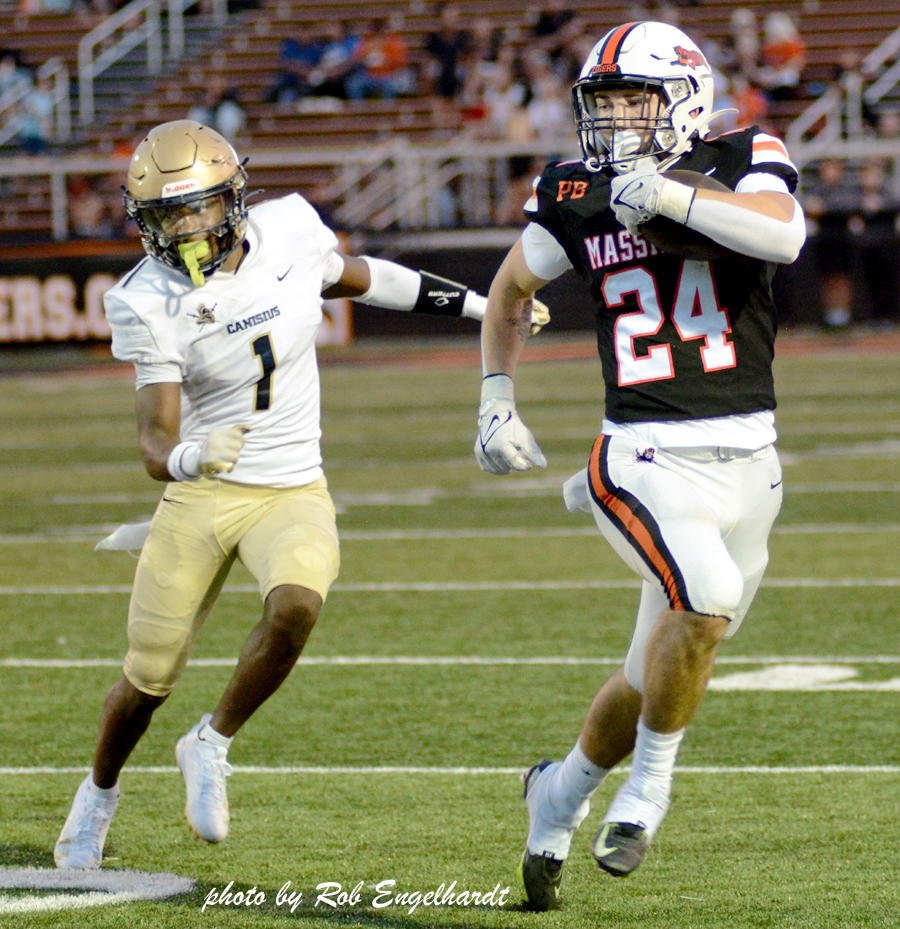
Tyler Hackenbracht (24) with the punt return; Jahyden Clark (1)
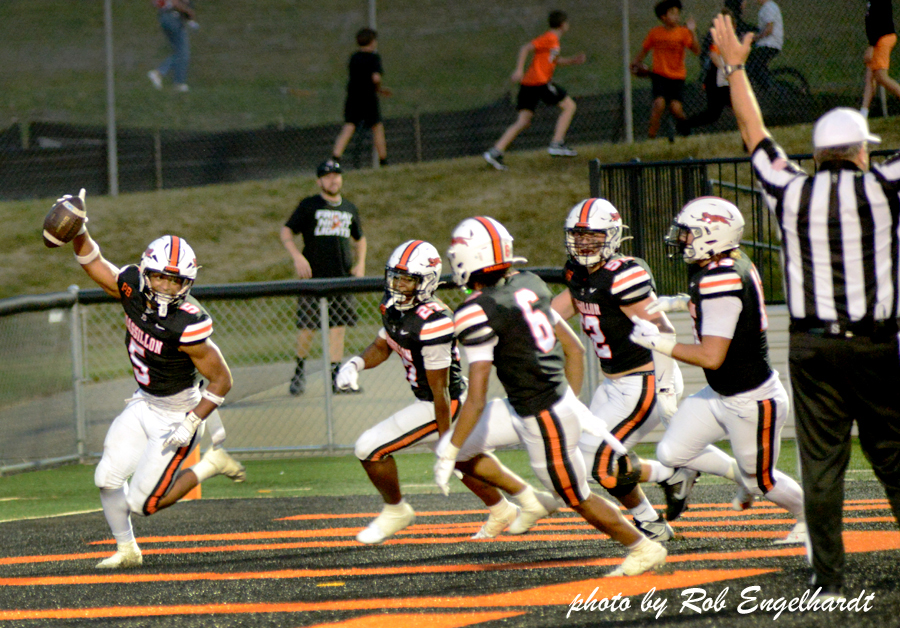
Mylen Lenix (5) with the fumble return; Tra’Yon Williams (27), Daylan Pringle (6), Chris Fair (52), Logan Allman (13)
Jacques Carter (7) with the touchdown reception
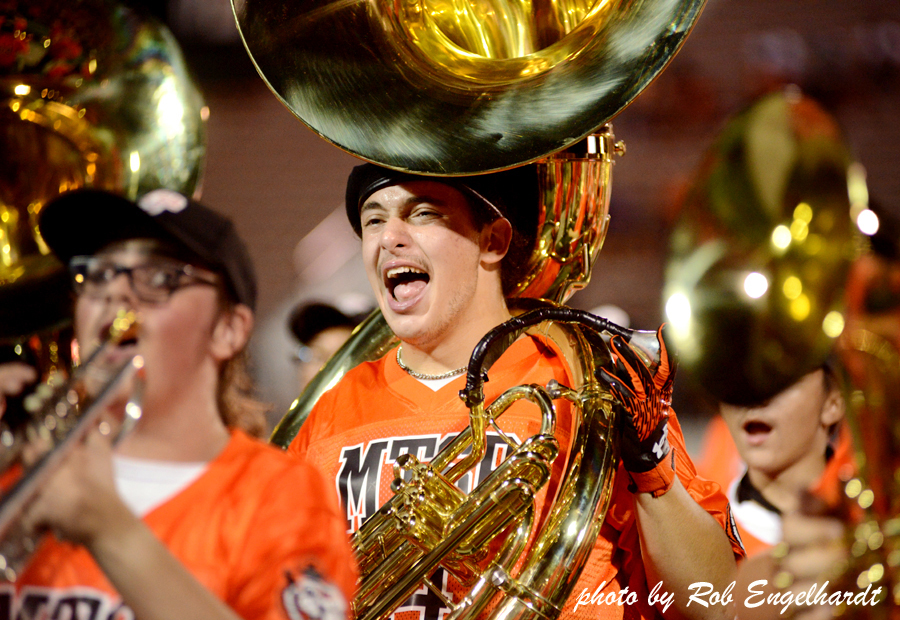
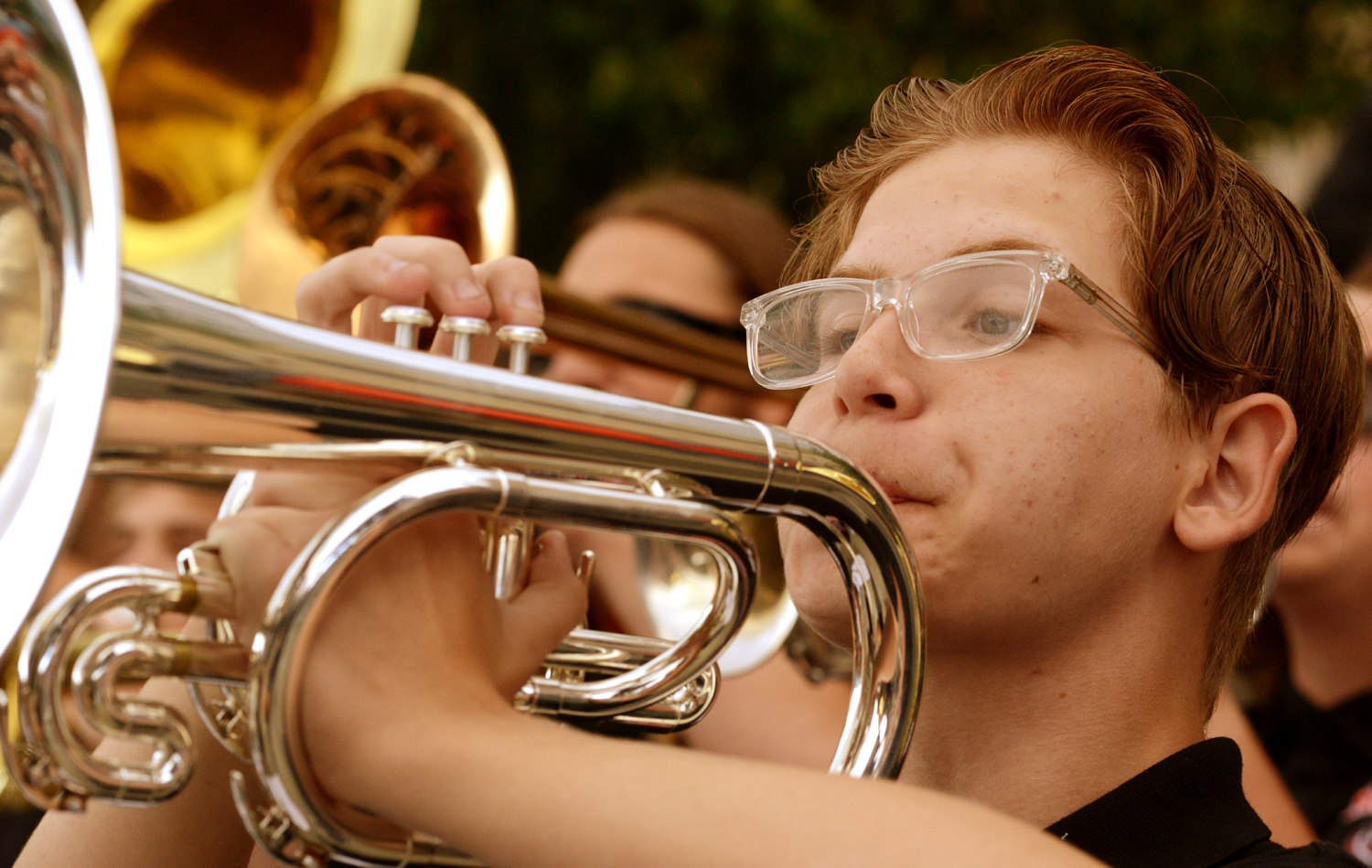
Leo Wingerter, a Tiger Swing Band Senior sousaphone player, entertains Tiger fans during the band’s half time performance.
Out-of-State and Parochial Schools Have Regularly Sprinkled Tiger Schedules
From the time of Paul Brown to the present Massillon fans have had opportunities to witness many big games against both out-of-state and parochial school opponents. Here is a look back at the history of these encounters.
Out-of-State Opponents
Over the past 85 years Massillon has played 50 games against teams from outside of Ohio and currently owns a 50-9 record against the lot. Some of the contests against the more prominent of these are shown below:
Covington Catholic, KY (1990) – Won 39-14 – It was played in Cincinnati as part of the Buddy LaRosa Classic. The Tigers controlled the game from start to finish as Falando Ashcraft carried the ball 28 times for 190 yards a touchdown.
Miami Southridge, FL (1995) – Lost 20-7 – Southridge scored twice in the fourth quarter to break a 7-7 tie.
Clovis West, CA (1998) – Lost 21-9 – The Tigers held a 7-0 lead at the half, but West came up with two long runs and a pass interception return in the second half to secure the win.
Hamilton Chandler, AZ (2006) – Won 35-26 – Brian Gamble took over the game, rushing for 159 yards and a TD, catching four passes for 44 yards and a two TDs from quarterback Bobby Huth and intercepting a pass that he returned for 37 yards. This was Chandler’s only loss and they finished the season as the No. 1 team in Arizona.
Jordan, UT (2008) – Lost 27-24 – Jordan kicked a 36-yard field goal with 45 seconds remaining in the game to pull out a victory. It negated an 8 of 10, 169-yard passing effort by Michael Clark.
East St. Louis, IL (2018) – Won 46-40 – It was perhaps the most athletic opponent that the Tigers have ever played. Massillon trailed for most of the game in this back and forth offensive affair. Finally, with 3.33 remaining in the game, quarterback Aidan Longwell connected with Jalen Ballard on a 39-yard touchdown pass to give the Tigers their final lead. It ended when Max Turner intercepted a desperation pass at the Massillon 8-yard line with 42 seconds left to secure the win.
Valdosta, GA (2023) – Won 28-17 – Massillon came back from 14 points behind against the winningest team in the country to secure the victory. The catalyst was quarterback Da’One Owens, who rushed 13 times for 241 yards and two touchdowns.
Bergen Catholic, NJ (2024) – Lost 35-21– The Crusaders scored twice in second half to break open a 17-17 tie. They are currently ranked No. 8 in the nation per Calpreps.com.
Historically, Nate Moore has played the most out-of-state opponents and has a record of 12-2. Behind him is Paul Brown, with a record of 11-1 and Jason Hall, who was 8-1.
Parochial School Opponents
Public schools as a whole have always had a difficult time defeating parochial schools, let alone winning state titles against them, owing to their much broader area from which to secure athletes. And Massillon is no exception. While the Tigers hold a 98-54-2 win-loss advantage overall, against the larger schools they have a deficit, with a mark of 27-34.
The Tigers played their first parochial school in 1933 when Paul Brown scheduled Akron St. Vincent as the season opener. Massillon won that one 39-0. Later that season his team beat Columbus Aquinas, 52-6. From that time on and up to the initiation of the playoffs in 1972, Massillon compiled a remarkable record of 37-4-2. But since that time the record is just 61-50, as the parochial schools have upped their game to compete for state playoff titles and Massillon has scheduled more of these larger schools in lieu of the smaller ones.
The most common opponents to appear on the schedule are shown below, along with the number of games played and the current record:
Akron St. Vincent (28) 22-6
Cleveland Benedictine (28) 23-4-1
Cleveland St. Ignatius (14) 2-12
Cincinnati Moeller (13) 2-11
Cleveland Cathedral Latin (12) 8-3-1
Lakewood St. Edward (9) 5-4
Youngstown Ursuline (9) 6-3
Walsh Jesuit (7) 5-2
Akron Hoban (6) 3-3
Cincinnati Elder (5) 5-0
Cincinnati LaSalle (3) 2-1
All others (11) 9-2
Some Massillon coaches have had success against these brethren, while others not so much. In the playoff era, Coach Moore leads the way with the most wins and a record of 16-10, followed by Jack Rose with a record of 11-3, Mike Currence with a record of 8-5 and John Moronto with a record of 5-1. Prior to the playoffs, Bob Commings posted a record of 9-0-1, Leo Strang was 7-1 and Tom Harp was 5-0. But many of these wins came against the smaller schools. Coach Rick Shepas had the most difficulty time, posting a record of just 4-12. But he certainly wasn’t shy about scheduling them.
This season, Massillon will face four parochial schools, including Bergen Catholic, Canisius (NY), Lakewood St. Edward and DeMatha (MD). Having four parochials on the schedule has happened only one other time, in 1991. In that year Owens Lee Owens defeated Walsh Jesuit and Toledo St. Francis, while losing to Cincinnati Moeller and Akron St. Vincent. In 2005, Coach Tom Stacy played four parochial schools, but two were in the playoffs. Following regular season victories against Cincinnati Elder and Cleveland St. Ignatius, his team defeated favorite Lakewood St. Edward in the Division I state semifinals, before losing to Cincinnati St. Xavier in the finals.
Some of the bigger wins against the larger parochial schools in the playoff era were as follows:
Walsh Jesuit (1989) – Won 42-24 in the playoffs – Massillon was down 24-6 at the half, only to score 36 unanswered points after the break. Lamonte Dixon rushed 10 times for 181 yards and a touchdown.
Cincinnati Moeller (1995) – Won 21-18 – It was the first ever win over the Crusaders. Vinnie Turner rushed 25 times for 196 yards and scored three times.
Cleveland St. Ignatius (2005) – Won 29-26. It was the first ever win over the Wildcats. The Tigers were down 26-14 at the end of the third quarter, but scored twice in the fourth. The second tally came with just ten seconds left in the game when backup quarterback Shawn Weisend ran five yards around left side and dove into the end zone for the winning points.
Lakewood St. Edward (2005) – Won 21-17 in the playoff state semifinals – Massillon was down 17-7 midway through the fourth, when Brian Gamble caught a 18-yard touchdown pass from Bobby Huth and then followed up with a 5-yard run with 1:56 left in the game to pull out the win.
Lakewood St. Edward (2022) – Won 31-28 – Against the Number 1 team in Division I, Braylyn Toles caught a 24-yard touchdown pass from Jalen Slaughter with eleven seconds remaining to pull out the win.
Lakewood St. Edward (2023) – Won 15-13 – Quarterback Da’One Owens led the way with 26 carries for 176 yards and two touchdowns and 8 of 11 yards passing another 50 yards. The Eagles again finished No. 1 in Division I.
Akron Hoban (2023) – Won 7-2 – The defense led the way in keeping the Knight offense off the scoreboard and winning the Division II state title, the Tigers’ first in the playoff era. Dorian Pringle broke up a fourth down pass at the goal line to secure the victory.
This week, Massillon will yet again play a large parochial school opponent, which is also an out-of-state team, in Canisius from Buffalo, New York.
Massillon Fans Get Behind the Tigers at the Annual Football Kickoff Rally
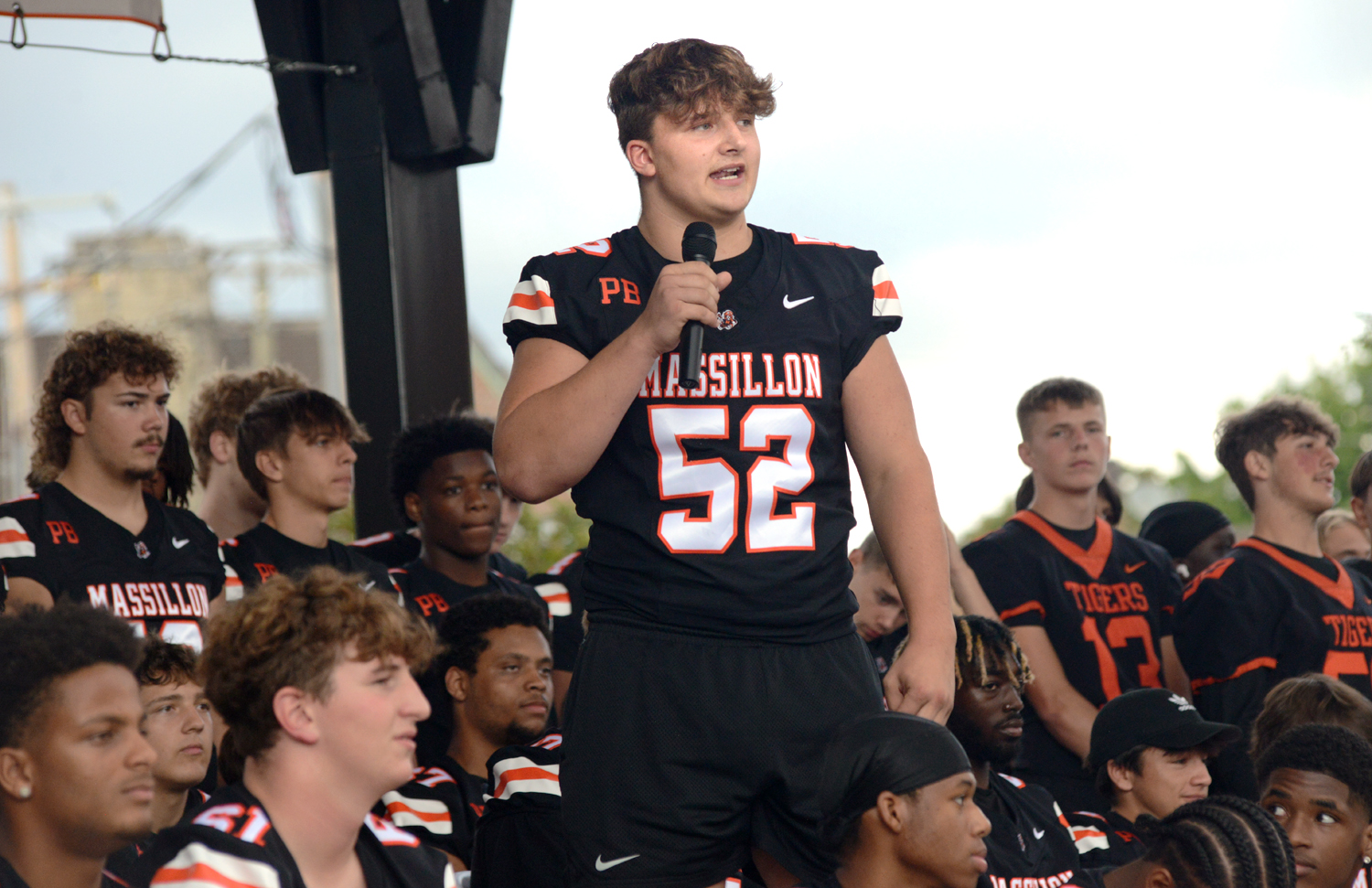
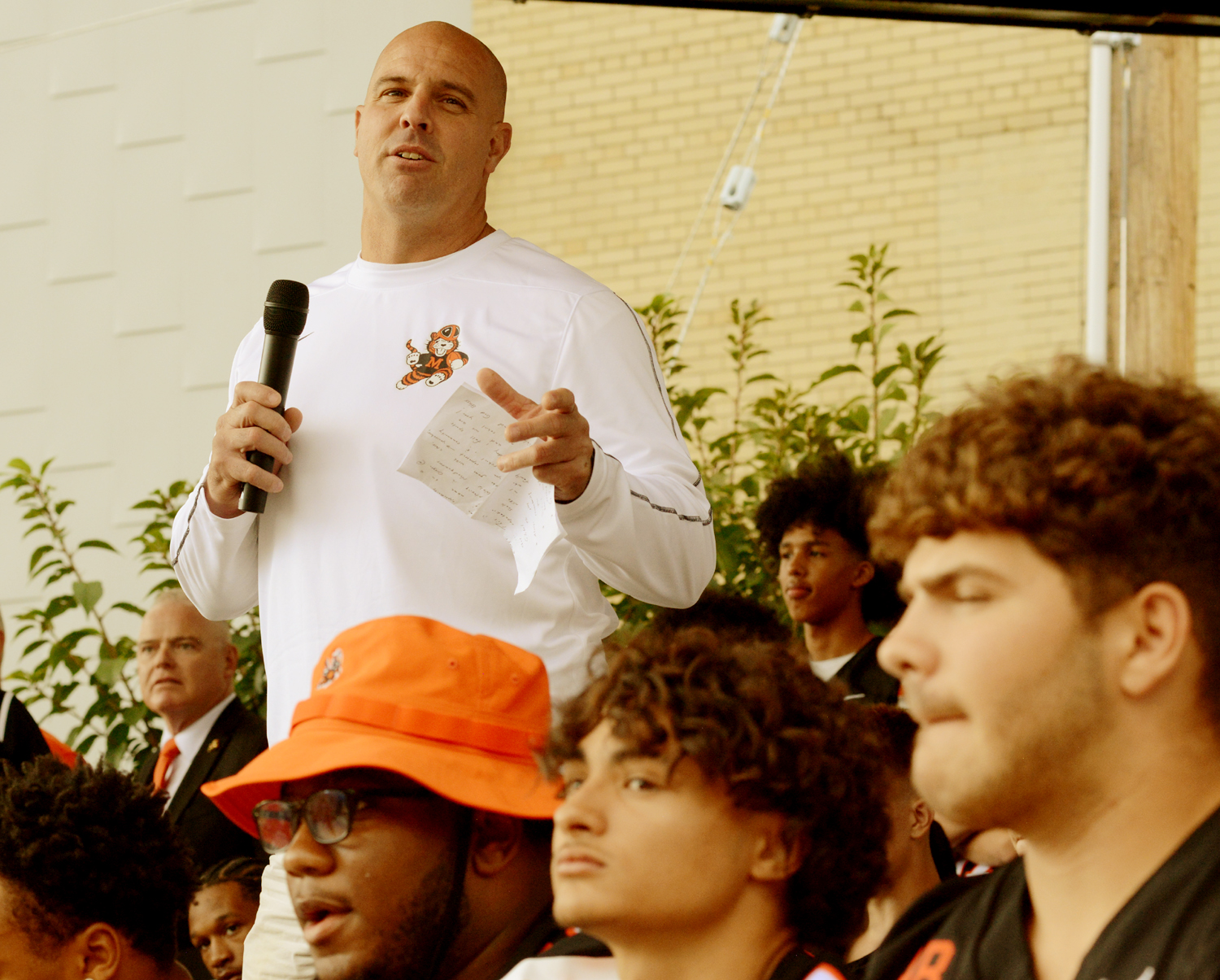
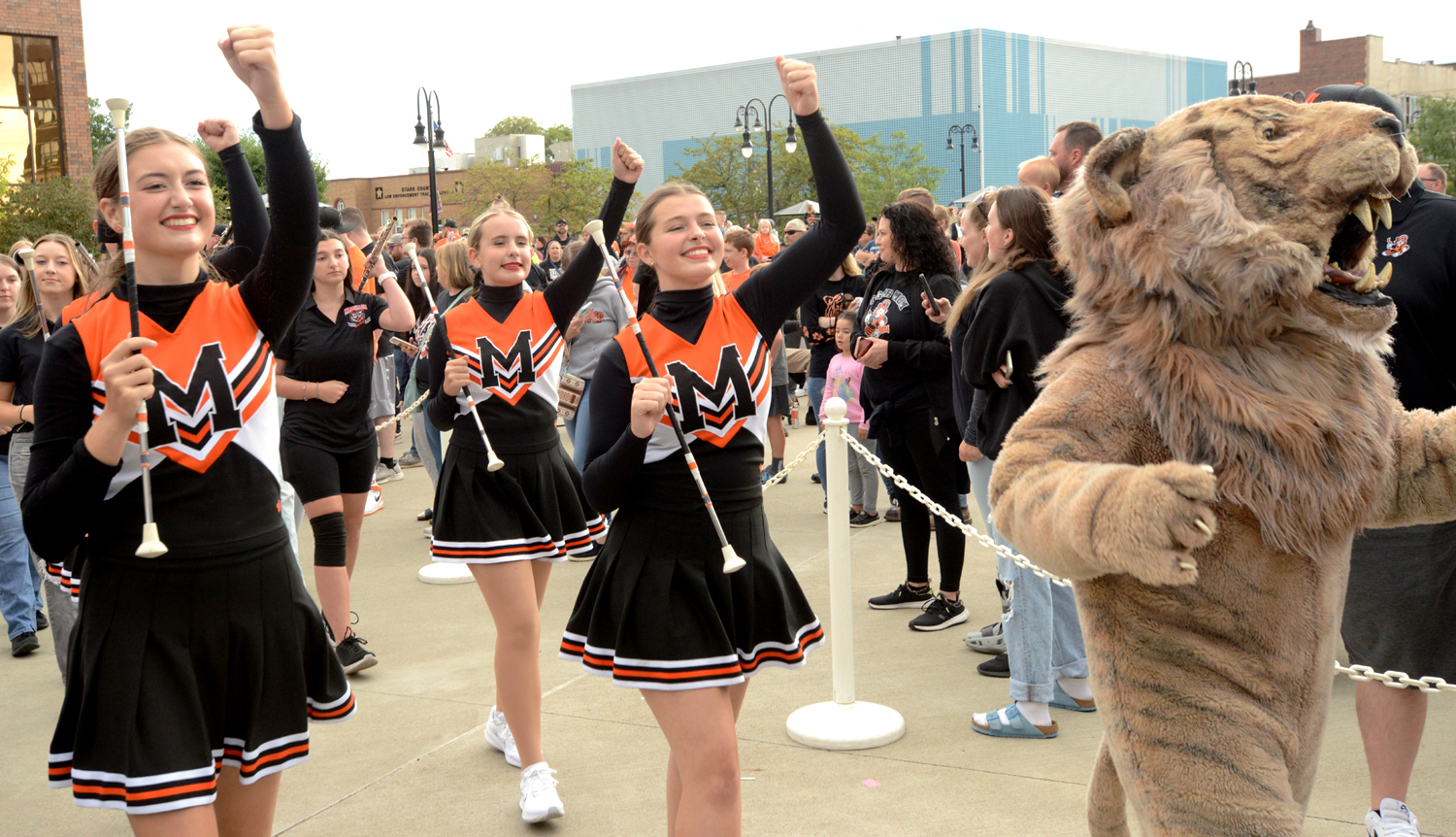
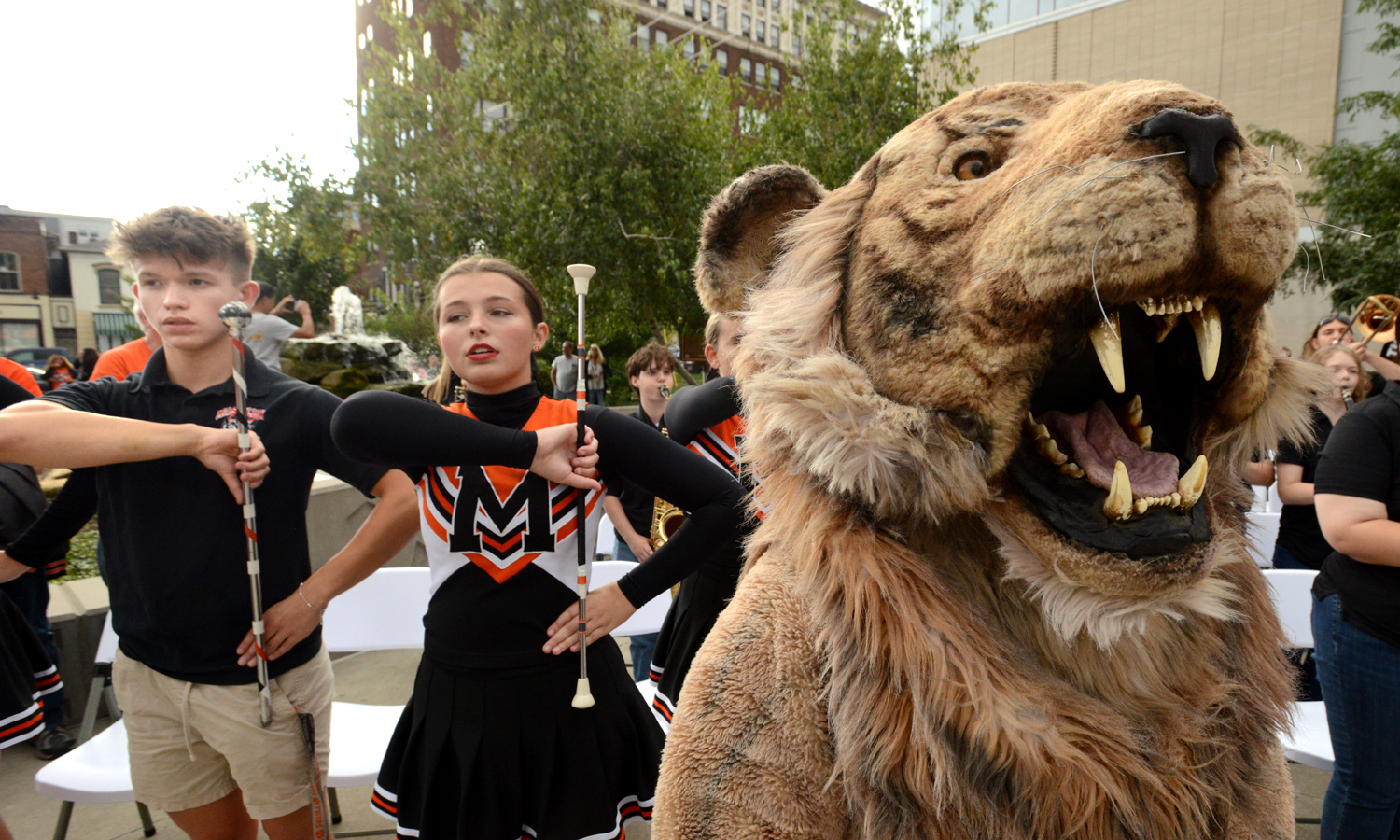
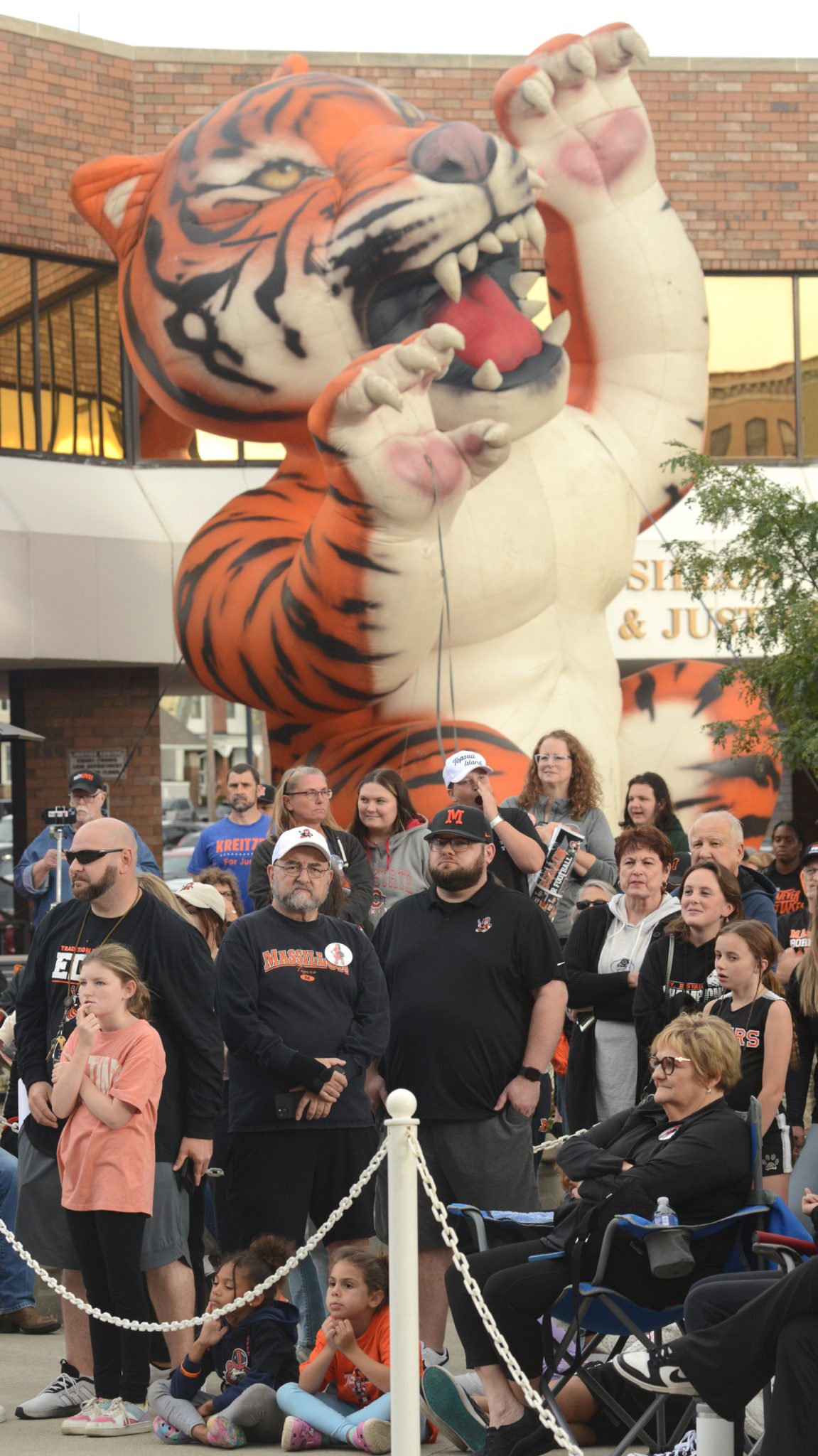
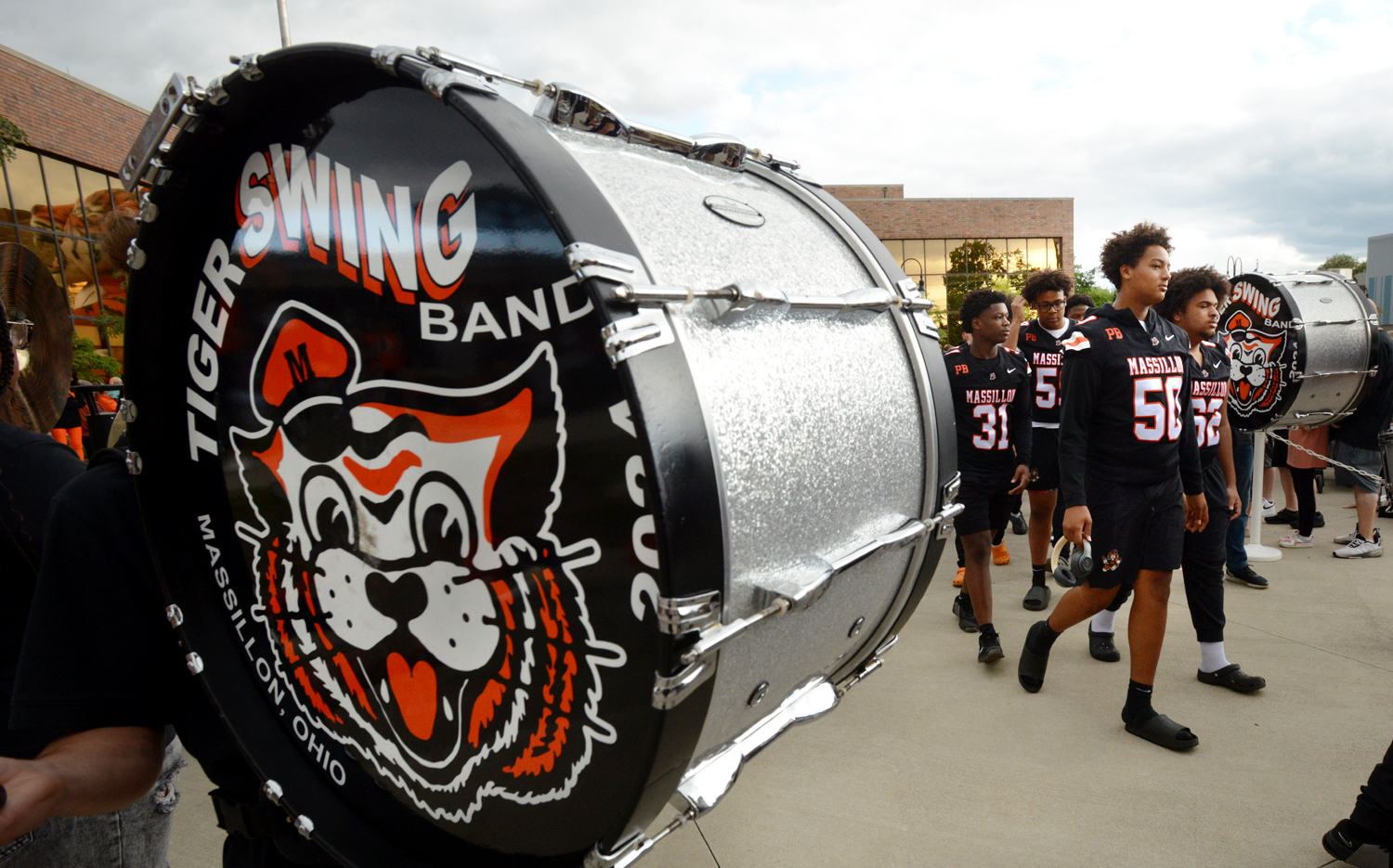
Orange and black was the attire of the day as a throng of Massillon faithful packed Duncan Plaza for the annual Football Kickoff Rally, sponsored by the Downtown Merchants Association and the Massillon Museum. The Tiger Swing Band strutted in to the sounds of Tiger Rag, a tune made famous in the 1930s by band director George “Red Bird.” The cheerleaders fired up the crowd with their T I G – E R S chant and impressed all with their back flips. And finally, the Massillon Tiger football team proudly strolled in and jammed the pavilion with their 122-strong number. And it wasn’t lost on the fans throughout the evening that these Tigers are ready to defend their Division II state title of a year ago.
WTIG’s Ray Jeske was the emcee of the event, which featured short speeches by Mayor Jamie Slutz, Superintendent Paul Salvino, Washington High Principal Dave Lautenschleger, Booster Club President Ed Starcher and Football Head Coach Nate Moore.
Salvino – “I can tell you how proud I am to be a product of Massillon and the Massillon Tigers.”
Lautenschleger – “Massillon against the world (2023 season theme). There’s probably not a better time for that phrase,” as he referred to the opening opponent, NFL Academy-London, in a game that will be played this Thursday in Beaverton, Oregon. “The beauty of the game this week is to expand globally around the world.”
Moore – “It’s great to be here. I’m so proud of our program and our great young men. We have put this program back as the premier program in Stark County and the State of Ohio. Last year we sent shock waves around the country. We’re now back as the team everybody is talking about. We have a chance to show the entire world that Massillon is the center of the world for its football. I wish everyone could be there (in Oregon). When we take the field the entire city of Massillon will be in our hearts as we put the team in front of the entire world.”
The evening wrapped up with ice cream provided by the Massillon Museum.
Photos by Rob Engelhardt.
Massillon Head Coach Nate Moore
Massillon Co-Captain Chris Fair
Massillon City Schools Superintendent Paul Salvino
Washington High School Principal Dave Lautenschleger
2024 Massillon Football Booster Club President Ed Starcher
Massillon Tiger Swing Band majorettes march into the rally at Duncan Plaza.
No kick-off is complete without Obie and the Tiger Swing Band.
The Tiger Swing Band plays while Tiger players join the rally at Duncan Plaza.
Adam Ezzo plays the mello phone during one of the Tiger Swing Band tunes.
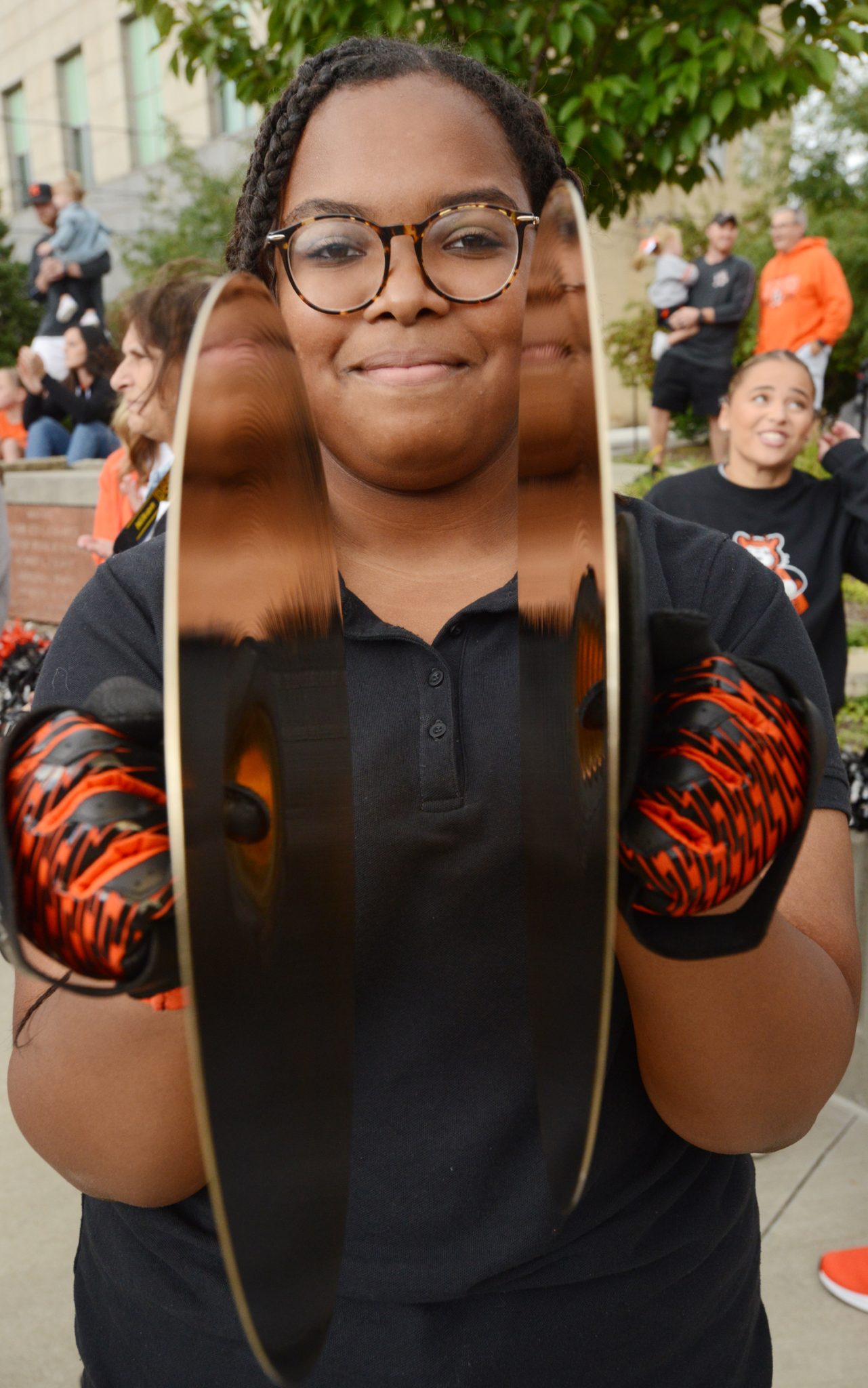
Tiger Swing Band member Mykal Burns-Gales provides the crash of the cymbals at the beginning of the kick off rally at Duncan Plaza.
5-year old Stella Wiles of Massillon shows her Tiger spirit with an Obie logo on her face.
Leo E. Strang is ranked as one of the nation’s 50 all-time greatest high school football coaches. He won two national and three consecutive Ohio high school state at storied Massillon Washington High School (1958-1963) and had an overall high school coaching school record of 109-26-1 (80.51 win-loss percentage) over thirteen seasons.
Read the rest of the story by clicking the link below:
It took just one game for Massillon fans to realize that Chris Spielman was heading for something special. On a warm September evening, in front of a season-opening crowd of 15,653, the Tigers were enroute to a 33-0 shellacking of the visiting Perry Panthers. On the team was a lone sophomore, who managed to work his way onto special teams during the preseason. Massillon kicked off to start the game and the play ended with the announcer stating that Chris Spielman made the tackle. Not a big deal. But then, he repeated that remark again on each of the next three kickoffs. Plus, all of the tackles were made inside the 20 yard line. Finally, on the fifth kickoff, the announcer said, “This time the tackle was NOT made by Chris Spielman.” Suddenly, the young sophomore was high on the radar of the avid Tigers fan base. And it pretty much set the tone, as the stalwart inside linebacker / running back held sway for the next three years, leading his team to a 28-5 record and a trip to the elusive playoff state finals. He continued that success as an All-American at Ohio State and then as an All-Pro performer in the NFL. Although he was not the biggest or the fastest defender on the field, he had an uncanny ability to (1) anticipate the play based on the formation and (2) respond quicker to his reads than any other player. He also performed with extreme physicality.
The Early Years
Charles Christopher Spielman, known to everyone as “Chris,” was born in Plain Township on October 11, 1965, to “Sonny” and Nancy Spielman as the second born son, the first being Rick, also a future Tiger. The Spielmans were a football family, with Sonny serving at the time as the head coach of Timken, so it was natural that Chris would be engrossed in football during his early years. He was on the practice field with his father every day and when old enough played midget ball.
Just prior to entering junior high, the family moved to Canton and Chris set his sights on playing for the best team in the city: Canton McKinley. But as fate would have it, a potential athletic director position for Sonny at McKinley did not materialize. So in 1980 the family moved again, this time to Massillon, where Sonny was hired as an assistant coach under Mike Currence.
At Longfellow Junior High as a freshman, Chris played both linebacker and running back and his team won every game. He also impressed the varsity coaching staff with his play in a post-season match against the sophomore team. So, the stage was set for that fateful game against Perry.
High School
Sophomore year (1981) – He was assigned No. 33 and he kept that number throughout his time at Massillon. At that time life as a Tiger would begin on the sophomore squad, as only juniors and seniors were permitted to suit up for varsity. But his size (6’-1”, 195 lbs.), strength and athletic ability were immediately evident. And it didn’t take long for him to become a starter at inside linebacker, joining his senior quarterback brother Rick in the lineup. Massillon finished with a 7-3 record that year, nearly upsetting state champion McKinley in the final game. Meanwhile, Chris recorded three pass interceptions, one coming in a 14-7 victory over Warren Harding and another against Niles that he returned for 27 yards.
“To start as a sophomore you had to be good and you had to be lucky,” said assistant coach Dale Walterhouse. “And you had to be lucky in that you better not have an All-Ohio player ahead of you in that position.” – Massillon Memories, by Scott Shook.
“People said that I couldn’t start as a sophomore at Massillon,” said Spielman. “I just felt like that didn’t have anything to do with me. I just thought that I’d be starting. It turned out things worked out for me.” – Massillon Memories, by Scott Shook.
Junior year (1982) – The junior year was a breakout season for this young player. Now up to 206 lbs, he was also assigned the position of starting running back, along with Jim Busche, and rushed for a team-high 844 yards and 15 touchdowns. He also caught 15 passes for 154 yards and a TD. On special teams, he returned 16 punts for 83 yards and blocked a field goal against Sandusky that turned the playoff game in the Tigers’ favor. He scored in every outing except one and tallied 96 points. On defense he recorded 156 tackles, intercepted four passes and recovered two fumbles. For his outstanding performance, Chris was named First Team All-Ohio Linebacker.
The team finished with a record of 12-1, while coming up short in the playoff state finals to Cincinnati Moeller. “We were a great football team in 1982,” Spielman said. “We were 12-1, got beat by Cincinnati Moeller. We were outmatched, when they were getting kids from three different states and all over Cincinnati. Like they were, it was very tough to compete against them. Any other school in the state or the nation, I believe, we would have beaten them handily. I think that was one of Massillon’s finest teams.” – Massillon Memories, by Scott Shook.
Season highlights:
Perry – Rushed 10 times for 130 yards (13.0 ave.) and one TD in a 29-8 victory.
Canton McKinley – Rushed 19 times for 101 yards (5.3) and scored the only touchdown of the game on a 1-yard run in the fourth quarter. Caught 5 passes for 50 yards.
Sandusky – Rushed 23 times for 113 yards (4.9) in a playoff 29-7 victory.
Moeller – Caught 5 passes for 60 yards in a 35-14 loss.
Senior year (1983) – It was another outstanding season of running back and linebacker play. But this time, in addition to earning First-Team All-Ohio honors, he was named All-County running back (the offense was voted on first), Northeast District Lineman of the Year, Akron Beacon Journal Player of the Year, Ohio National Guard Player of the Year, Parade Magazine All-American, Armour-Dial Male High School Athlete of the Year and Street and Smith Magazine National Top 15. He was Parade Marshall of the Massillon Downtown Merchants Christmas Parade. Plus, he was featured on the cover of the Wheaties Box, with the award made in New York City. However, as a shy young man, he just didn’t want to embrace all the fuss and the obligations that went with it.
“Being on the Wheaties box was great – but it was also very difficult for a 17-year-old kid,” said Spielman. “Over night I became a role model for a lot of kids. It was the first time I had people start staring at me, recognizing me. It made me feel funny. I became very self-conscious. You feel like you have to live up to their standard. I was just trying to hang out with my buddies. I was visiting sick kids in the hospital. And that was great. If I could make a kid who was sick feel better, or get better, I certainly didn’t mind doing that. But at 17, I wasn’t prepared for it. Every time I was in public I felt like I had to live up to ‘the boy that was on the Wheaties box.’ I was afraid to be myself.” – Massillon Memories, by Scott Shook.
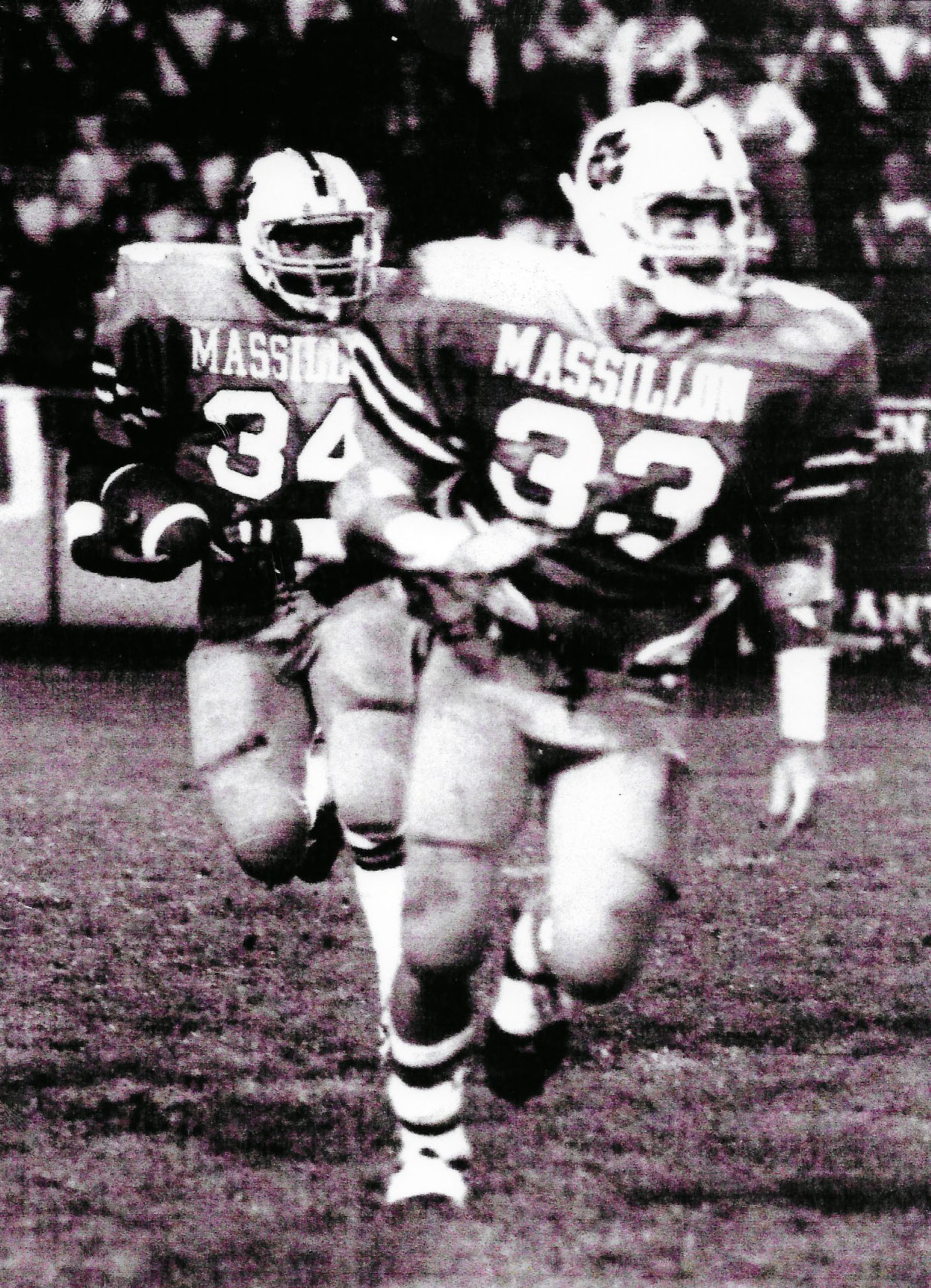
For the season, Spielman rushed for 459 yards and scored 8 touchdowns, while teaming with All-Ohio running back and state champion track speedster Craig Johnson (No. 34 in photo above). He also caught 10 passes for 151 yards and 3 TDs. On defense, he recorded 112 tackles, 6 pass interceptions that he returned for 126 yards and recovered two fumbles. Again, he returned punts, this time 17 of them for 245 yards.
Unfortunately, playoff hopes were squashed when Massillon (9-1) suffered an early-season loss to Akron Garfield, 14-10. The Golden Rams were led by Charles Gladman (U. Pittsburgh), who was named Ohio Back of the Year. Garfield advanced in the playoffs that year to the state finals, but lost to Cincinnati Princeton.
Chris finished his football career at Massillon with single season records for tackle points and unassisted tackles. The following summer he participated in the Ohio High School All-Star Football Game. But his time on the field was cut short with a sprained ankle, which would hamper him at the next level.
Spielman credits Steve Studer and his tortuous workouts for giving him a great start to his football career, preparing him to play with great physicality. “I’m 15, I’m not even driving yet,” he recalled. “I’m walking by his house every Saturday night, trying to get up the nerve to go in there and ask him if he would teach me. Finally, I did. He took me in. He taught me. If it weren’t for him, I wouldn’t be where I am today.” – Massillon Memories, by Scott Shook.
A 3-sport athlete, Spielman played basketball and earned All-County honors in that sport. He also participated on the track team, where he placed in the shot put at the state meet.
Chris relished his time playing for the Tigers. “Every time I tell someone I played at Massillon a feeling of pride comes over me.” – Massillon Memories, by Scott Shook.
Recruiting – High on Spielman’s list of colleges were, in order, Michigan, Ohio State and Miami of Florida. The Buckeyes, under head coach Earle Bruce, recruited him hard, with Bruce even bringing his squad to Massillon for a preseason scrimmage and Ohio Governor Richard Celeste getting in on the action. Dozens of OSU boosters would flock to any airport Chris flew into to add their support. But he still leaned toward Michigan. Until, that is, his father intervened and pushed him the other way. So, it was Ohio State.
College
Freshman year (1984) – Spielman was slated to be the starting inside linebacker for the opening game against Oregon State. Only, just prior to the game, he reinjured the bad ankle and was forced to the bench. But that didn’t stop him from pacing the sidelines and nagging Bruce to put him in. So, he got the call in the fourth quarter and on his first play he broke through the line and sacked the quarterback. He ended up playing just shy of ten minutes in that game, but recorded ten tackles and was named Defensive Player of the Game. For the remainder of the season he would play on and off as the ankle would permit. The Buckeyes finished with a record of 9-3, losing to USC 20-17 in the Rose Bowl. But they did win the Big Ten championship.
Sophomore year (1985) – As a starting linebacker, he recorded 140 tackles, 9 tackles for loss and three pass interceptions. He was also named All-Big Ten. His team posted a 10-2 record and repeated as Big Ten champions. Then they defeated BYU 10-7 in the Florida Citris Bowl.
(Eleven Warriors photo)
Junior year (1986) – Chris had another good year, with a team-high 205 total tackles, 9 tackles for loss and 6 pass interceptions. He also tied a school record with 29 tackles against Michigan. After the season, he was named All-Big Ten and First Team All-American by Associated Press, Kodak, Football Writers Association, Sporting News and Football News. He was also a finalist for the Lombardi Award and the Butkus Award. Earle Bruce called him, “the most intense player I have ever seen.” The Buckeyes finished with a record of 10-3, losing to Michigan 26-24, while tying the Wolverines in the standings for conference first. In the Cotton Bowl, they defeated Texas A&M 28-12, with Spielman returning a pass interception 29 yards for a touchdown and being named Top Defensive Player of the Game.
Senior year (1987) – Chris wrapped up his career at Ohio State as expected, with a team-high 234 tackles, 10 tackles for loss, 4 quarterback sacks, 3 forced fumbles and 4 pass interceptions. He was a team captain. He was named the team’s Most Valuable Performer. He was named All-Big Ten. He was named All-American. He won the Lombardi Award. And he left with a school record of 283 career solo tackles. However, the Buckeyes finished 6-4-1 and did not receive a bowl bid. Thus, Spielman’s sensational career at Ohio State had come to an end. As had Earle Bruce’s.
In 2000 Spielman was inducted into the Ohio State Hall of Fame and in 2009 he was inducted into the College Football Hall of Fame.
Professional
The Detroit Lions selected Chris Spielman in the second round as the 19th pick overall of the 1988 NFL draft. Spielman would spend the next eight years in Detroit as the starting linebacker, under had coach Wayne Fontes. In his first year, he was named NFC Rookie of the Year. Four times during his time at Detroit he was selected to play in the Pro Bowl and twice he was named the team’s defensive MVP. And he was All-Pro twice.
Detroit had four playoff appearances during his 8-year span, with best one in 1991, when they finished 13-5 and advanced to the NFC championship game against the Washington Redskins. Spielman finished with the Lions as the all-time leading tackler with 1,138 stops. He also led the NFL with 195 total tackles in 1994. The Lions later recognized his achievements by adding him to the stadium’s Ring of Honor
In 1996 Spielman signed with Buffalo and played for two seasons. But he heroically walked away from the game when his wife, Stephanie, was diagnosed with breast cancer. Two years later, with the disease under control, Chris connected with the Cleveland Browns. Only, a neck injury in an exhibition game led to a permanent retirement.
For his NFL career, Spielman finished with the following statistics:
148 games
148 starts
985 solos, 378 assists
11 sacks
12 forced fumbles
19 fumble recoveries (1 TD)
6 pass interceptions
Post-Football
Tragedy struck in 1998 when his wife Stephanie died at the young age of 42, leaving behind four children. Prior to that, the pair managed to raise millions of dollars for Ohio State’s James Cancer Hospital. Their story is documented in a book he co-authored, titled, “That’s Why I’m Here.”
The following year Spielman began a career as a TV color commentor for college and professional games, working alternately for Fox, ESPN and Lions Preseason TV and spending nearly twenty years in that capacity.
In 2009 Chris tried his hand at coaching, assuming the head position with the Arena Football League’s Columbus Destroyers. However, a 2-15 record made that stint short-lived.
Finally, in 2020, he landed his current position, special assistant to Detroit Lions chairman and president and CEO.
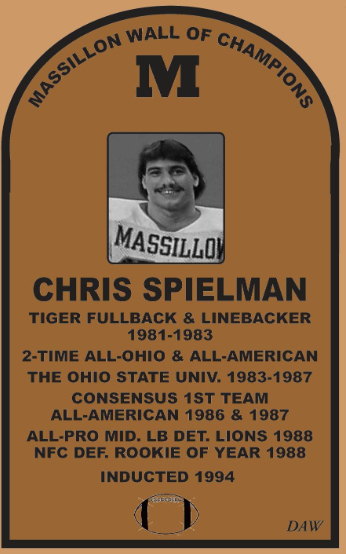
In 1994 Spielman was inducted into the Wall of Champions. In 2016 he was inducted into the Massillon Football Hall of Fame.
“With an overflow crowd of 15,000 spectators looking on, the Washington high school Tigers … opened their fine new football plant with a 40-13 triumph over a plucky Cathedral Latin high school team of Cleveland.” Those were the words of legendary sportswriter Luther Emery as he opened his story that covered the first game of the 1939 football season. It ever in the new Tiger Stadium and a capacity crowd was on hand to witness the event. Glowingly, it was far cry from the paltry crowds of just a few decades before.
Tiger Stadium would grow in size a few years later in order to accommodate crowds of nearly 20,000 each and every week. But the circus-like spectacle would not last. For various reasons, the average season attendance at Massillon games would slowly but steadily decline from then on to the present day.
Throughout its long history Massillon has played home games at eight different fields and the capacity limits of these venues have certainly had an influence on the number of fans that could attend. While most of the early fields had a small number of portable bleachers, the capacity increased exponentially when Massillon Field with 6,500 seats and then Tiger Stadium were built. A complimentary influence on crowd size was the instant success that the team achieved when Paul Brown became the coach. Suddenly, patrons were flocking to the games in droves. Thus, the need for a larger stadium.
Part 7 of the series takes a look back at the attendance at some of Massillon’s early games and then the seasonal averages from 1940 and on. It also presents the trends associated with the attendance at Massillon-McKinley games after Tiger Stadium and Canton’s Fawcett Stadium were opened.
The Early Years (1891-1923)
The first time the local media recorded the attendance for a Massillon home game was in 1894 when 200 fans attended a match against Canton Central, later to be named Canton McKinley. The contest was most likely played either on a Saturday or Friday afternoon, since there were no stadium lights at that time. And perhaps most of the attendees were high school students.
By 1908, 1,000 fans were in the North Street Field stadium to watch the Tigers defeat Alliance, 64-0. The following year, when Massillon captured its first state title, it was a throng of 2,000 patrons that witnessed a 9-0 win over Oberlin Academy, with everyone returning the following week to enjoy a 21-5 victory over New Philadelphia.
Home attendance continued to increase thereafter, particularly when the team played at Jones Field on Pearl Street. A crowd of 3,000 attended the 1920 Toledo Scott game, 6,000 were at the 1922 Cleveland Shaw game and 8,000 showed up for the 1924 game against McKinley. Suddenly, it was time for a bigger stadium.
Meanwhile, Tiger road games also saw an explosion in attendance numbers: 9,500 at the 1925 Canton McKinley game, 10,000 at the 1932 Alliance game, 10,000 at the 1933 McKinley game and 12,000 at the 1935 McKinley game.
Massillon Field (1924-38)
In 1924 Massillon opened a new stadium, one with permanent seating and a capacity of 6,500. It also had lights to accommodate night games. On occasion, additional portable seating would be brought in for a major opponent that boosted the capacity to 8,000 or more. But by 1935, when Brown was coach, the average home attendance swelled well above the 6,500 seat capacity. And in 1938, the last year of Massillon Field, the average home attendance was a whopping 11,500, with 18,000 squeezing in for the game against McKinley. Fortunately, by then, construction a new stadium was well underway.
The Tigers would leave Massillon Field with a home record of 71-16-4. Brown’s mark there was 41-4-2.
Paul Brown Tiger Stadium (1939 to present)
Tiger Stadium, later named after Paul Brown, opened in 1939 with a seating capacity of 14,000. It would soon be increased, including temporary sideline and end zone seats, to 22,500. Now Massillon had a stadium large enough to accommodate any football crowd. After some eighty years of use, Massillon’s current record there sits at 526-90-6.
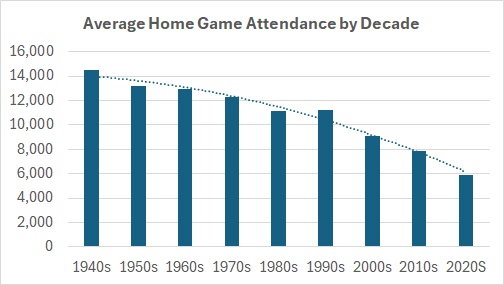
Home attendance was immediately impacted in that 1939 season with an average attendance of 13,200. The following year, owing to a home game against McKinley, the average was 17,450, a number that has stood since as an all-time record. Below is a chart of the average home attendance by decade from 1940 to the present.
In the decade of the 1940s, the average home attendance was 14,476. But that number has steadily declined over time and now stands at 5,901, although perhaps still higher than any other school in the state. There are perhaps several reasons for this trend:
Advent oftelevision – TV was not prevalent throughout households in the 1940s, so high school football was akin to the circus coming to town and most city residents flocked to local stadiums for an evening’s entertainment. Massillon was no different. This was especially true with the tremendous program left in place by Coach Paul Brown, who departed in 1941 for Ohio State. Although Massillon’s high level of success has continued into the present day, the attendance has not kept pace. In the 1950s televisions found their way into American homes, and even in Massillon the phenomenon created competition for high school football on Friday nights. The impact was felt again in the mid-1960s when Massillon Cable TV was introduced and it began airing delayed broadcasts of the games.
Opening of schools adjacent to Massillon – In the 1940s Massillon students resided not only in Massillon proper, but also in areas surrounding the city. However, in 1956 Perry High School was opened, followed shortly thereafter by Jackson and Tuslaw. Over time, all served to shrink the total area from which Massillon High School drew both students and sports fans.
Dissolution of the All-American Conference – In 1963 a league consisting of some of the top teams in Ohio (Massillon, Canton McKinley, Warren Harding and Niles) was formed. The addition of Steubenville in 1966 and Alliance in 1969 only made the league more prominent. Games against these rivals created tremendous fan interest and provided some of the most competitive and highly-attended games in the state. Because of this, attendance at Massillon games remained fairly steady during the 1960s and 1970s. But by the late 1970s, Niles, Steubenville and Alliance could not maintain competitiveness due to declining enrollment as a result of the steel mills closing and the All-American Conference played its final games in 1979. This consequence brought an immediate drop in fan attendance as league games one by one vacated the schedule.
Declining enrollment – The 1980s also saw Massillon’s enrollment begin a steady decline, now leveling off at about 30% less. Although having modest impact on attendance, there are now somewhat less students and associated parents attending the games.
Recession – The early 2000s brought the onset of an economic recession, which impacted the job prospects and incomes of many workers in Massillon. There was an obvious need for families to trim their household budgets and football tickets may have been one of the first items to go. The result was the largest decline in attendance, from 11,229 in the 1990s to 9,125 in the 2000s, or a reduction of 19%.
Aging Fans – Many fans in the 1940s, 50s and 60s were captivated by the success of the football team and continued to remain loyal to the program for many years thereafter, always hopeful of yet another state championship. However, there comes a time when a person is just too old to attend the games. Fans that were in their 20s during the 1940s are now aging out. To maintain the attendance level their losses needed to be recouped by younger fans. Unfortunately, young fans in the 1970s and beyond did not get to experience those championship years and are not as prone to embrace the football program and purchase tickets after graduation.
Games Against Canton McKinley
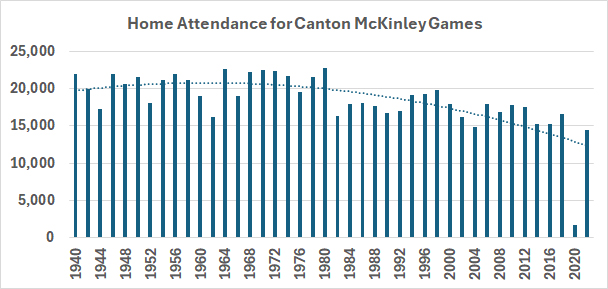
The attendance for the McKinley games has also seen a reduction, although of a different sort. Rather than a constant decline, there was a step change for home games beginning in 1982. From 1940 to 1980, the average attendance was 20,752. Afterwards, it has been 17,146 (not including the Covid year of 2020), or a decline of 17%. In addition, last year’s attendance of 14,474 was the lowest home attendance for this game since 1926 (not counting the Covid year).
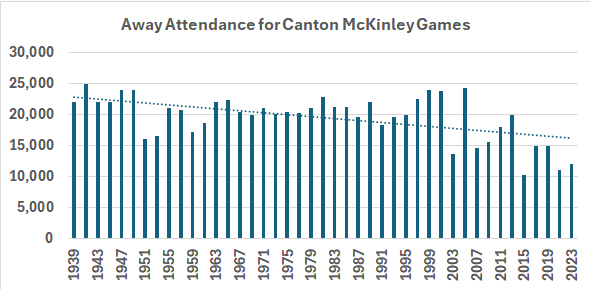
In case you were wondering about games in Canton, there was a similar step change, but theirs did not occur until 2007. From 1939 to 2005, the average was 20,883. Since then, it has been 14,610, or a decline of a whopping 30%. Also, the attendance of 2023 was 42% below the prior number.
Best Attended Home Games
It’s no secret that the best attended games are those against McKinley. Over the past thirty years these contests have drawn on average over 16,000 fans. Next up are the games against the large parochial schools, followed by the season openers. For the openers, it’s the anticipation of a new season and the weather is warm. And of late the competition has been high-caliber. Below are the 30-year averages for various categories:
17,200 – Canton McKinley
12,351 – Large Parochial Schools
10,075 – Season Opener
9,388 – Rival Public Schools
8,432 – Mid-size Parochial Schools
8,231 – Non-rival Public Schools
8,777 – Out-of-state
8,352 – Playoffs
Attendance Records
The home record for attendance was set in 1964 when 22,685 fans attended the game against McKinley. The Tigers won that one 20-14. Just behind are the 1972 game, which drew 22,371, and the 1968 game, which drew 22,305, followed by four games in which the estimated crowd was 22,000.
On the road, the Number One attended game was against Cleveland Cathedral Latin in 1945, which was held at Cleveland Municipal Stadium. The final score was 6-6. Here are the Top 5:
51,409 – 1945 – Cleveland Municipal Stadium – Cleveland Cathedral Latin
The average seasonal attendance at Massillon home games has declined steadily over the past eighty years for a number of reasons. But that does not deter a sizeable number of Tiger fans from still attending the games. For Massillon continues to outdraw every other school in Ohio. Nevertheless, there still seems to be a measurable decline as of late in attendance for the McKinley game. But this may have been influenced more by Canton’s declining support of the game than by Massillon’s, as evidenced by the 2023 game in Canton in which the Tigers outdrew the Bulldogs in their own stadium.
At times the attendance, and particularly season ticket sales, has seen a bump the following year when the Tigers win a championship or even when they advance in the playoffs to the state finals. It will be interesting this year to see how it plays out with Massillon fresh off of a Division II state championship.




 Covington Catholic, KY (1990) – Won 39-14 – It was played in Cincinnati as part of the Buddy LaRosa Classic. The Tigers controlled the game from start to finish as Falando Ashcraft carried the ball 28 times for 190 yards a touchdown.
 Walsh Jesuit (1989) – Won 42-24 in the playoffs – Massillon was down 24-6 at the half, only to score 36 unanswered points after the break. Lamonte Dixon rushed 10 times for 181 yards and a touchdown.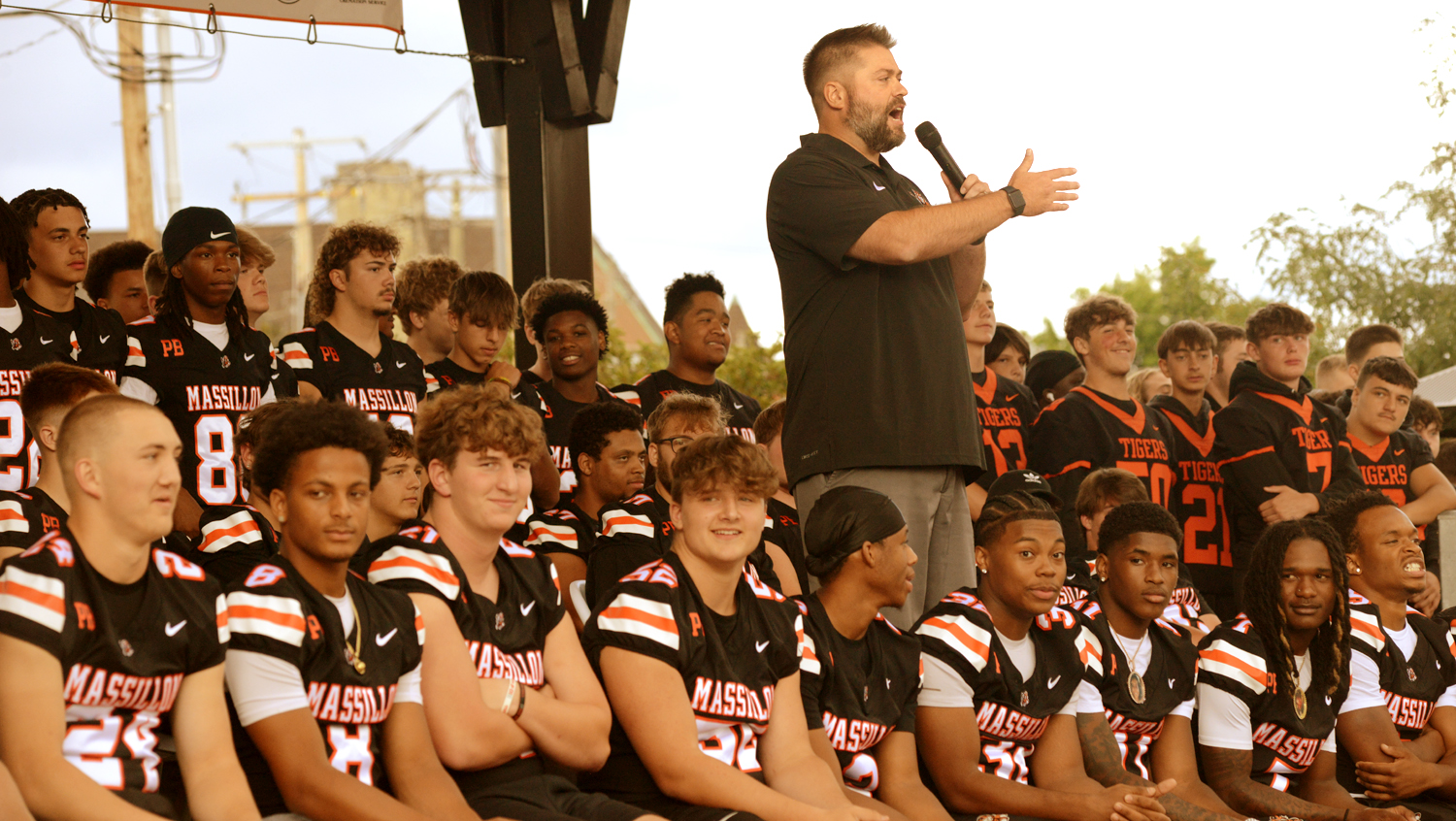



 The team finished with a record of 12-1, while coming up short in the playoff state finals to Cincinnati Moeller. “We were a great football team in 1982,” Spielman said. “We were 12-1, got beat by Cincinnati Moeller. We were outmatched, when they were getting kids from three different states and all over Cincinnati. Like they were, it was very tough to compete against them. Any other school in the state or the nation, I believe, we would have beaten them handily. I think that was one of Massillon’s finest teams.” – Massillon Memories, by Scott Shook.
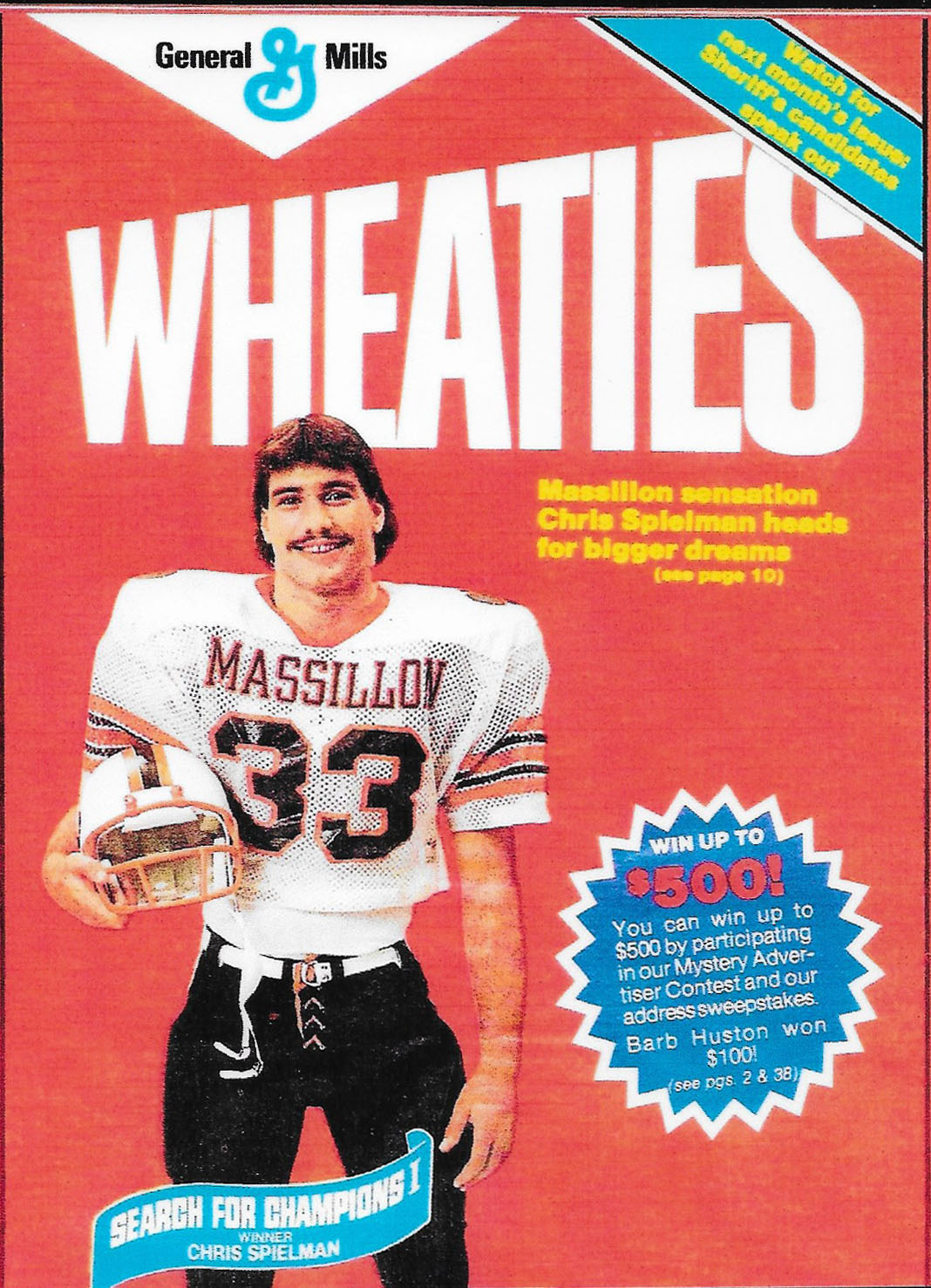 “Being on the Wheaties box was great – but it was also very difficult for a 17-year-old kid,” said Spielman. “Over night I became a role model for a lot of kids. It was the first time I had people start staring at me, recognizing me. It made me feel funny. I became very self-conscious. You feel like you have to live up to their standard. I was just trying to hang out with my buddies. I was visiting sick kids in the hospital. And that was great. If I could make a kid who was sick feel better, or get better, I certainly didn’t mind doing that. But at 17, I wasn’t prepared for it. Every time I was in public I felt like I had to live up to ‘the boy that was on the Wheaties box.’ I was afraid to be myself.” – Massillon Memories, by Scott Shook.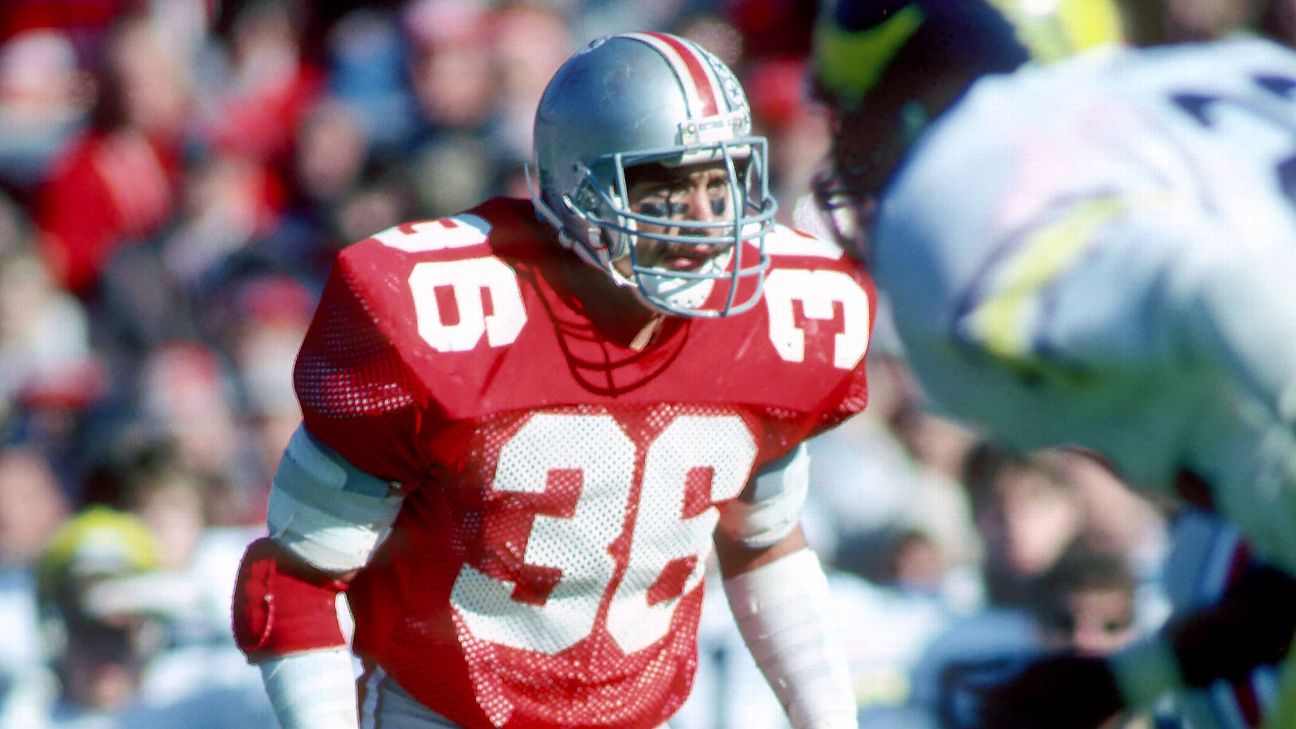
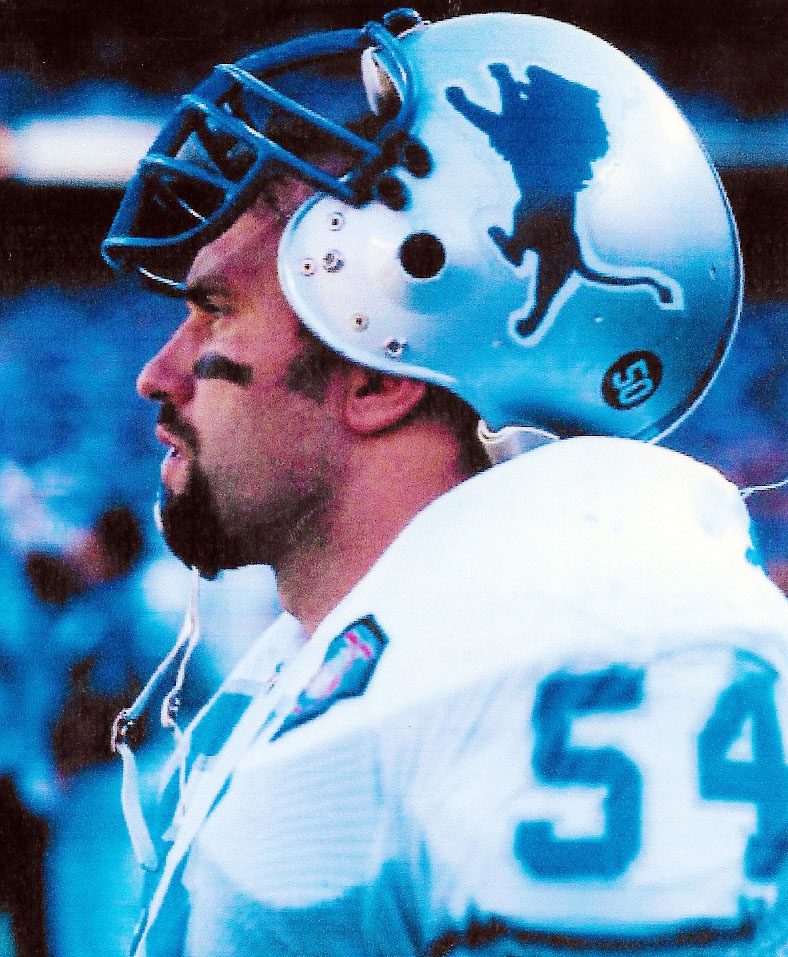 Detroit had four playoff appearances during his 8-year span, with best one in 1991, when they finished 13-5 and advanced to the NFC championship game against the Washington Redskins. Spielman finished with the Lions as the all-time leading tackler with 1,138 stops. He also led the NFL with 195 total tackles in 1994. The Lions later recognized his achievements by adding him to the stadium’s Ring of Honor