Steve Studer – Wall of Champions
Simply put, Steve Studer is a Massillon legend. Very few other players, coaches or contributors have earned the respect that he has for his contributions to the Massillon football program. He fully grasped the concept of the Massillon tradition and embraced passions for the many activities he did throughout his life. But largely, he served many young Tigers as both an exceptional athletic trainer and a close personal mentor. But as fate would have it, he left us too soon. Fortunately, his influence on the program has remained.
 Numerous legacy families have come through the Massillon system during its long history and the Studer family was no exception. Junie and his wife Delores were long-time supporters of the football program, with the two of them founding the Studer Library of Football History. Junie also served as Booster Club President in 1972. In 2016 the pair were inducted into the Massillon Football Hall of Fame.
They raised two sons: Steve and Joe. Steve played center for the Tigers from 1969-71 and Joe played center in 1972-74, earning All-Ohio honors his senior year. Both went on to become involved in high school sports, Steve as a Massillon strength and conditioning coach and Joe as a football coach at several schools. And both were subsequently inducted into the Tiger HOF. Finally, Steve’s two sons, Dan and Joey, each suited up for the Tigers and wore Number 55, like their father. Dan played in 1997-99 and is the current Massillon strength and conditioning coach, while Joey played in 2007-09 and is a Massillon assistant coach.
Steve Studer, affectionally known as “Stu” to everyone in the Massillon sports community, was born on February 4, 1953. Growing up, he always had a fondness for football. “I singled out Ben Bradley, he was my hero. I’d go to the games with my dad. I had this old pair of binoculars. I’d sit up there and focus in on Ben Bradley the whole game. As a little, kid, I remember telling my dad, ‘I want to play center for the Massillon Tigers.’ That’s because Ben Bradley was my idol.” – Massillon Memories, Scott H. Shook.
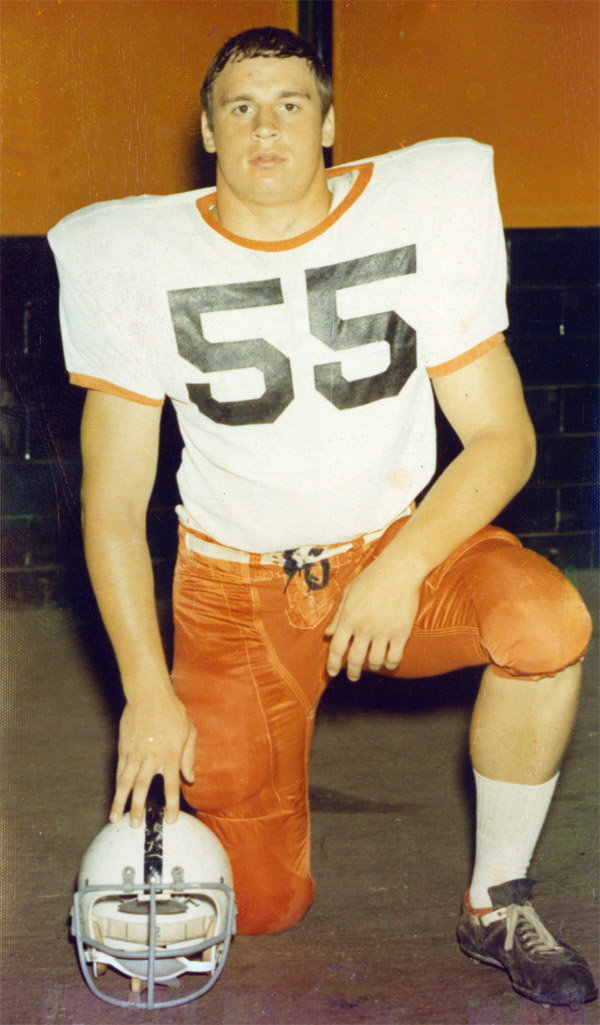 He would get his chance to become a varsity starter in 1970 as a junior on a team comprised of mostly seniors. And what a start it was. Playing under head coach Bob Commings as a 5’-11”, 200 lb. center, the Tigers fashioned a perfect 10-0 record and were never seriously challenged in any game. In fact, they outscored their opponents by an average margin of 41-3, while rushing for 277 yards per game.
In his senior year, now at 5’-11”, 215 lb., he played on a Massillon team that finished 8-2, with two 1-point losses, to 7-2-1 Niles McKinley and 10-0 state champion Warren Harding. The team rushed for 288 yards per game (9th all-time) and outscored the opposition by an average of 30-3. Following the season, Studer was named All-American center by both Letterman Magazine and Gillette. He also participated in the Ohio North-South All-Star game.
Aside from football, he was captain of the wrestling team and earned three letters, while winning a sectional championship during his senior year.
His next stop was Bowling Green to continue his football career, choosing the Falcons over interest from Ohio State and Miami of Ohio. His four years were as follows:
- Freshman (1972) – Played center at 6’-1”, 218 lbs. 5th on the depth chart. One of two freshmen to earn a letter, assuming the duties as short snapper for kicks and long snapper for punts. Of course, his jersey number was “55.” The team finished 6-3-1.
- Sophomore (1973) – Played center at 6’-0”, 223 lbs. 2nd on the depth chart. The team finished 7-3.
- Junior (1974) – Starting center, playing at 6’-0”, 224 lbs. 2nd Team All-MAC. The team finished 6-4-1. Coach Don Nehlen’s pre-season evaluation – “Steve could develop into the best center in the MAC. e is a good blocker and has great upper body strength.”
- Senior (1975) – Starting center, playing at 6’-0”, 240 lbs. Co-captain along with Art Thompson (Massillon). Joined on the team by brother Joe, who was a freshman center. 1st Team All-MAC and A.P. and Parade Magazine Honorable Mention All-American. 1976 East-West Shrine Classic. The team finished 8-3. Coach’s comment – “One of the best centers in the Midwest who is very underrated in agility and quickness because of his great strength. A very good one-on-one blocker.”
After Bowling Green, Studer had a try-out with the Chicago Bears, but failed to make the team. So he returned to Massillon and in 1985 landed a position as both strength and conditioning coach and physical education instructor.
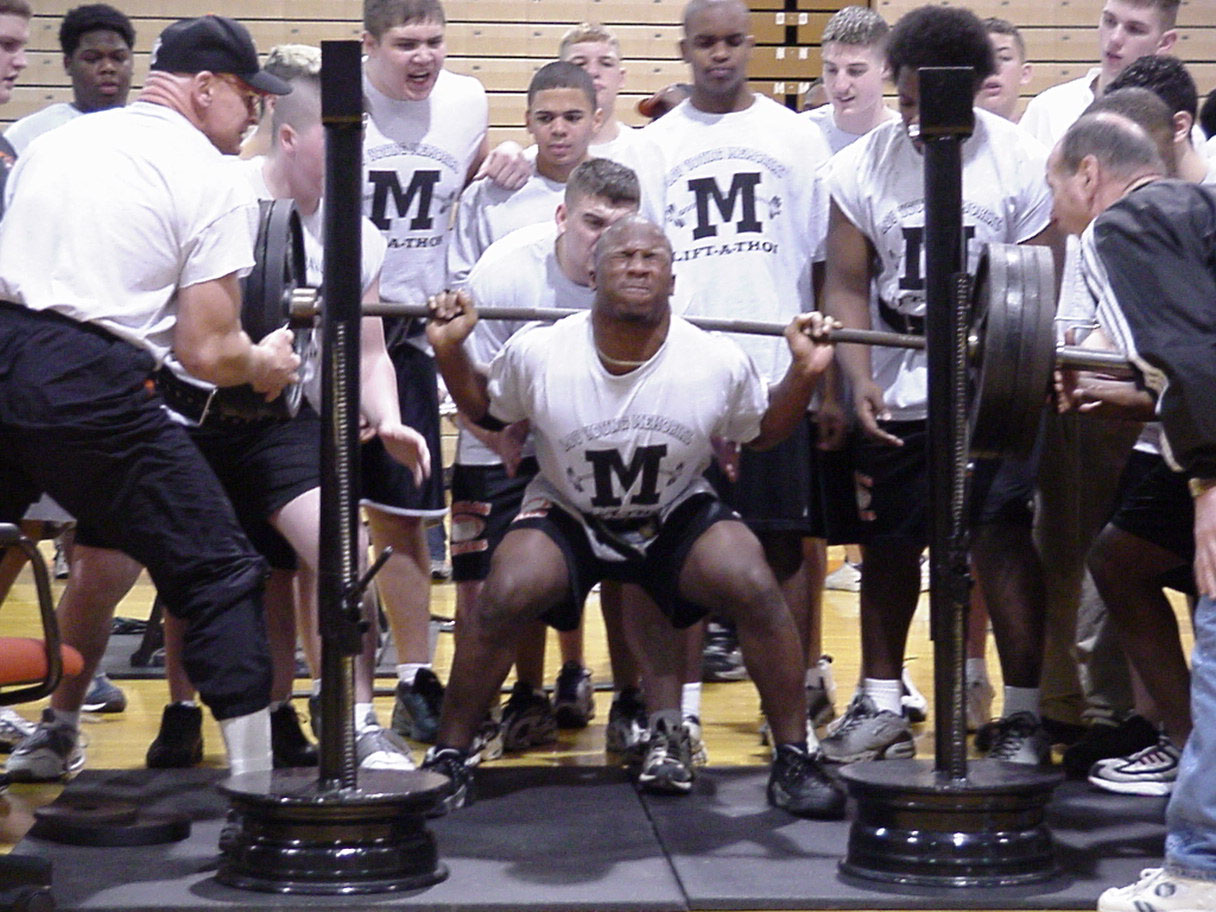 His pride and joy was the weight room that he established at Massillon and the strength program he instituted, which is still in place today. “Our weight room is 55’ by 70’,” said Studer. “It’s the same size as the weight room we had at the old high school. When we built the new high school we patterned it after the old one. It pretty much consists of free weights. We really compare the weight room to a lot of Division 1 colleges. There’s going to be your Tennessees, your Nebraskas and your Michigan where they have a better facility than this. I would compare this to any MAC school. Our core lifts are the squat, the clean, the bench press, and the dead lift. The machines that we have in the weight room are pretty much hammer-strength machines and it’s all top-of-the-line equipment. It’s the same equipment that they use at Michigan, Notre Dame and a lot of the NFL teams.” Studer also formed a powerlifting team in 1994 and the Tigers won the state championship in 1996.
An Interview with Steve Studer
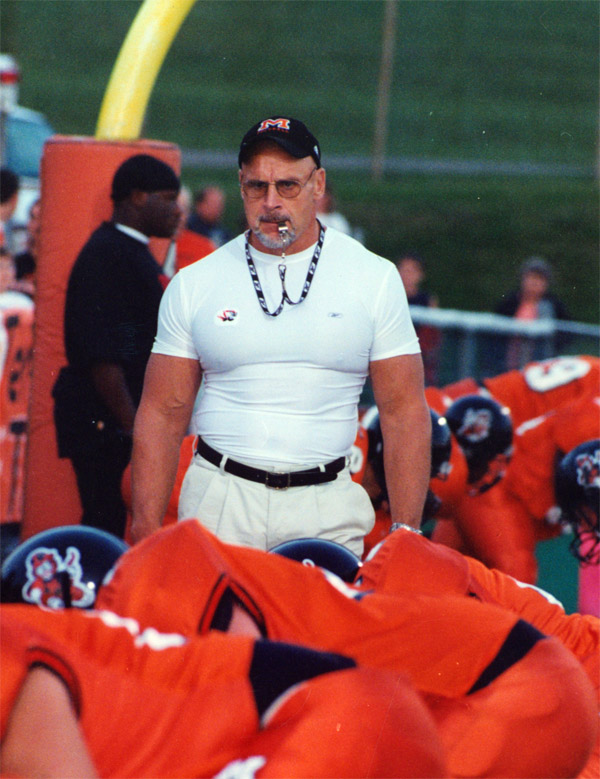 “He was a true Tiger,” said Jack Rose, who as head coach of the Tigers from 1992-97 worked with Studer. “If you ask someone what is a Massillon Tiger, their answer would be Studer. He loved training kids, helping make them stronger for football. He had a great rapport with the players.” – Dave Hutton, Masssillon Independent.
“A lot of what the program is about begins and ends in the weight room,” said former head coach Rick Shepas. “Stu has been probably more valuable than any coach who has ever been there.” – Todd Porter, Massillon Independent.
“I don’t know if there has been a coach who has had more impact on those Massillon kids than Steve,” said Rose. “He epitomized what a Massillon Tiger was. The kids loved him. He taught them how to work hard, how to set goals. He was just a special person.” – Todd Porter, Massillon Independent.
“A lot of the things he taught us and instilled in us, not only football and weightlifting, was about being a good person and the approach you take to be the best you can be,” said former player Rick Spielman. “Along with my parents, he’s one of the most influential people in my life.” – Todd Porter, Massillon Independent.
 “Playing for him, and being around him, you were just afraid to fail for him,” said Craig McConnell, a former captain for Washington’s football team. “You were afraid to work in his weight room and not to exceed. You had that much respect for him. Everything was Massillon to him – this tow, this program, this school. He was what everyone in this city wanted to be.” – Elbert Starks III, Akron Beacon Journal.
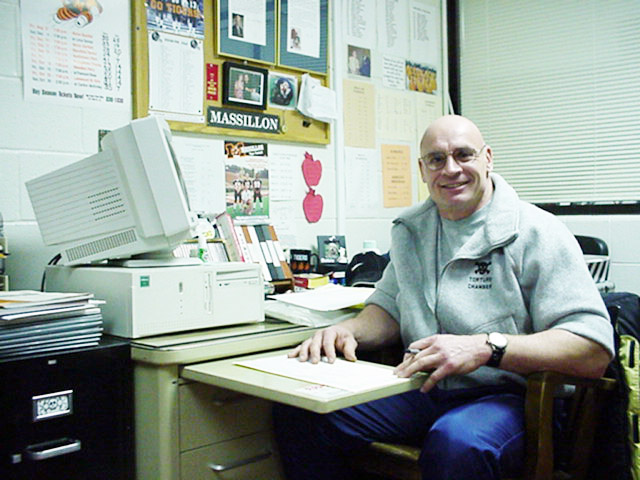
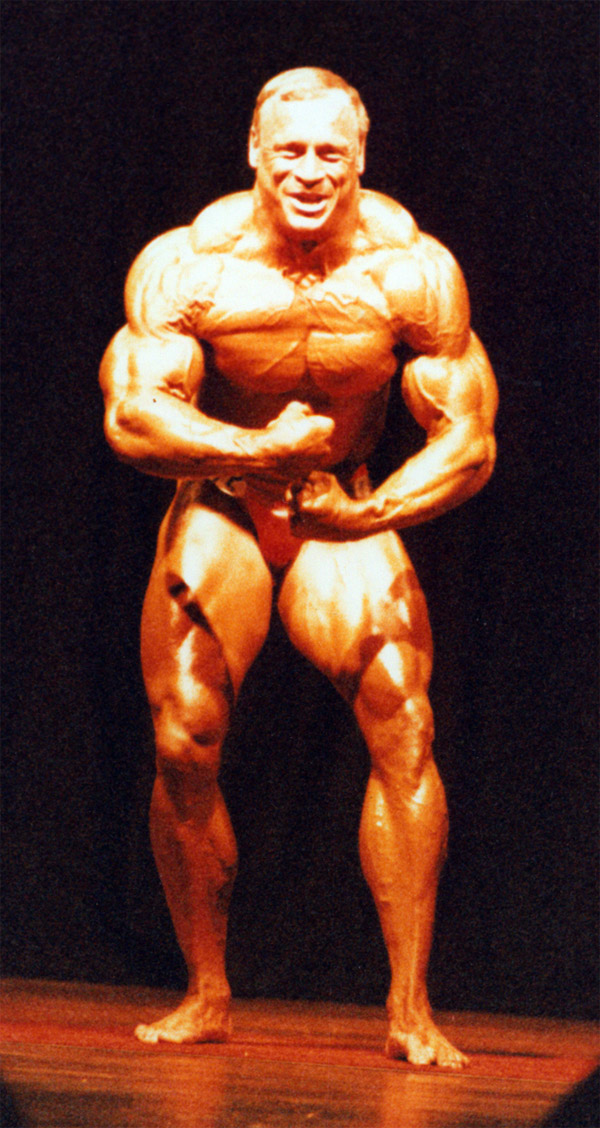
Even outside of his career as a high school coach, he pursued personal weight training, participating in drug-free power lifting, where he became a state champion in 1988. Then, there was the “Torture Chamber”, where he trained many college and professional athletes, including Chris Spielman. “I’m 15, I’m not even driving yet, I’m walking by his house every Saturday night, trying to get up the nerve to go in there and ask him if he would teach me. Finally, I did. He took me in. He taught me. If it weren’t for him, I wouldn’t be where I am today.” – Chris Spielman on Steve Studer – Massillon Memories, Scott H. Shook.
Aside from sports, the Bowling Green art major was heavily involved as a graphic artist and sign painter in his father’s business, Studer Sign Company, and also the original Tiger Store.
But this extraordinary man died suddenly on February 9, 2004, at the young age of 51 following a heavy workout in the WHS weight room. Fortunately for everyone who follows, his high school weight training program lives on, now managed by his son, Dan.
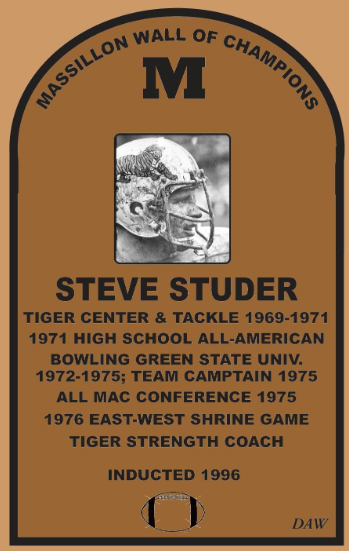
In 1996, Steve Studer was inducted into the Massillon Wall of Champions. And his jersey number, “55”, has been retired; the only number retired by the Tigers, as a tribute to the respect shown by the community to “Stu.”
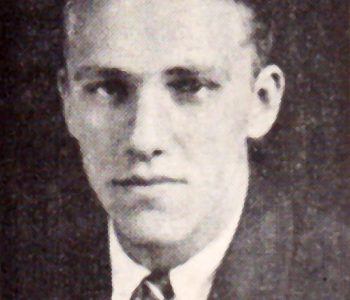
 Pflug was born in Massillon on October 4, 1905, and had the opportunity to play high school ball throughout his entire Tiger career under legendary Coach Dave Stewart.
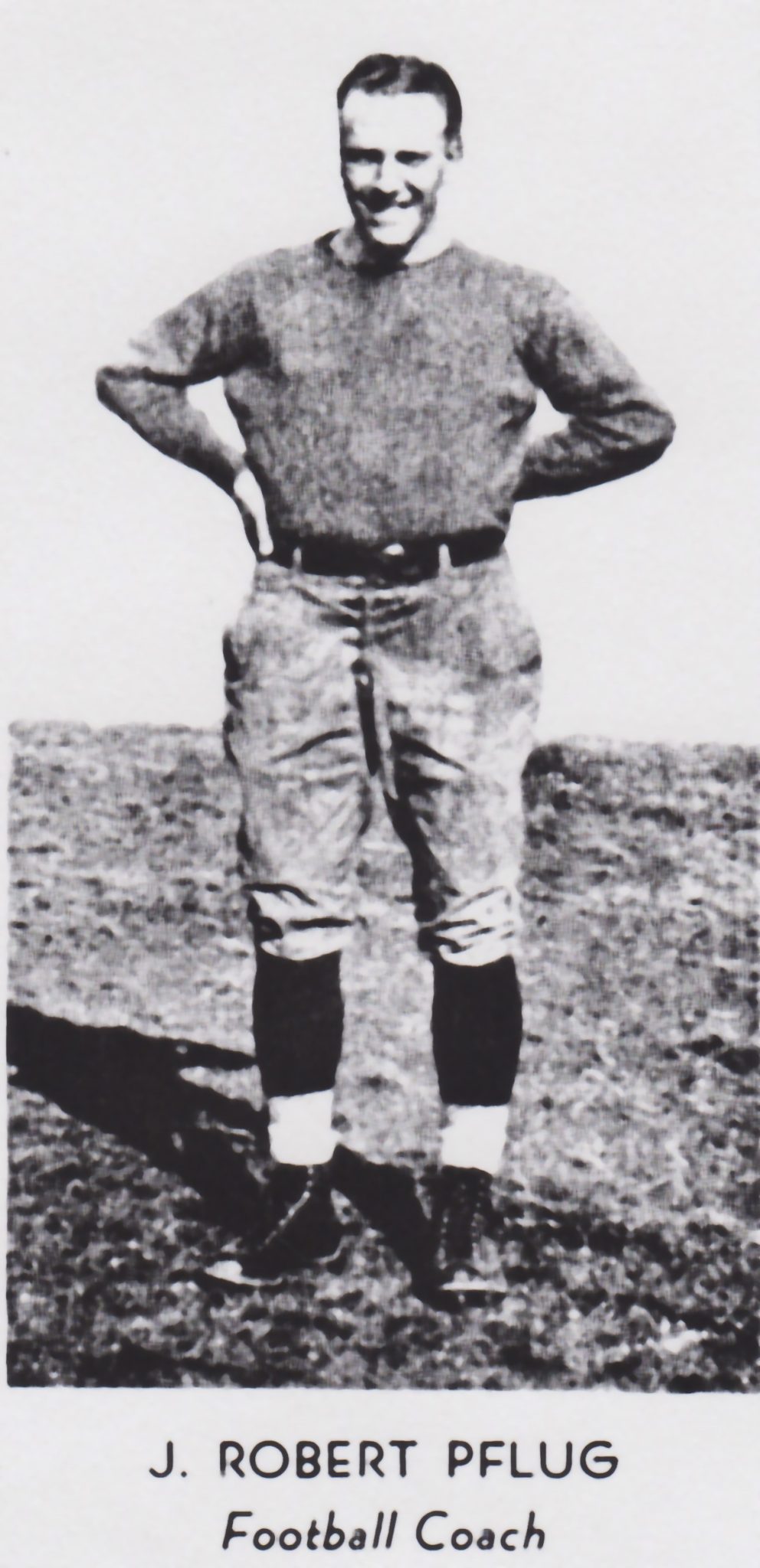 His first stop as a coach was at Knox High School in Pennsylvania from 1928-31, where he compiled a record of 20-10-1. After that came Bradford High School from 1932-50, which he left with a remarkable record of 126-29-5. Seven times his team was undefeated. He had a 31-game unbeaten streak (1933-36) and a 25-game unbeaten streak (1937-40) overlapping the great years of Massillon’s Paul Brown. But unfortunately, the two teams never met. He departed Pennsylvania as the winningest all-coach in the Big 30, which included teams in northern Pennsylvania and southern New York. In 1968, Bradford named their football stadium J. Robert Pflug Field.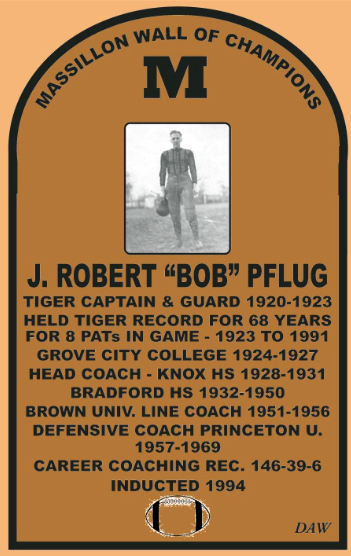
 The McKinley game was special to James. “You know, the week of the game there’s not a helluva lot on anybody’s mind but the [Massillon-McKinley] game,” he said. “So much is brought up about the tradition and history and former games and former players – and there’s a little hatred mixed in there – competitive hatred. You don’t want to lose to these guys if you lose to anybody. I would compare McKinley Week to, as a coach out at Washington, getting ready to play USC or the Rose Bowl or the Orange Bowl – not just any Bowl – one of the big ones, here there’s so much on the line and so much visibility involved.” – Massillon Memories, Scott H. Shook, 1998.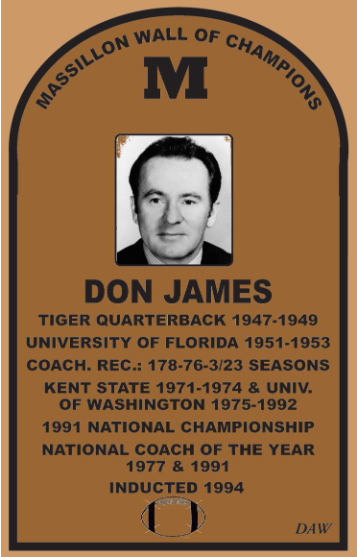

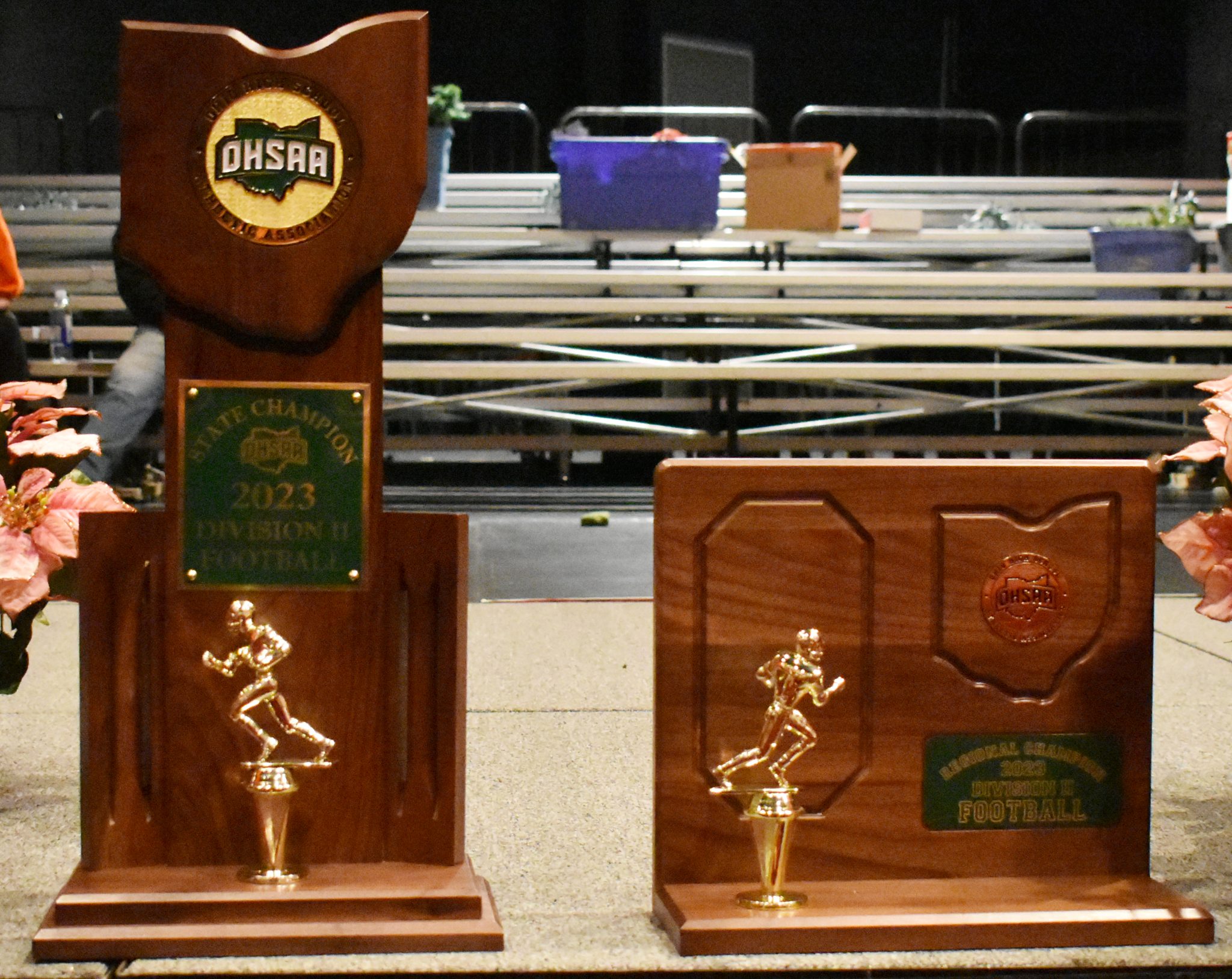 What a great season it was. Division II state champions. Perfect 16-0 season. Defeating the Division I state champion for the second consecutive year. Besting the team having the most wins in the country. The national rankings. And on and on. Here is a recap of a season to remember and one that all future teams will surely be measured against.



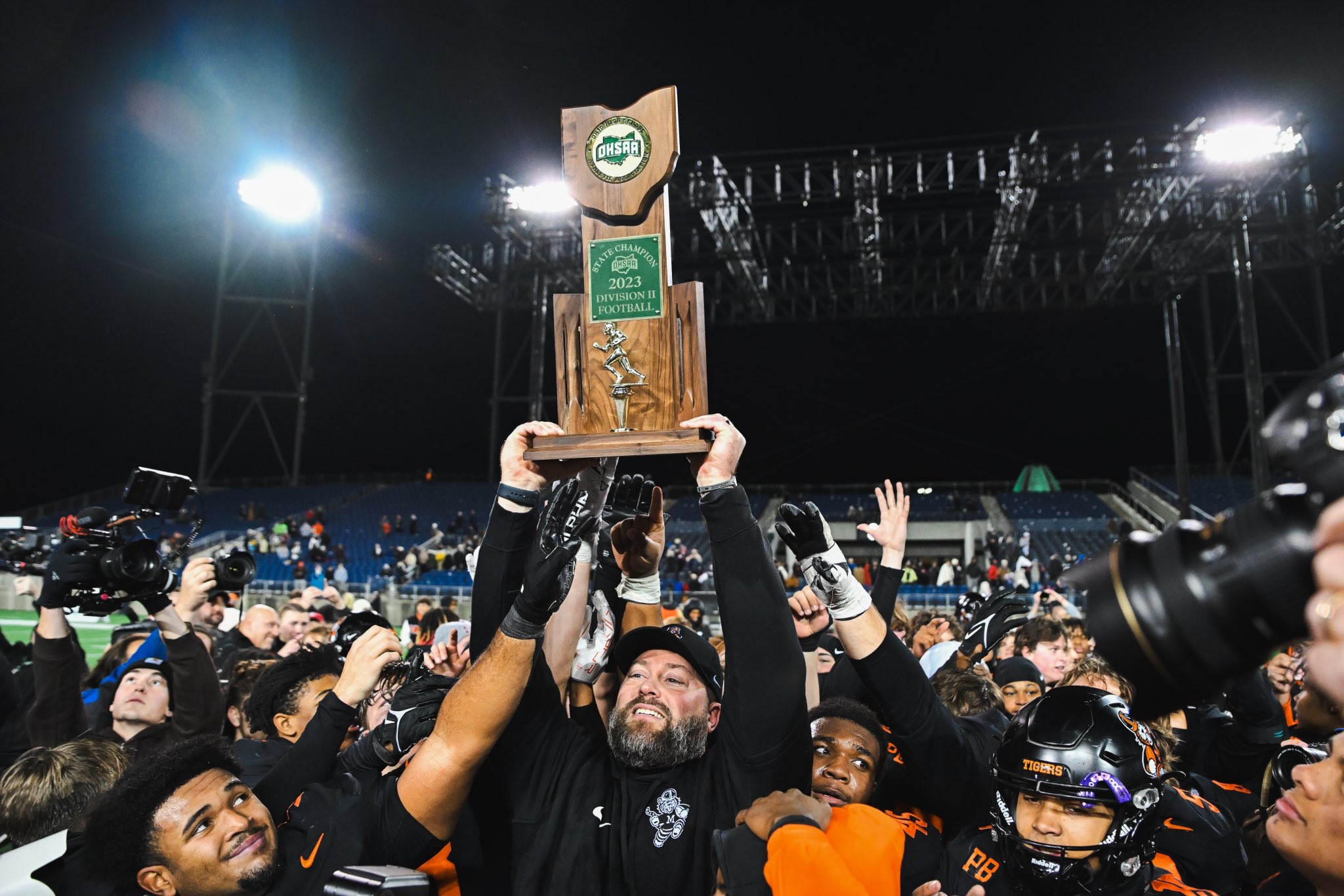 Akron Hoban game (state finals) – It was two great high school defenses battling it out in front of a near-capacity crowd (fifth largest in a Division II finals) at Tom Benson Stadium, with each team held below 200 yards of offense. Massillon tallied in the second quarter on a 6-yard run by Mylen Lenix, only to surrender a safety later in the period. The Knights, however, although stymied throughout most of the game, were in position to take the lead late in the fourth quarter, following a failed fake Tiger punt near midfield. An errant 3rd down snap led to a 4th and 8 at the 17, setting up a Hoban pass into the end zone for the win. But Pringle closed on the intended receiver and reached him just in time to break up the pass, securing both the game and the state title. Pringle had returned from injury for this game and led both teams with 14 tackles and 3.0 tackles-for-loss. The title was No. 25 for Massillon and the first in the playoff era. Following the game Tiger fans welcomed the team back to town with a rousing celebration. A parade with fireworks was held the following week as a formal salute. And commemorative merchandise went flying off the shelves.