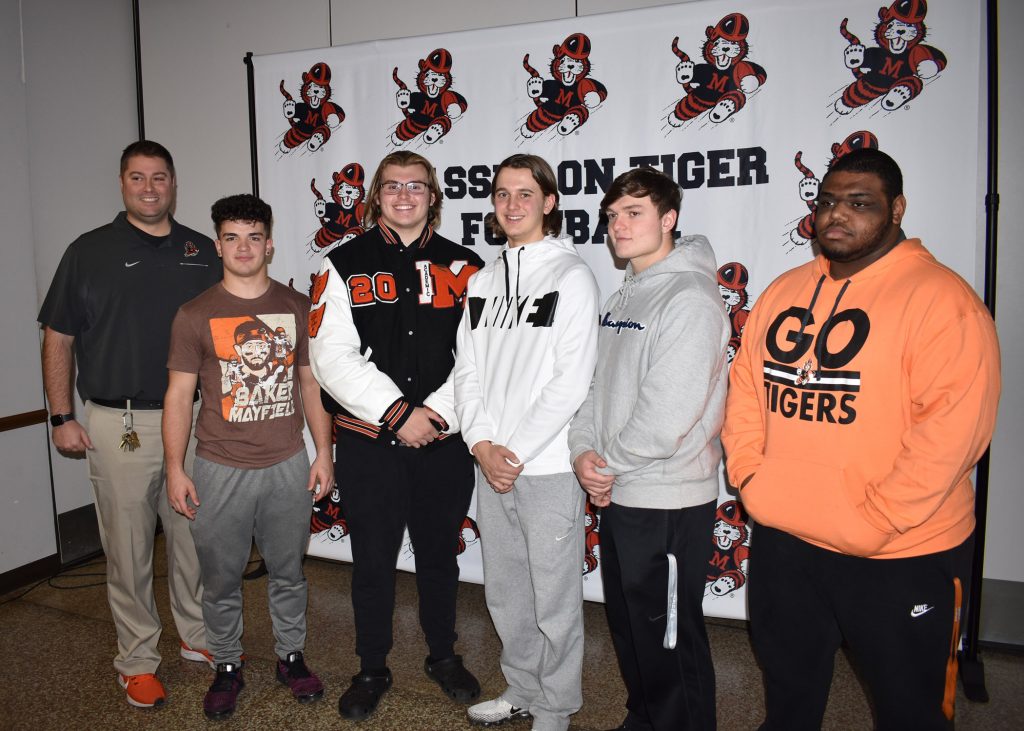
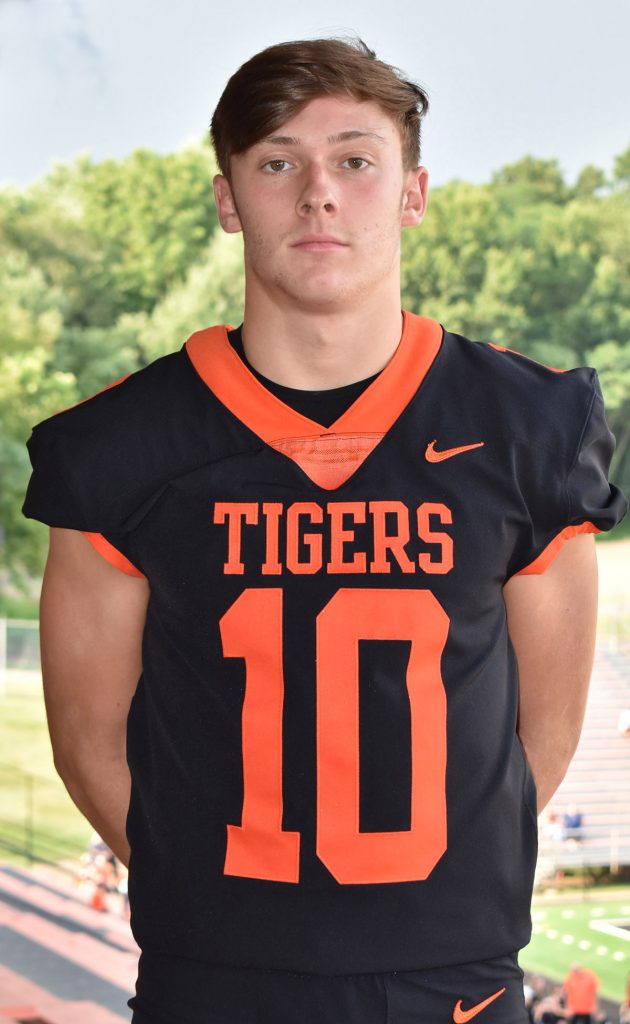
Massillon senior Anthony Pedro has selected Wittenberg University to continue his education and play the sport he loves. Wittenberg participates in football at the NCAA Division 3 level and is a member of the North Coast Athletic Conference (NCAC). The Tigers currently have the most wins of any team in Division 3, with an overall record of 727-353-22. Last year they compiled a mark of 7-3 and finished in a tie for first place in the NCAC. They are coached by Joe Fincham, who has been there for 24 years.
Pedro was one of just a handful of players last year to see action on both sides of the ball for the Massillon Tigers, who finished with a record of 14-1 and advanced to the Division 2 state championship game. On offense he lined up as a slot receiver with a primary responsibility to block on the tag screens, while also being available to catch an occasional pass. He finished with five receptions for 63 yards and a touchdown, the TD coming against Penn-Trafford in a 42-21 victory over the 11-2 team from Pennsylvania. On defense Anthony was a starter at cornerback where he recorded 10.0 tackle points (5 solos and 10 assists), two pass breakups and a tackle for loss.
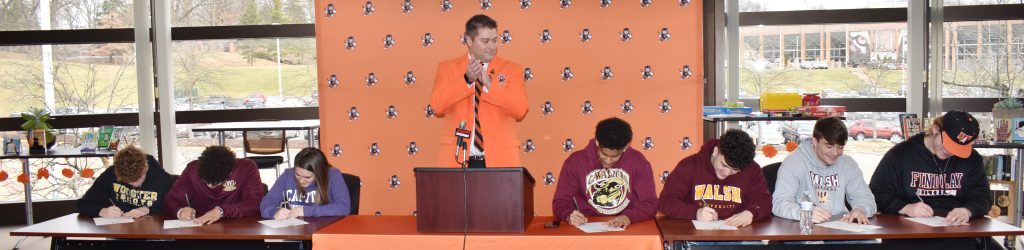
Four standouts from the 2019 Massillon football team signed letters-of-intent to play at the next level. They include Robbie Page, Preston Hodges and Jarron Hodges, who will attend Walsh University, and Cole Jones, who is headed to the University of Findlay. Joining them are Hannah Frey, who is headed to Capital University to play golf, TJ Harper, who will play golf at The College of Wooster, and Erroll Isaiah II, who will join the bowling team at Walsh University.
Robbie Page was a starting safety on Massillon’s 14-1, state runner-up team in 2019. He was fourth on the team with 58.5 tackle points (49 solos and 19 assists). He also intercepted three passes, broke up eight passes and recovered a fumble. An All-County selection, Page will be remembered as a player who challenged any opposing receiver to catch a pass over the middle.
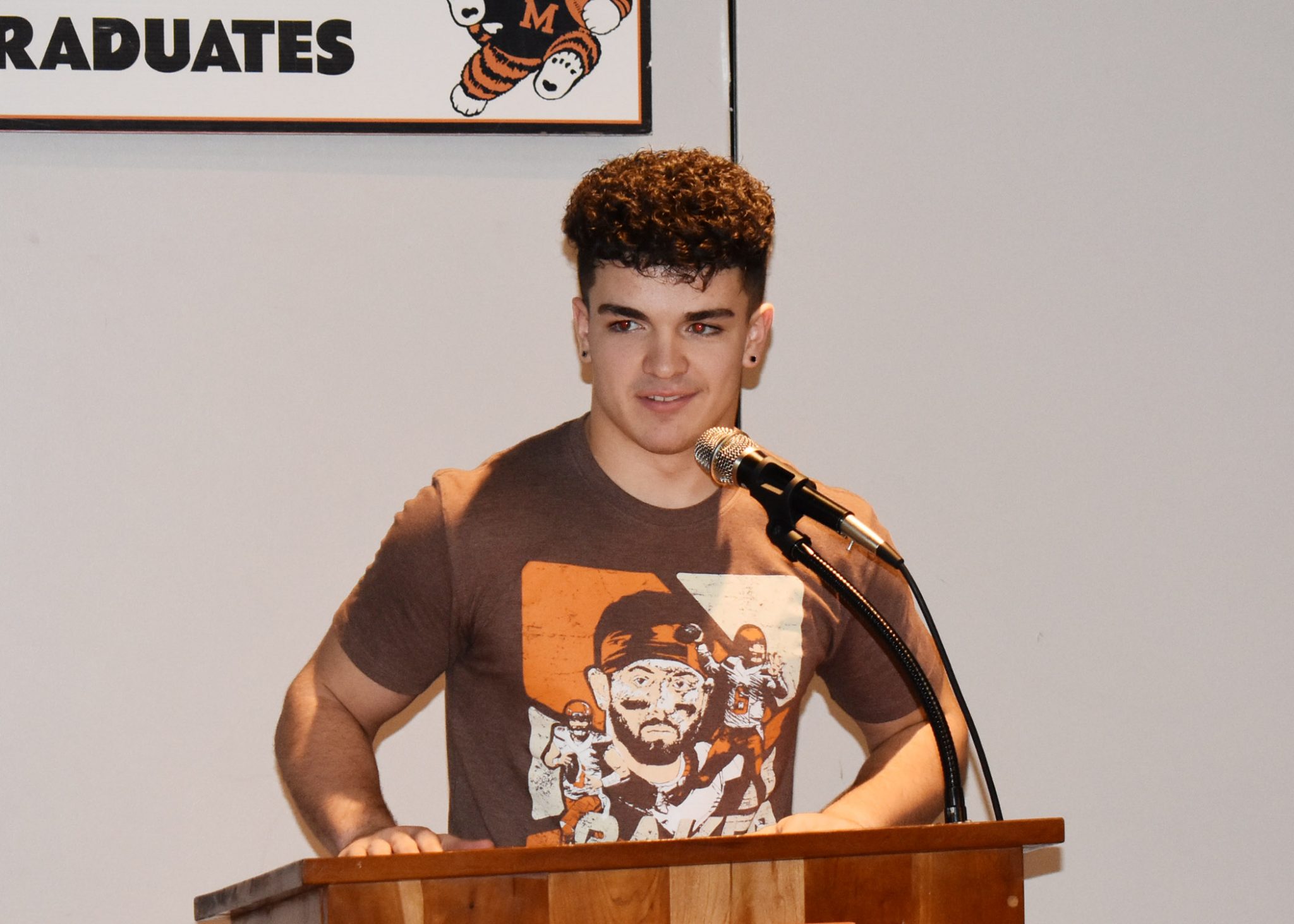
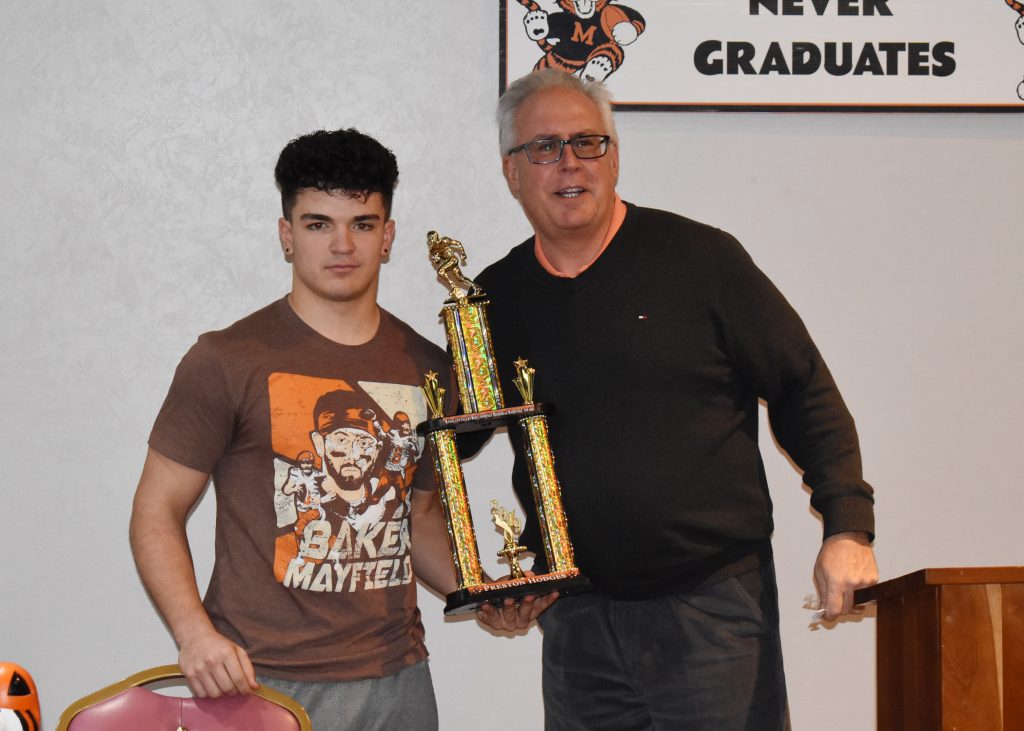
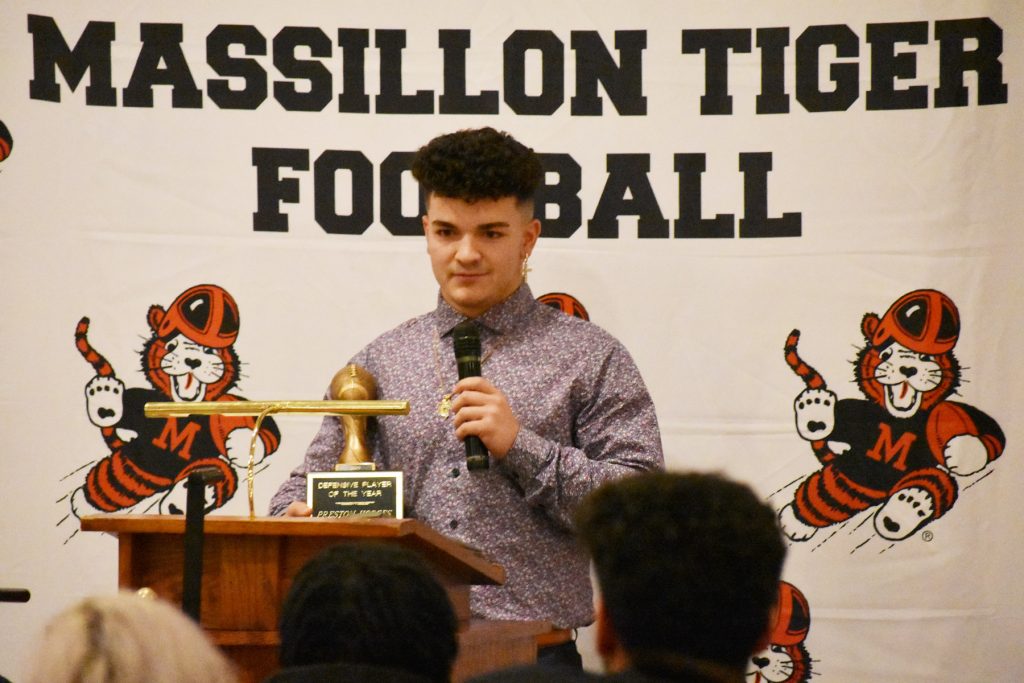
Preston Hodges was third on the team with 65.0 tackle points (27 solos and 56 assists). He also recorded 14.5 tackles for loss, 1.5 quarterback sacks, four pass interceptions returned for 78 yards and two touchdowns, five pass breakups and a blocked punt. He saw limited duty in the backfield, where he carried the ball eleven times for 78 yards and scored two touchdowns. Hodges received the Touchdown Club Hardnose Award and was awarded Defensive Player of the Year. One of the co-captains, he was named to the All-County, All-District and All-State Teams.
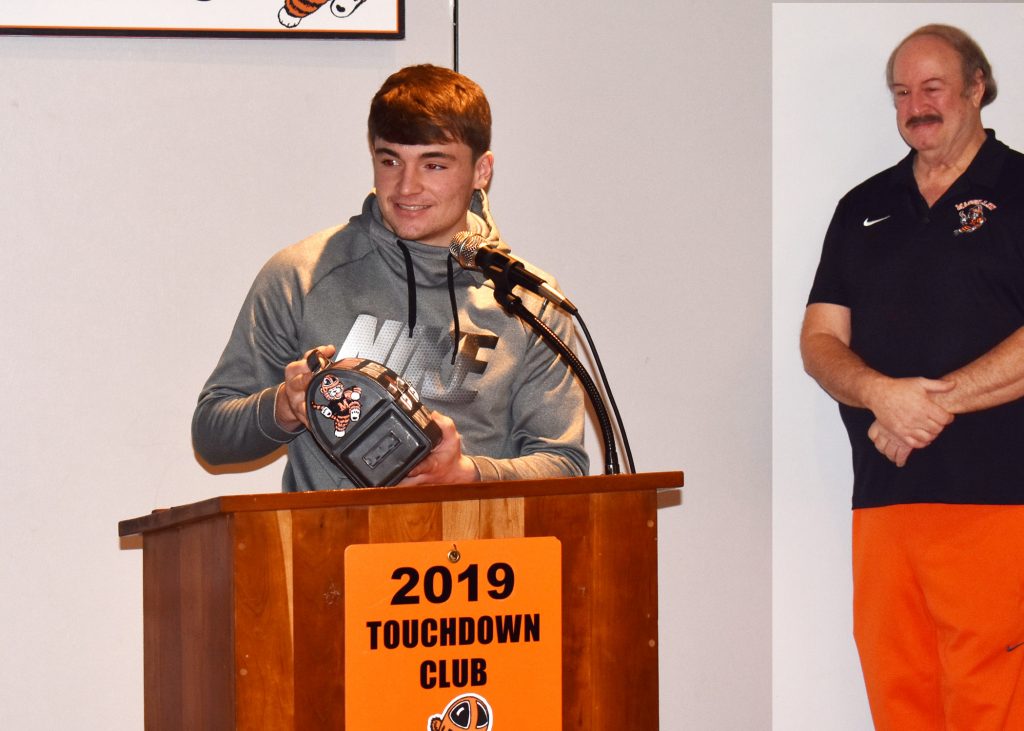
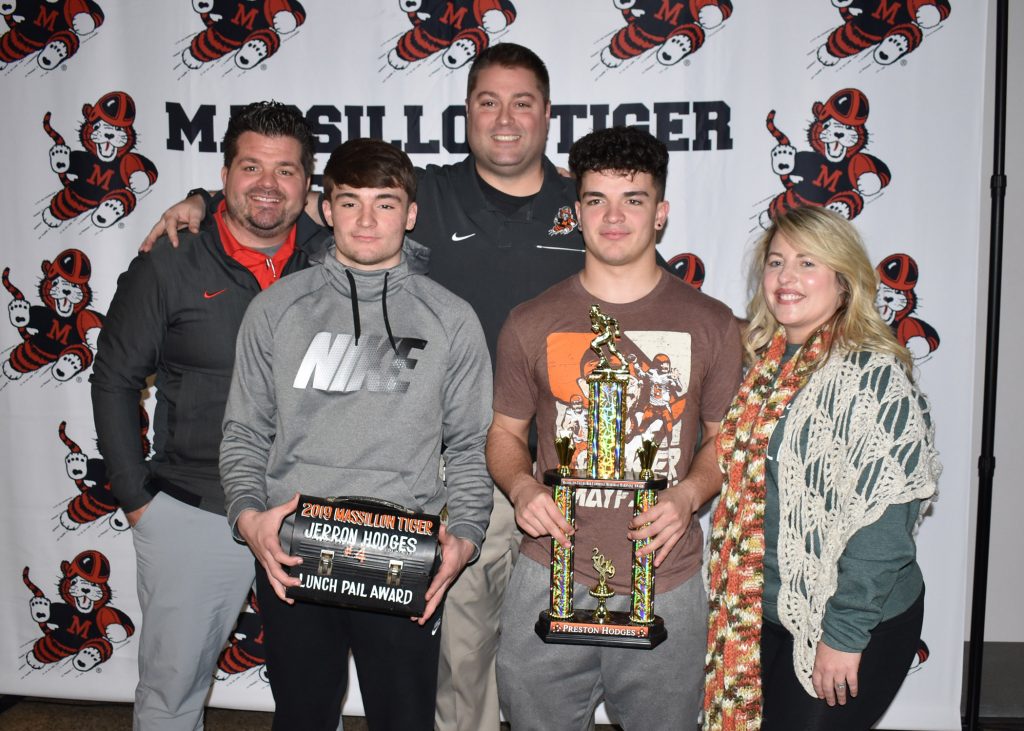
Jarron Hodges was third on the team as a wide receiver, catching 14 passes for 127 yards. Used primarily as a short-to-medium distance receiver, he averaged 9.1 yards per catch. Hodges also received the “lunch bucket” award, given to the player that comes to practice every day ready to work.
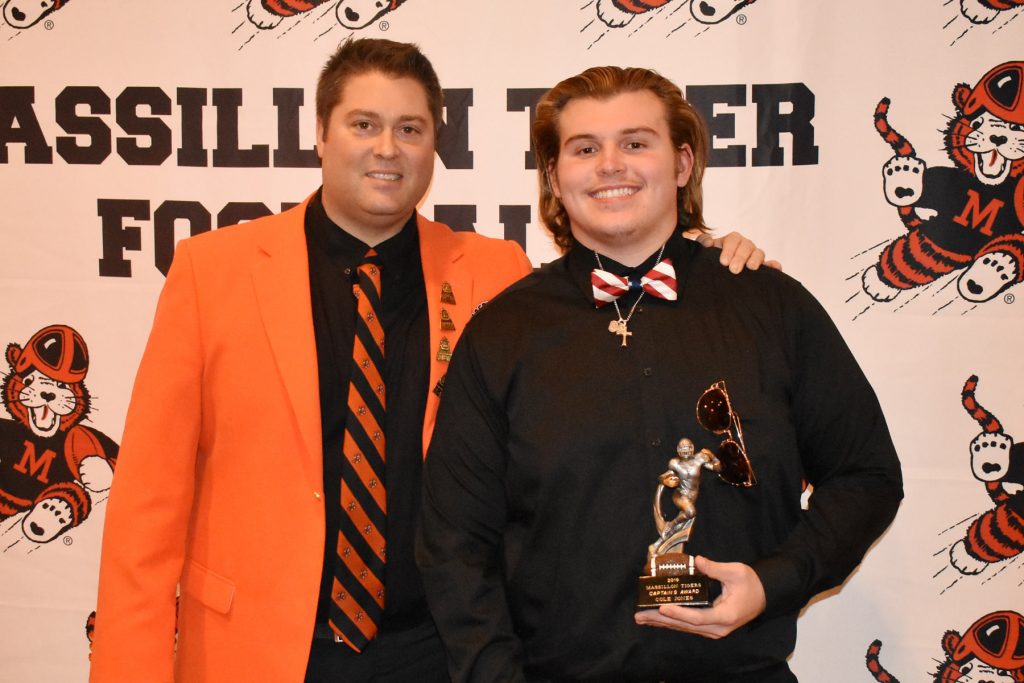
Cole Jones led an offensive line that averaged 180 yards rushing per game and surrendered just five quarterback sacks over 15 games. A co-captain, playing both guard and center, Jones was presented the Ducky Schroeder Outstanding Lineman Award. He was also named All-County, All-District and All-State. Cole has been invited to participate in the Ohio North-South Classic, scheduled for April 25, tentatively at Paul Brown Tiger Stadium.
Hannah Frey is a standout on the Girls Golf Team. Last fall she was named Senior Academic All-Ohio, Honorable Mention Stark County and Honorable Mention All Northeast Ohio District.
TJ Harper is a standout on the Boys Golf Team. Last fall he was named Senior Academic All-Ohio, Honorable Mention Stark County and Honorable Mention All Northeast Ohio District.
Erroll Isiah II is a member of this winter’s Boy’s Bowling Team.
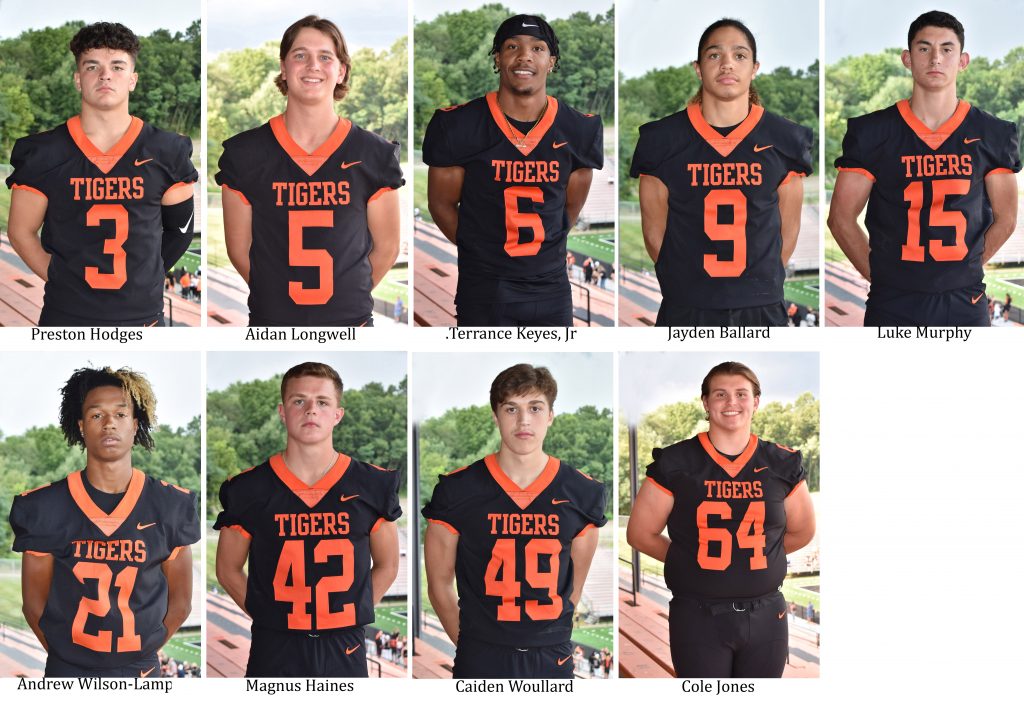
On early signing day last fall, both Aidan Longwell and Luke Murphy committed to Kent State, Aidan for baseball and Luke for football.
Longwell, a 3-year starter, was a standout quarterback who owns career passing marks for yards (7,705), attempts (795), completions (484) and touchdowns (84). A co-captain, he received the Most Valuable Player award. He was also named All-County, All-District and All-State.
Murphy saw action primarily at safety, where he was the leading tackler on the team with 85.5 tackle points (60 solos and 51 assists). He also had five tackles for loss, intercepted two passes returned for 43 yards, broke up six passes and blocked a punt. He was named All-County, All-District and All-State.
Congratulations to all nine of these Tigers.
2020 Signing Day. (Row 1, L-R) Hannah Frey, Robbie Page and Preston Hodges; (Row 2) TJ Harper, Erroll Isaiah II, Cole Jones and Jerron Hodges.
The Massillontigers.com website maintains over 2,500 player and team game records. The data comprises 270 categories, such as rushing, passing and receiving, and lists the Top 10 record holders in each category. For the last several months I have been reviewing past history to verify the accuracy of these entries. Some of the more obvious ones are Jamir Thomas and Aidan Longwell as the all-time career rushers and passers. Then there are remote ones, like Chauncey Watson having the longest touchdown run of 99 yards against Akron Garfield 1991 and Art McConnel with the longest punt of 81 yards vs. Warren in 1925.
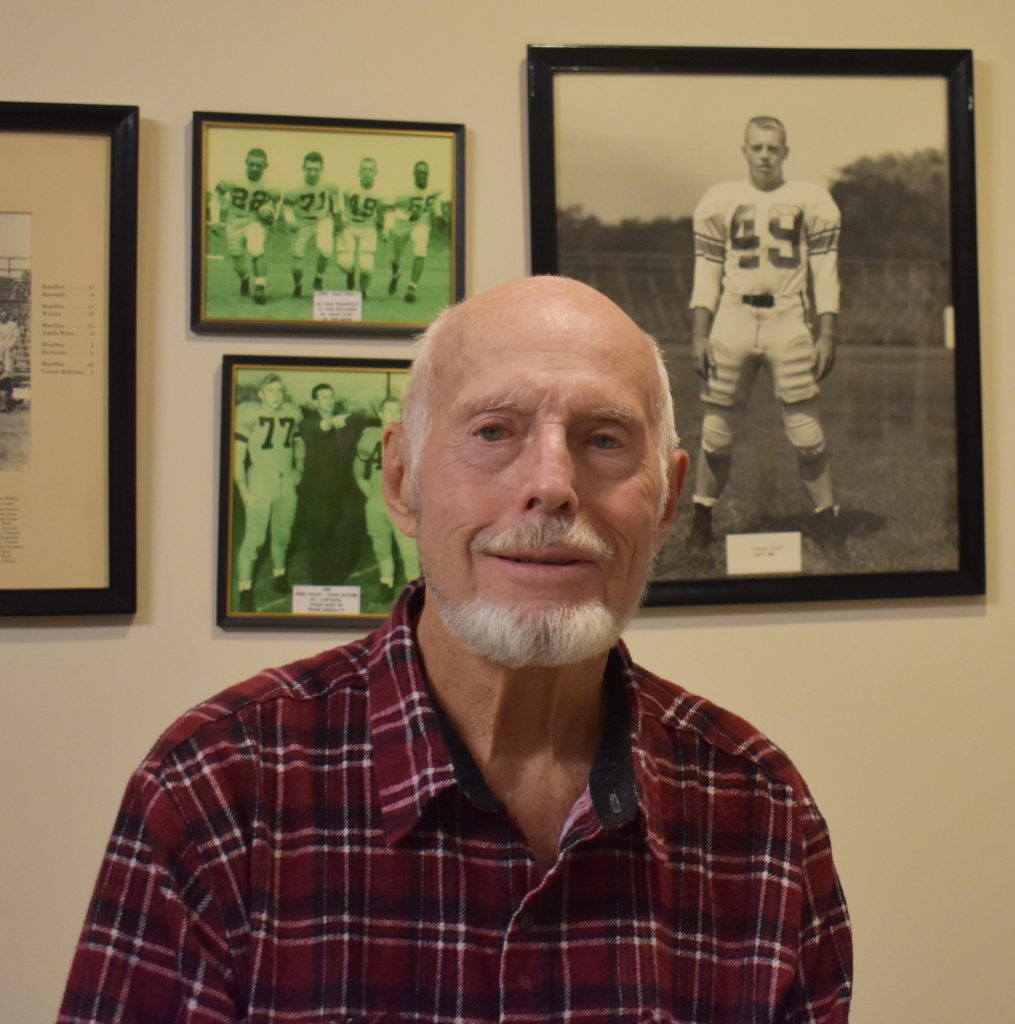
But there is one record that always bothered me: Chuck Vliet’s 42 tackles in the 1950 game against Warren Harding. How could this be? Is that even possible? The No. 2 player on the list, Cooper Ivan, has just 14 tackle points. Fortunately, the aging Chuck is still with us to tell the story. And it’s a good one. I had a chance recently to sit down with Chuck and talk about that record, but first a little background.
Chuck played football in 1949-51 under the legendary coach Chuck Mather. During his 6-year tenure, Mather racked up an inconceivable 57 wins in 60 games. In all six years his teams were honored as the best in the Ohio and three times named national champs.
“I thought he was a great coach,” Vliet said about Mather. “One thing I liked about Chuck Mather and his whole staff, they never yelled or cussed at us. They would walk up to us with a calm voice and look at us straight in the eye. They might put their hand on your shoulder and say, ‘What is your assignment on this play? What are you supposed to do?’ He always told us, ‘You play the game the way you practice.’ If someone made a nice block and they had their head and shoulders on the wrong side, they were told about it. We were all graded. Our position coaches were the ones that graded in that position.”
It was during the 1950 season (Mather’s 4th) that Vliet, a 5’-8”, 160 lb. junior running back / linebacker set the record. It was one of those years when Massillon was undefeated and both state and national champions. And they outscored the opposition 407-37. Along the way they defeated No. 8 Canton McKinley 33-0 and No. 9 Steubenville 35-12.
Game 7, held on October 17, 1950, was against Warren Harding, who entered the fray with a 5-1 record, having lost earlier to the Bulldogs 19-7. Massillon led 7-0 at the half and pulled away after the band show to win 23-6. Harding’s only score came on a 72-yard pass, but overall was held to just 87 total rushing yards in 46 attempts.
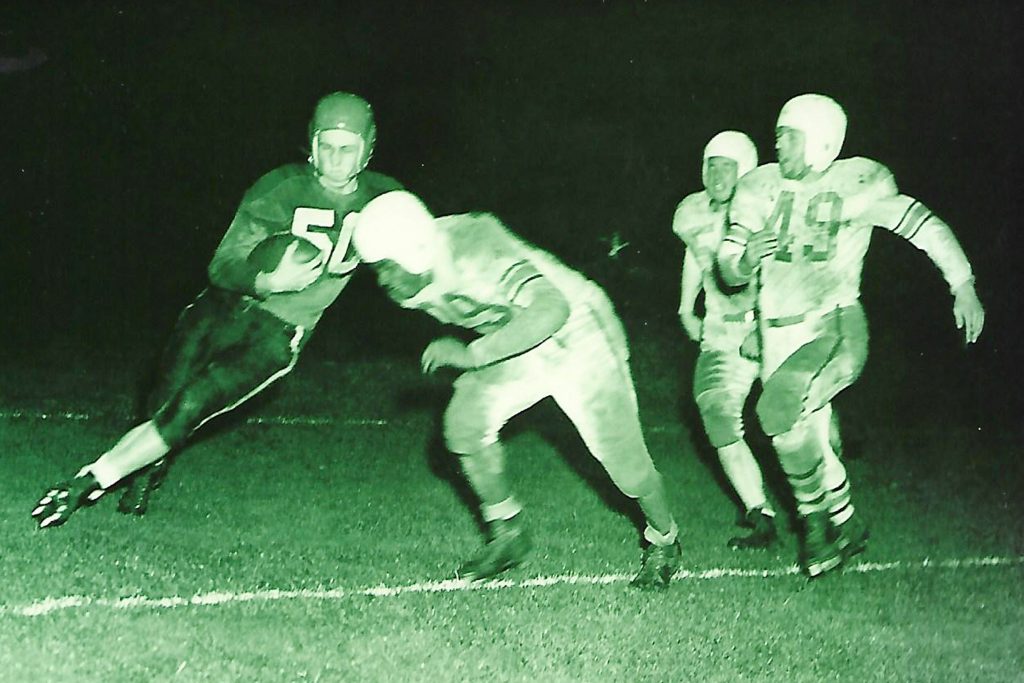
This is where Chuck Vliet, who proudly wore No. 49, enters the story by setting a record for the most tackles in a single game. The amazing part is that out of 58 plays Warren ran that night, 12 were passes and Chuck did not tackle any of the three players who caught a pass. In addition, Harding lost a fumble, which means that, if you do the math, Vliet made 42 tackles out of 45 opportunities, which was simply amazing.
Here’s how Chuck told the story:
“At the beginning of this game against Warren in 1950 on our field we practiced a solid week for their passing offense. Back in our time we didn’t run into many teams that threw a lot and we had to gear up for that particular game. So the whole week our defense was all pass. It was pass here, pass there. We had to learn what they were doing, read the quarterback, and so on.
“So we came out that night onto the field. Did our exercises. Came off the field. We’re in the locker room. I’m standing there. Mather came over. He says, ‘Vliet. We’re going to change the defense tonight.’ I said, ‘What, coach?’ He said, ‘We’re changing the defense.’ I said, ‘What for?’ He said that we found out that their quarterback on Wednesday twisted his ankle quite bad and cannot play in this game. So they brought a second quarterback in which cannot throw, so that Warren will be running all night. He says, ‘So what we’re going to do on defense, we’re going to make a 7–man front and we’re going to have you as a roving linebacker.’ I thought that time I got a big old goose bump all over me because I didn’t know what he was talking about. And I was going to be the only linebacker. He said, ‘You will be my roving linebacker.’ I said, ‘Roving linebacker?’ He said, ‘Yes. You have to cover from sideline to sideline.’ Again, that hit me real hard. I said, ‘Coach. What about Joe Gleason and Ray Lane? They’re both seniors.’ He said,’ I want you!’ Well, I was scared. I really was.
The 1950 defense: (Row 1, L-R) linemen Thomas Zeller, James Geiser, James Shumacher, Jack Strobel and Allen Murray; (Row 2) linebackers Joe Gleason, Chuck Vliet and Ray Lane; (Row 3) defensive backs Robert Khoenle, William Stoner and Ernie Russell
“So he got us together, and this was about ten minutes before we were ready to go back onto the field, and on our defensive front, at right guard, he said, ‘We’re going to put those two on double duty.’ And (Jerry) Krisher let out a little bit of noise. He didn’t like that. And, anyhow, he took Ray Lane and put him over defensive guard on the right side he took Joe Gleason, the outside linebacker, and put him on the left side. They put Krisher in (Jack) Strobel’s place and (Jim) Richenbach over the nose man. And he said, ‘This is what we call our 7-1-2-1.” What we now know as a diamond defense. We never practiced that beforehand. We never practiced that the whole time I was there. And we never used that defense again.
“He told each one of the defensive people up front, ‘keep the lineman off of Vliet. Hit them and hold them up at the line and let him (Vliet) do his job.’ And I called them My Magnificent Seven because I didn’t have anyone coming out hitting me and I had free range from one side of the field to the other side. And I did not know at the end of the game or that week or thereafter how many tackles I made in that game until I read that piece in the paper (the following year in an article presenting Vliet and Frank Gibson as the captains of the 1951 team).
“It was a defense that nobody played against us. He threw this at them because they knew our regular defense. And they were always set up to block a regular defense. And this threw them off balance. And then telling our defensive line people, ‘Keep the offensive players off of Vliet.’ And that worked. And they did a job. I’m not kidding you. I used to think sometimes that he was psychic. He just seemed to know how to do everything and sprung that on us. But we had the type of people, whatever they were told to do, they could do it. That’s the type of people we had.”
It’s a record that’s sure to never be broken. Lee Nussbaum, a member of that 1950 team, said later, “If I could tackle as well as Chuck Vliet, I’d have been first string at Ohio State in 1954.” The mark is documented on the Ohio High School Athletic Association website under “Individual Miscellaneous Feats.”
So, if you see an SUV going down the road with a license plate that reads “CV 49”, give a wave to former Tiger great Chuck Vliet, a Massillon Tiger forever.
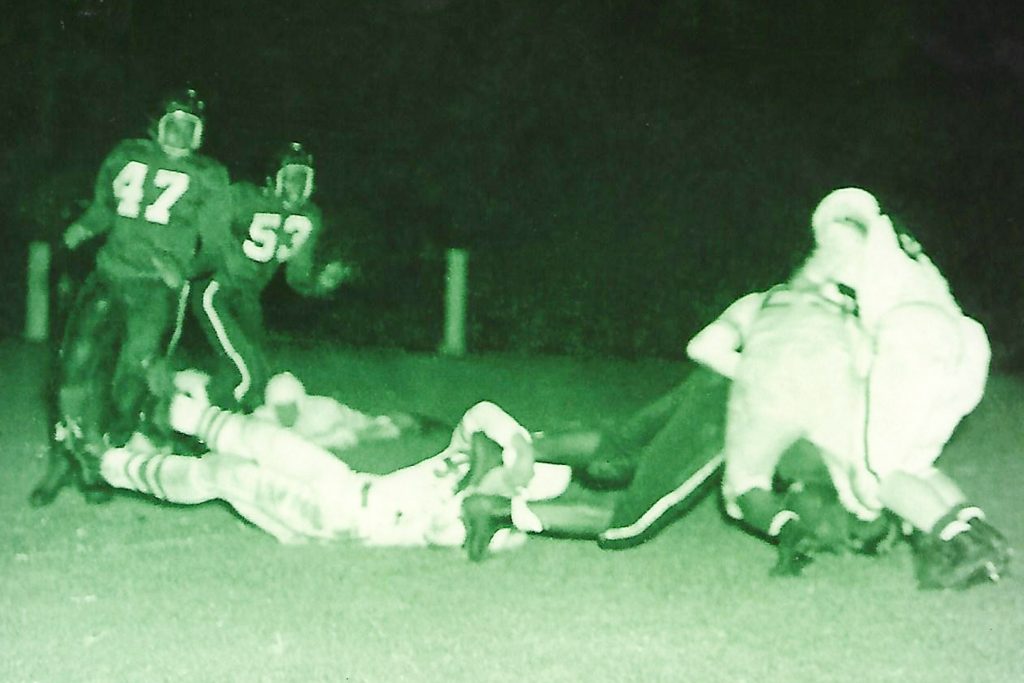
Chuck Vliet (49) positions himself to make the tackle after Ernie Russell (29) slows the runner down. Also shown is Allen MurrayChuck Vliet (on the ground) brings down the Warren ball carrier. Assisting is Erie Russell
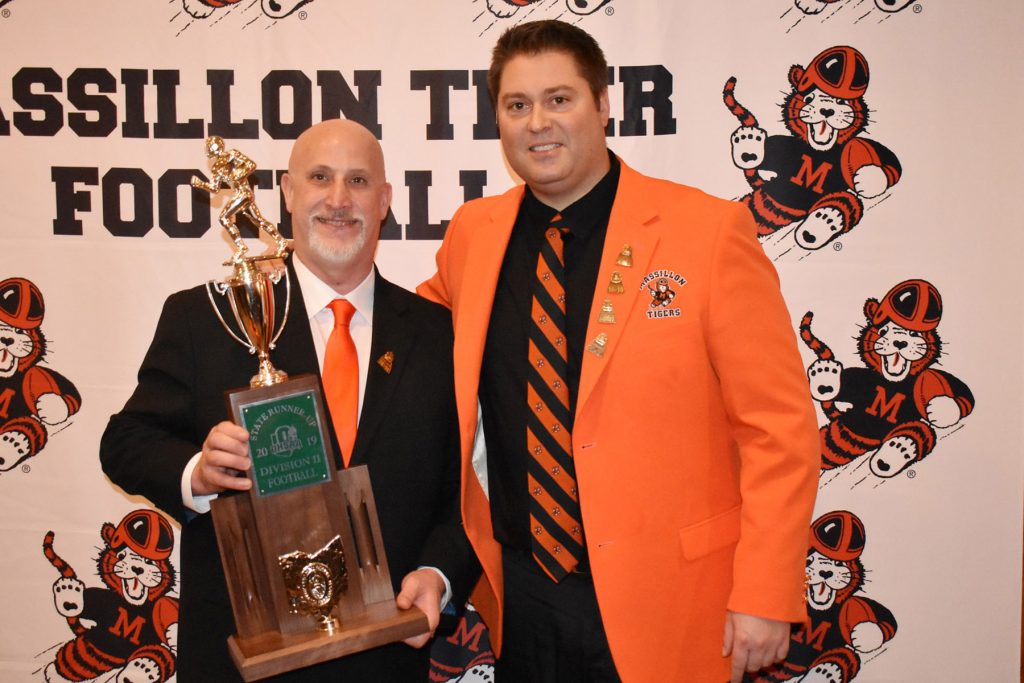
2019 Booster Club President Bruce Gallagher (holding State Runner-Up Trophy) with Head Coach Nate Moore
The 2019 season has long been over, but it was a good time at the banquet to look back on a great year and recognize those individuals that made so much success possible. Outgoing Booster Club President Bruce Gallagher welcomed all and went great lengths to thank everyone who helped him accomplish the Club’s goals of supporting the players throughout the past season. Special tribute was paid to the Tiger Moms, who were instrumental in feeding the Tigers throughout the campaign. Bruce also introduced next year’s president, Eric Smith.
Head Coach Nate Moore then spoke to the several hundred players, coaches, parents and fans who attended, thanking nearly everyone for supporting the program. But he couldn’t talk enough about the past year. “I’m so proud of this football team,” he said. “They played in 14 playoff games. They set all kinds of records. But what I’m most proud of is that they played for the City of Massillon. They have reset the standard of Massillon football.”
The 2018 Massillon football team was a hard act to follow: they won the most games ever during the season by fashioning a 14-1 record, they participated in the playoff state finals for the first time in 13 years and they had the all-time leading rusher in Jamir Thomas. But the 2019 team did exactly that. They met and in some cases exceeded that previous team. Led by an outstanding senior class, these Tigers repeated both the 14-1 record and the appearance in the state finals. And although nearly matching the offensive stats of the previous year, it was the defense that flexed it muscles the most in playing the best football on that side of the ball since the 2002 season. Consider these accomplishments:
14-1 record (number of wins ties all-time record)
605 points scored (40.3 per game) (2nd all-time)
177 points allowed (11.8 per game) (fewest since 2002)
899 overall wins (5th in the country)
2nd consecutive undefeated regular season (first time since 1965)
3rd consecutive playoff regional title (13th overall)
2nd consecutive state finals appearance (5th appearance overall)
4th consecutive win over Canton McKinley; 8 of the last 9 (series record: 72-53-5)
17-14 victory over 2017 and 2018 Division II champion Akron Hoban
Defeated five out of five playoff opponents in regular season
Rated in the U.S. Top 50 by several national publications
Academic All-Ohio with an overall GPA of 3.37 during the football season
This team has also penciled itself into many areas of the record book, including the following:
2,910 passing yards (4th overall)
62.9 pass completion percentage (2nd overall)
10.5 yards per pass attempt (1st overall)
35 touchdown passes (3rd overall)
185.2 pass efficiency rating (1st overall)
5,602 total offensive yards (3rd overall)
7.4 yards per play (4th overall)
84 touchdowns (2nd overall)
337 passing yards vs. Perry (5th overall)
The senior class never lost to Canton McKinley. They won more playoff games (11) in three years than any previous class. They own a 21-game regular season winning streak. And who can forget Ben Krichbaum’s end-of-the-game sack of the Akron Hoban quarterback to seal the victory in the regional finals. Then there were the two memorable passes from Aidan Longwell, one breaking the record for the longest pass ever and the other sealing the win over McKinley. What a senior class. They will also be a hard group to follow.
So at this evening’s banquet the 2019 players took their final bows and in turn received a multitude of accolades, including participation awards for JV players, letters for varsity game participants, senior awards, captain awards and top player acknowledgments.
Captain Awards – Quarterback Aidan Longwell, Offensive Lineman Cole Jones, Defensive Lineman Manny McElroy, Inside Linebacker Ben Krichbaum, Outside Linebacker Preston Hodges and Honorary Captain Nathan Forte
All-County – Robbie Page, Preston Hodges, Aidan Longwell, Terrance Keyes, Jr., Jayden Ballard, Luke Murphy, Andrew Wilson-Lamp, Cole Jones, Manny McElroy, Alex Bauer and Zion Phifer
All-District – Aidan Longwell, Terrance Keyes, Jr., Jayden Ballard, Cole Jones, Caiden Woullard, Preston Hodges, Luke Murphy and Magnus Haines.
All-State – Aidan Longwell (1st Team), Jayden Ballard (1st Team), Cole Jones (1st Team), Luke Murphy (1st Team), Terrance Keyes, Jr. 2nd Team), Caiden Woullard (2nd Team), Preston Hodges (2nd Team), Magnus Haines (3rd Team) and Andrew Wilson-Lamp (Special Mention)
Through the Roof Player of the Year (Sponsored by Progressive Auto Group) – Aidan Longwell (offense) and Preston Hodges (defense)
Character Award – Ethan Tobin
Thayer Munford ACT Award – Deven Warfield
John Pizzino, Sr. Academic Football $1,000 Scholarship – Ahmon Williams
Paul David Academic Award – Anthony Pedro
Defensive Player of the Year – Preston Hodges
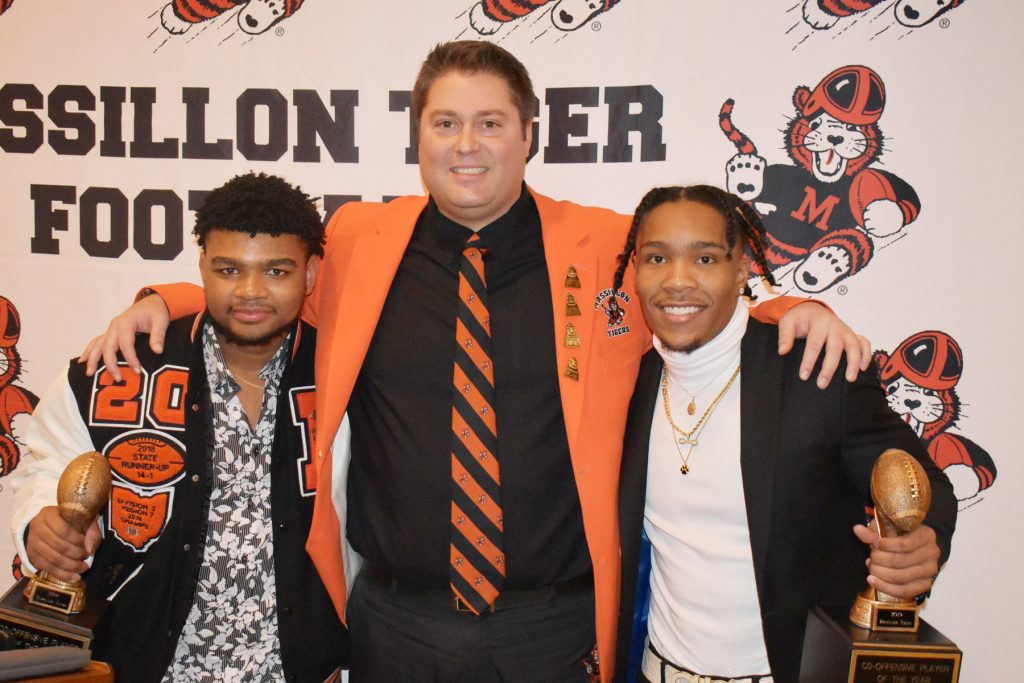
Co-Offensive Player of the Year – Terrance Keyes Jr.
Co-Offensive Player of the Year – Zion Phifer
Lifter Of the Year – Ben Krichbaum
Scout Team Offensive Player of the Year Offense – Tanner Pierce
Scout Team Defensive Player of the Year – Nick Hatheway
Ducky Schroeder Award Outstanding Lineman – Cole Jones (All-County, All-District, 1st Team All-State)
Special Teams Player of the Year – Seth Lance
Bob Smith / Bill Snyder Sportsmanship Award – Noah Richards
Lee Tressel Citizenship Award – Davon Woods
Tom Harp Coaches Award – Peyton Mendenhall
Touchdown Club HardnoseAward – Preston Hodges
Most Valuable Player – Aidan Longwell
Massillon Record Setters – Aidan Longwell (career passing yards, career touchdowns pass attempts, career pass completions, career yards per pass attempt, career touchdowns, season pass efficiency and longest pass completion), Jayden Ballard (career touchdowns, season touchdowns and longest pass reception) Caiden Woullard (season tackles-for-loss), Zach Catrone (career pass completion percentage) and Alex Bauer (season PAT kicks attempted, season PAT kicks made and career field goal percentage).
See you next year.
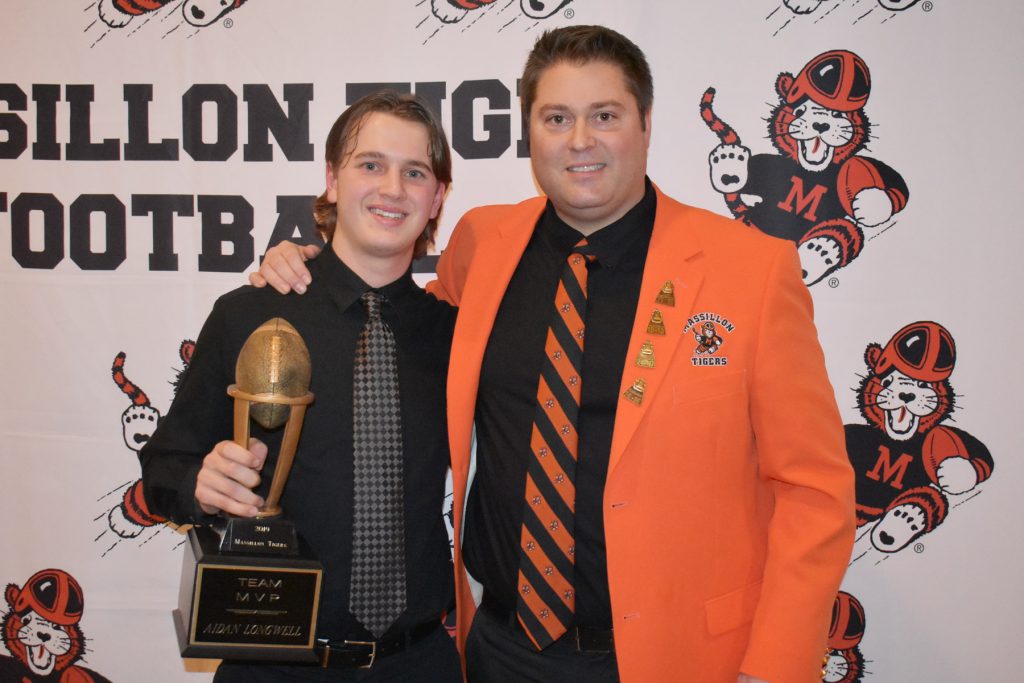
2019 Most Valuable Player Aidan Longwell with Head Coach Nate Moore
2019 Defensive Player of the Year Preston Hodges2019 Co-Offensive Players of the Year Zion Phifer and Terrance Keyes, Jr., with Head Coach Nate Moore2019 Ducky Schroeder Outstanding Lineman Award Cole Jones with Head Coach Nate Moore
Former Massillon player and current Mount Union defensive back Kordell Ford was recently named Division 3 1st Team Collegiate All-American by the Associated Press. The 5′-10″, 190 lb. Ford, who majors in Sports Business, had a productive junior year in helping his team to an 11-1 record and a birth in the post-season playoffs. For the season, he recorded 53.0 tackle points, two quarterback sacks and a pass interception, including a season-best eight tackles against Heidelberg. In addition to his All-American status, Ford was named to the All-Ohio Athletic Conference first team and recognized as the OAC’s top defensive back. He has also been nominated for the Cliff Harris Award as the top small college defensive player in the country. In his previous two years, Kordell was credited with 56 tackles, including 4.5 tackles for loss, a quarterback sack and a fumble recovery.
At Massillon, the 2017 graduate played varsity ball extensively for three season, first under Jason Hall and then Nate Moore, lining up at both running back and defensive back. As a senior, he was a team co-captain and named to both the All-County and All-District teams. His stats were as follows:
Sophomore – 1 carry for 28 yards; 6 pass receptions for 66 yards and 1 TD; 3 solo tackles and 1 assist.
Junior – 2nd on the team in tackles; 35 solos and 37 assists; 4 pass interceptions.
Senior – 55 carries for 208 yards and 2 TDs; 4 pass receptions for 63 yards; 1st on the team in tackles; 40 solos, 26 assists, 3 tackles for loss, 2 pass interceptions returned for 77 yards and 1 TD TD; 8 punt returns for 68 yards; 10 kick returns for 182 yards
Kordell is the son of Charles and Jodi Ford.
FIRST TEAM
OFFENSE
Quarterback — Broc Rutter, senior, North Central (Ill.).
Running backs — Robert Shufford, junior, Birmingham-Southern; Ethan Greenfield, sophomore, North Central (Ill.).
Linemen — Sharmore Clarke, junior, North Central (Ill.); Quinn Meinerz, junior, Wisconsin-Whitewater; Nic Vetter, senior, Wartburg; Sean Sherman, senior, Mount Union; Dan Greenheck, senior, St. John’s.
Tight end — Ryan Curtiss, senior, Muhlenberg.
Receivers — Andrew Kamienski, junior, North Central (Ill.); Justin Hill, senior, Mount Union.
All-purpose player — Willie Julkes III, senior, Concordia-Moorhead.
Kicker — Anthony Avila, sophomore, Mary Hardin-Baylor.
Linebackers — Scottie Bobeck, senior, Benedictine; Dante Capozzoli, junior, Kean; Anton Clark, senior, East Texas Baptist.
Secondary — Jeff Hector, senior, Redlands; Spencer Rowland, senior, Wheaton (Ill.); Jake Beesley, junior, North Central (Ill.); Kordell Ford, junior, Mount Union.
Punter — Zach Warcola, senior, College of New Jersey.
SECOND TEAM
OFFENSE
Quarterback — Jackson Erdmann, senior, St.John’s.
Running backs — Alex Minton, senior, Denison; Wesley Schools, senior, Grove City.
Linemen — Ben Bartch, senior, St. John’s; Joe Krall, senior, Monmouth (Ill.); Tyler Norwood, senior, Salisbury; Ryan Malarkey, senior, Muhlenberg; Steven Sellers, junior, Mary Hardin-Baylor.
Tight end — Dan Allen, senior, Delaware Valley.
Receivers — Ruhann Peele, senior, Wesley (Del.); Ravi Alston, sophomore, St. John’s; Samuel Staehling, senior, St. Norbert.
All-purpose player — Brock Martin, sophomore, Ohio Northern.
Linemen — Jordan McInerney, senior, Lake Forest; Danny Pietruszewski, junior, St. John’s; Tim Ousley, senior, Muskingum; Mike Williams, senior, Washington & Jefferson.
At the end of each season, the Touchdown Club honors one of the players with the “Bob Commings Memorial Hardnose Award.” That player would have received the most votes from among weekly tallies taken by the club members. Past players honored include John Mulbach (Ohio State), David Whitfield (Ohio State), Chris Spielman (Ohio State), Shawn Crable (Michigan), Brian Gamble (Illinois/Ashland) and Jamir Thomas.
Bob Commings was a very successful coach for the Tigers from 1969 to 1973, compiling a record of 43-6-2, including Massillon’s last state championship (1970) and qualification for Ohio’s first ever state playoff games (1972). Commings departed following the 1973 season to become head coach of the University of Iowa and later coached at GlenOak High School, for which their field was later named.
This year’s Hardnose Award goes to senior outside linebacker and team captain Preston Hodges, recently named Second Team All-Ohio, First Team All-District and WHBC All-County. Hodges’ stats are aplenty, including:
3rd on the team in tackles with 37 solos and 56 assists
14.5 tackles for loss, accounting for 48 negative yards
1.5 quarterback sacks, accounting for 15 negative yards
4 pass interceptions returned for 78 yards and 2 touchdowns
5 pass breakups
9 passes defended
1 blocked punt
11 rushes for 79 yards and 2 touchdowns
3 punt returns for 18 yards and a touchdown
30 points scored
175 all-purpose yards
When asked about the award after the presentation, Preston said this: “It means everything to me. I know being an undersized guy you have to be a hard-nosed player. You have to go all out every single play. It’s just the mindset you have to have going into every single game. I really love the game of football and I just give it my all.” But the admiration for his teammates was not lost on him. “I love this football team,” he said. “They’ve had my back every step of the way. We all push each other to be better. I created life-long friendships with this team, I can already tell. I was very happy with our season. It didn’t end the way we wanted. But I’ll still love every single one of those guys and they’re my brothers for life.”
A new award was added to the ceremony this year for the player that comes to practice every day and gives maximum performance. It’s called the “Bucket Award.” And this year’s winner is Jerron Hodges.
Preston Hodges receives the Hardnose Award from Bob Commings, Jr.Jerron Hodges with Touchdown Club President Steve BerecekJerron and Preston Hodges, with parents Nick and Jennifer, and Coach Nate MooreCoach Nate Moore with the 2019 team captains: Preston Hodges, Cole Jones, Aidan Longwell, Ben Krichbaum and Manny McElroy
The final Booster Club of the 2019 season kicked off with recognition for job well done by this year’s president, Bruce Gallagher, who thanked all of the members for their unending support throughout the year.
The date of the Football Banquet has not yet been set.
Head Coach Nate Moore did not dwell on the state finals loss to Cincinnati LaSalle, but instead elected to expound on the accomplishments of the 2019 team and the outgoing senior class. “This was a great year,” he said. “So proud of our kids. They fought hard every week. Bittersweet at the end. Our kids really wanted to win it (the state championship) for the City of Massillon. But we have to move on.
“What an incredible year Aidan Longwell had. Really hard to compare to anyone else. Having two 1,000-yard receivers. Lots of records set. The last few years for these seniors, it’s really been an incredible run.”
A win-loss record of 38-6 (fewest losses in three years since 1983)
A playoff win-loss record of 11-3
Two consecutive undefeated regular seasons (previously only accomplished by Earl Bruce, Chuck Mather and Paul Brown)
Three consecutive playoff regional championships (a first for Massillon)
Two consecutive playoff state finals appearances (a first for Massillon)
A fourth consecutive victory over Canton McKinley
Seven games finishing with a running clock
Defeated 4-time defending state champion Akron Hoban in the Regional Finals
Record-setting quarterback for a career (Aidan Longwell: attempts (795), completions (484), completion percentage (60.9%), yards (7,705) and touchdowns (84))
Record-setting quarterback for a season (Aidan Longwell: quarterback efficiency rating (186.5))
1,000-yard+ rusher (Terrance Keyes, Jr.: 227 attempts for 1,592 yards and 23 touchdowns)
Two 1,000-yard+ receivers (Jayden Ballard: 68 receptions for 1,202 yards and 18 touchdowns, Andrew Wilson-Lamp 55 receptions for 1,049 yards and 11 touchdowns)
Record-setting kicker (Alex Bauer: PAT kick attempts (83), PAT kicks made (81))
Record-setting defender (Caiden Woullard: tackles for loss (18))
Most receiving yards in a game: Andrew Wilson-Lamp (232) vs. Akron St. Vincent-St. Mary
Longest touchdown pass: Aidan Longwell to Jaydon Ballard (95 yards) vs. Monroeville Gateway, PA
Moore then addressed the prospect for next year. Defensively, the Tigers return just one starter in Caiden Woullard. So that area will be a work in progress. “Somebody will step up and take their place.” he said of the departing starters. “It will be like that at a lot of positions. But we will return a lot on the offensive side of the ball: 3 of 5 offensive linemen, two wide receivers, two fullbacks and the two kickers.” Backup quarterback Zach Catrone has a great shot at being the starter next year. “The juniors are now seniors,” he said. “It’s their team. I fully expect to compete at the state level next year. And it’s a very reasonable goal.”
Moore acknowledged the contributions of the assistant coaches saying that Massillon’s development process for players is second to none. And the facilities are “unbelievable.” The coaches will now prepare over the next month during the “hands-off” period and welcome the players back into the weight room on January 6.
Three open dates remain on next year’s schedule, week 5, 7 and 9, with a special opponent in the works for Week 1 So far it looks like this:
Filled, not announced
Canton GlenOak (A)
Warren Harding (H)
Filled, not announced
Open
Austintown Fitch (H)
Open
Barberton (H)
Open
Canton McKinley (H)
A college showcase for Division 2 and 3 college coaches is scheduled for December 19, the day after the D1 early signing date. All senior players are welcome to attend. The event is open to all area schools. Moore expects 40-50 coaches to attend. The annual college showcase for D1 college coaches will be held in the spring and will be open to underclass Massillon players.
CANTON It hasn’t been too often this season Massillon has found itself trying to scramble from a second-half deficit.
Unfortunately for the Tigers, the first time they truly found themselves in that position came in Thursday night’s Division II state championship game against Cincinnati La Salle. It proved to be too much, as they would suffer a 34-17 loss in front of 11,286 at Tom Benson Hall of Fame Stadium.
“First thing’s first, you have to give credit to La Salle,” Massillon coach Nate Moore said after his team finished with its second consecutive 14-1, state runner-up season. “They’re a great football team and played a great ballgame. They put us in some tough spots, so you have to give them a lot of credit.”
La Salle did so with a three-headed rushing attack that gained 337 yards, the most Massillon had given up in a game this season. The Lancers had a pair of 100-yard rushers, with quarterback Zach Branam gaining 166 yards on 22 carries while Gi’Bran Payne added 133 yards and a touchdown on 15 rushes.
Payne’s lone score was a six-yard run which put La Salle in front 7-3 midway through the first quarter, on which he had been originally ruled down at the Tiger 1. It was the first play to be looked at by instant replay, which was approved for the state championship games for the first time this season.
Cam Porter was the third piece of the rushing attack for La Salle. Porter gained 57 yards on 18 carries, with three touchdown runs — giving the Lancers leads of 14-3, 21-10 and 28-17.
“If you watch us all year, that’s what we do,” said La Salle coach Pat McLaughlin, whose 13-2 team brought the school’s fourth state title in the last six years. “We run the ball. We’re not necessarily thinking plays, we’re thinking players. We want to get Cam and Gi’Bran and Zach in space and making them defend the entire run game.”
The problem for Massillon was that La Salle was able to defend much of its offense, especially in the second half. The Tigers did get a pair of long pass plays to Andrew Wilson-Lamp, a 59-yard completion to set up an opening-drive Alex Bauer field goal and the other a 69-yard touchdown to pull them within 21-17 in the second quarter.
Jayden Ballard also brought in a 38-yard touchdown pass in the second quarter to cut the deficit to 21-10. Ballard finished with seven catches for 88 yards, while quarterback Aidan Longwell was 12-of-23 for 245 yards.
“They were (changing) a little bit,” said Longwell, who was held to 8-of-16 passing for 74 yards in the second half. “Their corners were playing off the ball a little bit more. We just didn’t have a good play, I guess.”
Massillon finished with 327 total yards. In the second half, however, the Tigers were only able to get 103 yards on 27 plays.
What also hurt Massillon was a pair of fumbles — of three total in the game — in its own territory. There was one in each half, and both resulted in points for the Lancers.
The first came on the first play of the second quarter, when the Tigers coughed it up at their own 17. Porter’s first touchdown run, a six-yarder, would make it 14-3 La Salle.
The second came on the first play of Massillon’s second third-quarter possession, this time on its own 38. The Lancers would close out that drive with Porter’s final scoring run, a three-yarder, to make it 28-17 with just under two minutes left in the third.
“We’ve said it all week,” said McLaughlin, whose team picked up Jake Seibert field goals of 43 and 38 yards in the fourth quarter. “Big games come down to three things. No. 1 is the turnover battle, and I think we were up three. So, the turnover battle, which we won; the ability to run the ball and stop the run, which we did, and then I think we have the No. 1 kicker in the nation, and it come down to plays in the kicking game. So, you stop the run, you force turnovers and you kick the ball, those six points were very valuable.”
Nine players from Massillon’s regional champion football team have received Division II All-Ohio honors, with quarterback Aidan Longwell leading the way. Longwell was named Co-Offensive Player of the Year, sharing the award with Miyan Williams of Cincinnati Winton Woods, whom the Tigers defeated in last year’s state semifinal game. Massillon will face Cincinnati LaSalle this Thursday for the state championship.
Aidan Longwell – 1st Team, Co-Offensive Player of the Year. Senior quarterback. Completed 145 of 223 passes (65%) for 2,359 yards and 28 touchdowns. All-time career passing leader for attempts, yards and touchdowns. Will play baseball next year at Kent State University.
Jayden Ballard – 1st Team. Junior wide receiver. Caught 61 passes for 1,114 yards and 17 touchdowns. Caught the longest touchdown pass in Massillon history. Committed to Ohio State University.
Cole Jones– 1st Team. Senior offensive lineman. Anchored a line that help Massillon rack up an average of 376 yards per game.
Luke Murphy – 1st Team. Senior safety. Led the Tigers in tackles with 53 solos and 47 assists. Had two interceptions and 5 pass breakups. Committed to Kent State University.
Terrance Keyes, Jr. – 2nd Team. Senior running back. Rushed 229 times for 1,577 yards and scored 23 touchdowns.
Caiden Woullard – 2nd Team. Junior outside linebacker. Had 36 solo tackles and 26 assists, along with with two pass interceptions and six quarterback sacks.
Preston Hodges – 2nd Team. Senior outside linebacker. Third on the team in tackles with 32 solos and 53 assists. Had four pass interceptions.
Magnus Haines – 3rd Team. Junior punter / kickoffs. Punted 24 times with an average of 38.3 yards per attempt. Kicked off 99 times, averaging 53.5 yards per boot.
Andrew Wilson-Lamp – Special Mention. Junior wide receiver. Caught 53 passes for 921 yards and 10 touchdowns. Has received several offers from D1 universities.
Massillon returns to the Division II State Championship game following a convincing 35-10 win over the previously-undefeated Avon Eagles. It was Win No. 899 for the long-standing program, which has won 29 of the last 30 games.. This Thursday marks the Tigers’ second straight appearance in the final game where they will face Cincinnati LaSalle, a school coached by Nate Moore in 2014, which captured the D2 state title that year. The game will be played at Canton’s Tom Benson Stadium, where Massillon earlier this year defeated Canton McKInley, 24-14.
The sportswriters give preferential treatment in their polls to teams that advance deep into the playoffs. Here’s a current snapshop:
Associated Press Football Writers Association: No. 1 in Ohio Division II
USAToday: No. 25 in the U.S.; No. 4 in the Midwest Region (top rated team in Ohio regardless of division)
Calpreps.com: No. 30 in the U.S. (behind Mentor and Cincinnati Elder)
The Booster Club is sponsoring buses to the LaSalle game, which will leave at 5:00 pm from the K-Mart parking lot. The cost is $20.00. Tickets can be purchased at Keller’s Office Furniture.
Massillon had an excellent offensive performance against Avon, scoring the first three times it had the ball and punting just twice. With Terrance Keyes held out for an injury, senior Zion Phifer filled in admirably, rushing 20 times for 140 yards and four touchdowns. Phifer certainly had his best game of the season, following up a second-best 60-yard performance against Akron Hoban last week. But the offensive line was really the additional catalyst that spurred on the attack. “We really got our mid-zone (blocking) going pretty well,” said Moore. “It’s been good for us the last couple weeks. “Quarterback Aidan Longwell completed key passes when necessary, finishing the night 9 of 14 for 91 yards and no interceptions. Four passes went to Andrew-Wilson Lamp.
Defensively, the Tigers got off to a sluggish start, surrendering a touchdown on Avon’s second possession during which the Eagles ran 13 plays for 78 yards. Avon also engineered a 14-play, 78-yard drive on their last possession of the first half. Fortunately, the defense stiffened at the 6 yard line and the Eagles were held to a field goal, cutting the margin to 21-10. But in the second half Massillon stepped it up and held Avon to just 108 yards in 30 plays (3.6 yards per play) and they never threatened to score. In fact, the Tiger first team has given up just one second-half score the entire season, that going to Canton McKinley. Ben Krichbaum led the team in tackles with 10 solos and 3 assists. Luke Murphy added 8 tackles and 2 assists. Also, Robbie Page came up with a big interception that set up Massillon’s third touchdown. “We definitely came out and played better in the second half,” said Moore. “We tweaked some things at halftime.”
Cincinnati LaSalle enters the game with a 12-2 record. Along the way, they captured the Greater Cincinnati League (GCL) with a 3-0 record, by defeating Cincinnati Elder (D1 finalist), Cincinnati St. Xavier and Cincinnati Moeller. Losses were to Covington Catholic, the No. 1 team in Kentucky, and Cincinnati Winton Woods, a team Massillon defeated handiliy last year in the state semifinals. Below is their schedule:
Lakota West (D1) (7-4): 31-7
Mason (D1) (5-6): 31-0
Mansfield, MA (D2) (10-1): 38-16
Dayton Dunbar (D3) (4-6): 37-7
St. Joseph’s Collegiate, NY (D2) (6-4): 48-0
Cincinnati Moeller (D1) (2-8): 41-20
Covington Catholic, KY (D2) (14-0): 7-27 L
Cincinnati St. Xavier (D1) (9-3): 22-15
Cincinnati Winton Woods (D2) (6-3): 211-26 L
Cincinnati Elder (D2) (12-2): 27-25
LIttle Miami (P.O.) (8-3): 42-0
Cincinnati Walnut Ridge (P.O.) (11-1): 35-7
Harrison (P.O.) (11-2): 45-8
Toledo Central Catholic (P.O.) (13-1): 35-21
“The Lancers are an excellent football team,” said the coach. “Very talented. “The quarterback makes the offense go. He is a good thrower and excellent runner.” That QB is Zach Branam, a 5′-10″, 201 lb. junior who was recently named All-GCL. LaSalle operates mostly out of the spread offense, using 2 X 2 and 3 X 1 receiver formations. They will also at times go with an empty backfield. On occasion there will be a fullback or tight end in the formation. Their tendency is to run first and pass second, with lots of zone read. They have excellent skill players. While no one particularly stands out on the offensive line, they are pretty good as a group and average 6′-1″, 276 lbs.
The defensive alignment depends on the opponent, but they are usually in an odd-stack 3-3. The strength of the defense is the secondary, where three of the five players have been offered by Power-5 colleges. The next best group is the linebacker corps..
Several players have been offered collegiate scholarships and many others have been named All-GCL. However, they are also a team dominated by underclass players, with just 5 senior starters on offense and 4 on defense. Below is a list of the standout players:
Cam Porter, senior, 5′-11″, 207 lbs., running back, backup linebacker, offered by Northwestern (3-star player, runs with power)
Gi’Bran Payne, sophomore, 5′-9″, 189 lbs. running back, linebacker, offered by Northwestern (3-star player, runs with speed)
Devonta Smith, junior, 6′-0″, 200 lbs., wide receiver, safety, offered by Penn State (3-star player)
Jake Seibert, senior, 6′-1″, 181 lbs., wide receiver, accepted an offer from Ohio State as a kicker (3-star player)
Jaylen Johnson, junior, 6′-3. 210 lbs., safety, offered by Ohio State (3-star player)
Devonta Smith, junior, 6′-0″, 200 lbs., safety, offered by Ohio State (3-star player)
Lesa Jarmon, junior, 5′-11″, 200 lbs., cornerback, offered by Iowa State (3-star player)
Ben Blevins, senior, 6′-1, 275 lbs., defensive nose tackle (very good, very physical, comes off the ball well)
Eight other players were named All-GCL
Moore says that LaSalle is an excellent football team. However, “we also have an excellent football team. We had two good days of practice and everyone is looking forward to Thursday.”
 News
News
 Massillon senior Anthony Pedro has selected Wittenberg University to continue his education and play the sport he loves. Wittenberg participates in football at the NCAA Division 3 level and is a member of the North Coast Athletic Conference (NCAC). The Tigers currently have the most wins of any team in Division 3, with an overall record of 727-353-22. Last year they compiled a mark of 7-3 and finished in a tie for first place in the NCAC. They are coached by Joe Fincham, who has been there for 24 years.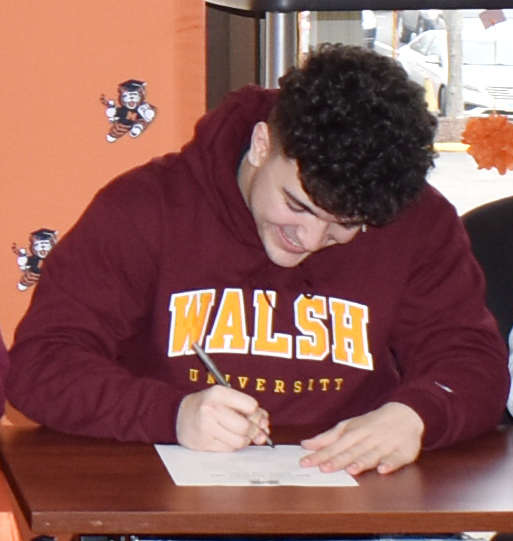
 Robbie Page was a starting safety on Massillon’s 14-1, state runner-up team in 2019. He was fourth on the team with 58.5 tackle points (49 solos and 19 assists). He also intercepted three passes, broke up eight passes and recovered a fumble. An All-County selection, Page will be remembered as a player who challenged any opposing receiver to catch a pass over the middle.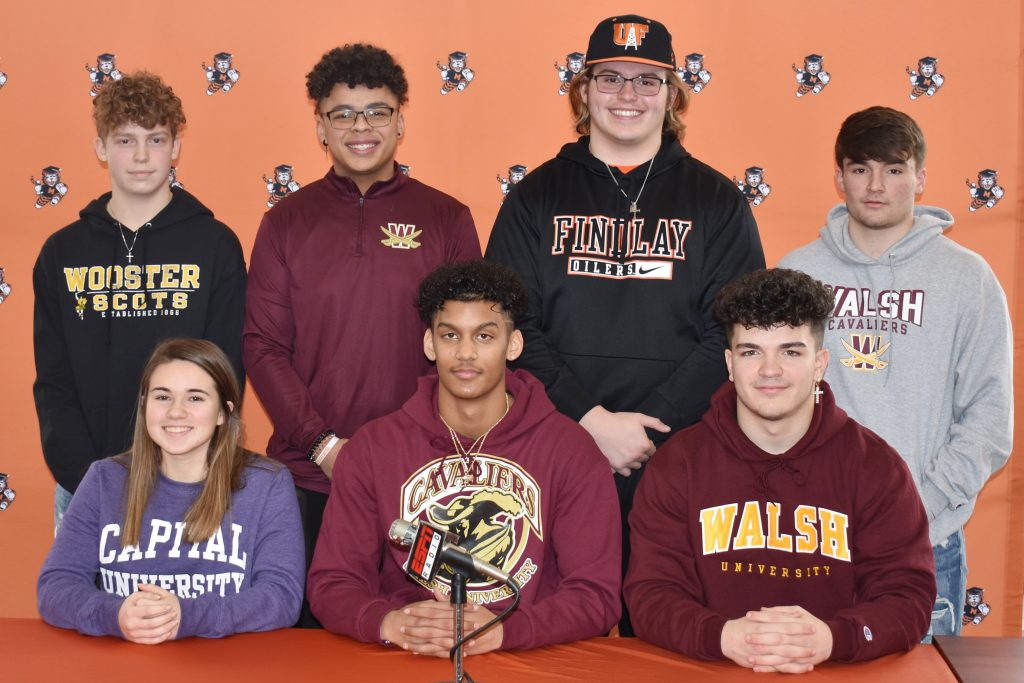
 But there is one record that always bothered me: Chuck Vliet’s 42 tackles in the 1950 game against Warren Harding. How could this be? Is that even possible? The No. 2 player on the list, Cooper Ivan, has just 14 tackle points. Fortunately, the aging Chuck is still with us to tell the story. And it’s a good one. I had a chance recently to sit down with Chuck and talk about that record, but first a little background.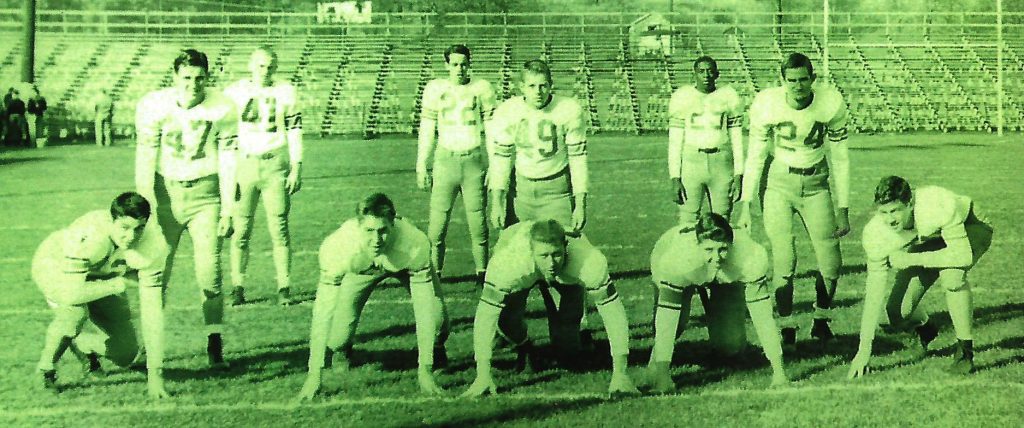
 Former Massillon player and current Mount Union defensive back Kordell Ford was recently named Division 3 1st Team Collegiate All-American by the Associated Press. The 5′-10″, 190 lb. Ford, who majors in Sports Business, had a productive junior year in helping his team to an 11-1 record and a birth in the post-season playoffs. For the season, he recorded 53.0 tackle points, two quarterback sacks and a pass interception, including a season-best eight tackles against Heidelberg. In addition to his All-American status, Ford was named to the All-Ohio Athletic Conference first team and recognized as the OAC’s top defensive back. He has also been nominated for the Cliff Harris Award as the top small college defensive player in the country. In his previous two years, Kordell was credited with 56 tackles, including 4.5 tackles for loss, a quarterback sack and a fumble recovery.